[Preprint]. 2023 Sep 29:2023.09.28.559935.
doi: 10.1101/2023.09.28.559935.

Identification of host factors for Rift Valley Fever Phlebovirus

Affiliations

Identification of host factors for Rift Valley Fever Phlebovirus

Velmurugan Balaraman et al. bioRxiv. .

Update in

  • Identification of Host Factors for Rift Valley Fever Phlebovirus.
    Balaraman V, Indran SV, Li Y, Meekins DA, Jakkula LUMR, Liu H, Hays MP, Souza-Neto JA, Gaudreault NN, Hardwidge PR, Wilson WC, Weber F, Richt JA. Balaraman V, et al. Viruses. 2023 Nov 13;15(11):2251. doi: 10.3390/v15112251. Viruses. 2023. PMID: 38005928 Free PMC article.

Abstract

Background: Rift Valley fever phlebovirus (RVFV) is a zoonotic pathogen that causes Rift Valley fever (RVF) in livestock and humans. Currently, there is no licensed human vaccine or antiviral drug to control RVF. Although multiple species of animals and humans are vulnerable to RVFV infection, host factors affecting susceptibility are not well understood.

Methodology: To identify the host factors or genes essential for RVFV replication, we conducted a CRISPR-Cas9 knock-out screen in human A549 cells. We then validated the putative genes using siRNA-mediated knockdowns and CRISPR-Cas9-mediated knockout studies, respectively. The role of a candidate gene in the virus replication cycle was assessed by measuring intracellular viral RNA accumulation, and the virus titers by plaque assay or TCID50 assay.

Findings: We identified approximately 900 genes with potential involvement in RVFV infection and replication. Further evaluation of the effect of six genes on viral replication using siRNA-mediated knockdowns found that silencing two genes (WDR7 and LRP1) significantly impaired RVFV replication. For further analysis, we focused on the WDR7 gene since the role of LRP1 in RVFV replication was previously described in detail. Knock-out A549 cell lines were generated and used to dissect the effect of WRD7 on RVFV and another bunyavirus, La Crosse encephalitis virus (LACV). We observed significant effects of WDR7 knock-out cells on both intracellular RVFV RNA levels and viral titers. At the intracellular RNA level, WRD7 affected RVFV replication at a later phase of its replication cycle (24h) when compared to LACV which was affected an earlier replication phase (12h).

Conclusion: In summary, we have identified WDR7 as an essential host factor for the replication of two relevant bunyaviruses, RVFV and LACV. Future studies will investigate the mechanistic role by which WDR7 facilitates Phlebovirus replication.

Keywords: A549 cells; LACV; MP-12; RVFV; WDR7; bunyavirus; host factor; phlebovirus.


Conflict of interest statement

Conflict of Interest All authors declare no conflict of interest. The JAR laboratory received support from Tonix Pharmaceuticals, Xing Technologies, Esperobvax, and Zoetis, outside of the reported work. JAR is inventor of patents and patent applications on the use of antivirals and vaccines for the treatment and prevention of virus infections, owned by Kansas State University, KS.

Figures
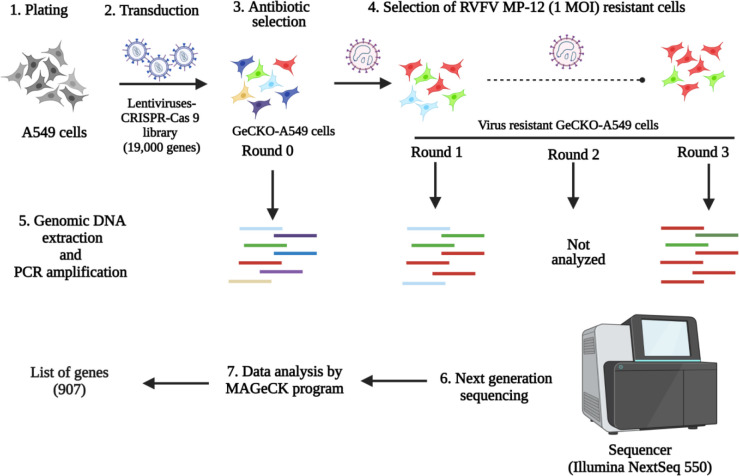
Fig 1:
Fig 1:. Schematics of GeCKO-A549 cells generation, selection, NGS, and data analysis.
A549 cells were transduced with lentivirus-CRISPR-Cas9 library to generate GeCKO-A549 cells. Then, the GeCKO cells were subjected to three rounds of infection with RVFV MP-12 (1 MOI) virus. The genomic DNA of round 0 GeCKO-A549 cells, the round 1, and the round 3 virus resistant GeCKO cells, were sequenced using Illumina NextSeq 550 platform. The output NGS data was analyzed by the MaGeCK program to generate the list of genes involved in RVFV replication.
Fig 2:
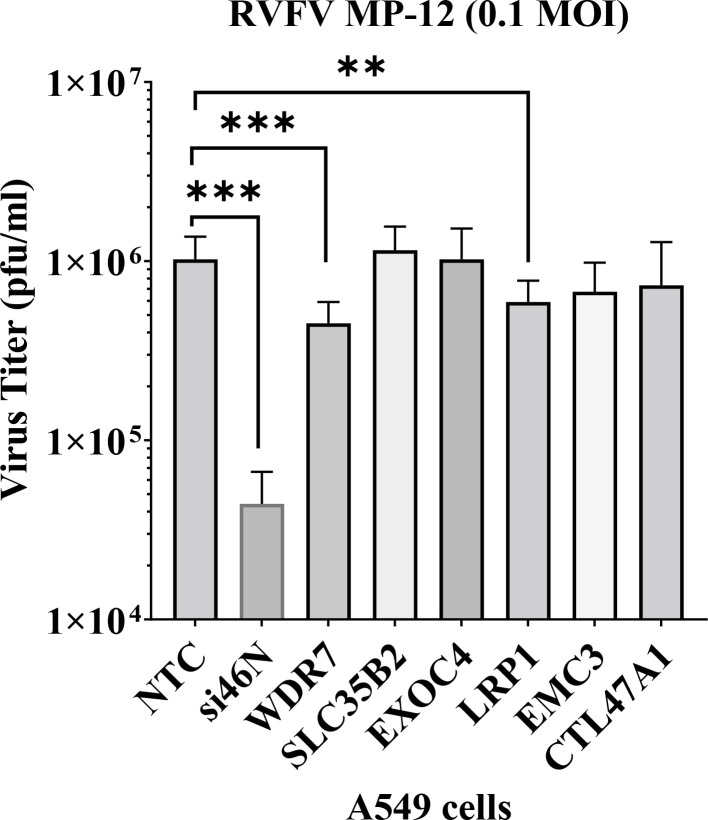
Fig 2:. Validation of gene hits by siRNA gene knock-down study.
A549 cells were transfected with 50 nM of siRNAs. At 48 hours post-transfection, the cells were infected with RVFV MP-12 virus at 0.1 MOI. At 24 hours post-infection, the supernatant was collected and titered by plaque assay. NTC- non-target control siRNA, si46N- anti-RVFV siRNA, WDR7-, SLC35B2-, EXOC4-, LRP1-, EMC3-, CTL47A1- gene specific siRNAs. Each bar represents the average virus titer (pfu/ml) along with the corresponding standard deviation. Statistical analysis was done on two independent experiments with four replicates for each, using Mann-Whitney U independent Student’s t-test (** p-value < 0.005, *** p-value <0.001).
Fig 3:
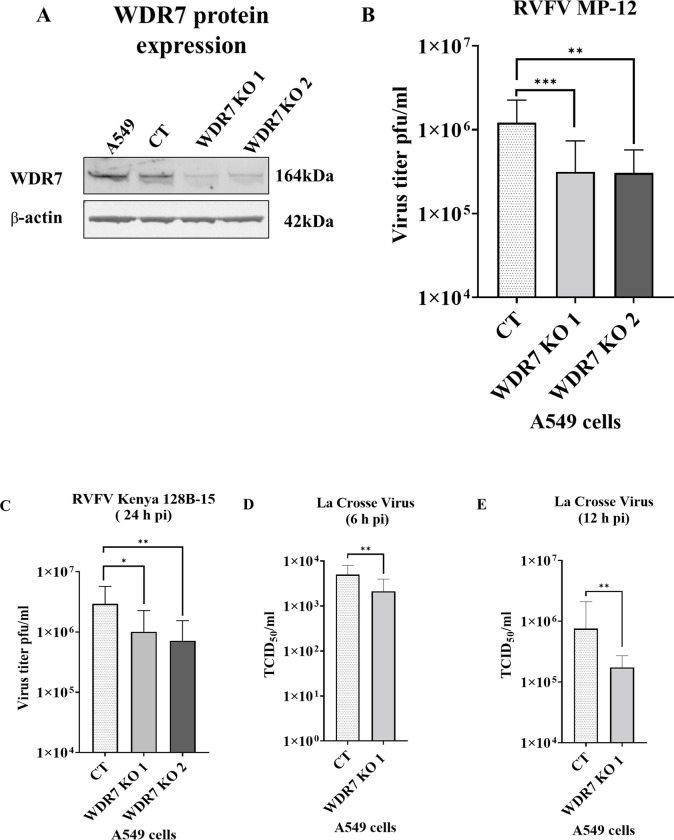
Fig 3:. Effect of WDR7 gene knock-out (KO) on virus production of bunyaviruses.
(A) A549 cells, CT (non-knock-out control) cells, and WDR7 gene KO cell lines #1 and #2 were analyzed for WDR7 protein expression by western blot using a WDR7-specific polyclonal antibody. (B, C, D & E) CT cells and WDR7 KO A549 cells were infected with RVFV MP-12 vaccine strain, (B) with the wild-type RVFV Kenya 128B-15 strain, (C) or with La Crosse encephalitis virus (D, E) at 0.1 MOI. Supernatant was collected at 6, 12 or 24 h post infection (h pi) and titered by plaque assay (RVFV) or TCID50-CPE assay (LACV). RVFV MP-12 testing on CT A549 cells, WDR7 KO lines #1 or #2, and NTC- non-target control cells involved three to five independent experiments with three to four technical replicates each. RVFV Kenya 128B-15 testing involved independent experiments with three technical replicates each. LACV testing was performed in two independent experiments with eight technical replicates each. Statistical analysis was done using Mann-Whitney U independent Student’s t-test (* p-value < 0.05, ** p-value < 0.005, *** p-value <0.001).
Fig 4:
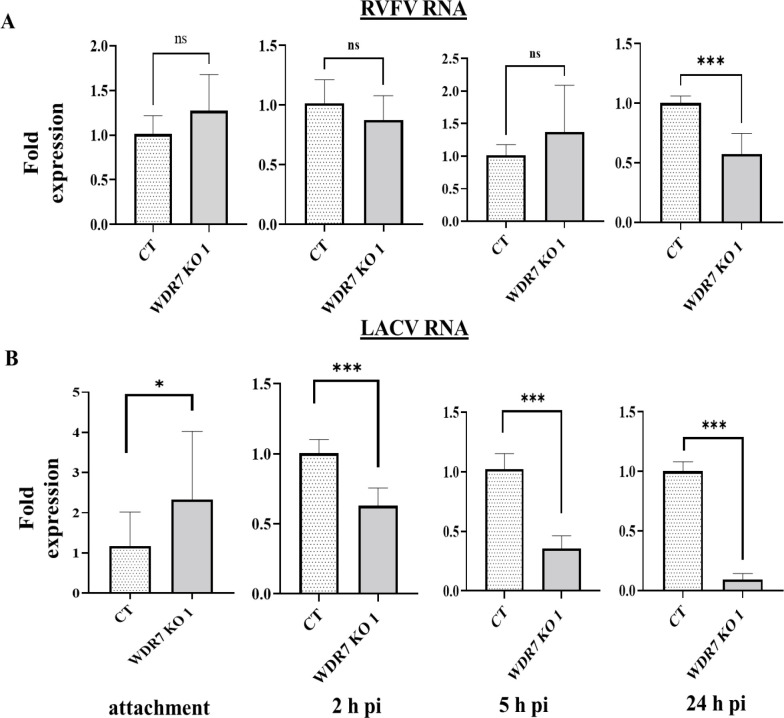
Fig 4:. Viral RNA accumulation at various time points post infection in WDR7 knock-out (KO) cells.
CT and WDR7 KO #1 cells were infected with the (A) RVFV MP-12 vaccine strain or (B) the LAC virus at 0.1 MOI. Total cellular RNA was harvested at various hour(s) post-infection (h pi). One-step RT-qPCR was performed to detect the level of viral RNA using the PGK1 gene as an internal control. CT and WDR7 KO #1 cells were utilized. Each bar graph represents the average fold change in viral RNA expression, along with the corresponding standard deviation. Statistical analysis was done on three independent experiments with two to three technical replicates for each, using Mann-Whitney U independent Student’s t-test (* p-value <0.05, *** p-value <0.001, ns, non-significant).

References

    1. Daubney R, Hudson JR, Garnham PC. Enzootic hepatitis or rift valley fever. An undescribed virus disease of sheep cattle and man from east africa. J Pathol Bacteriol. 1931;34: 545–579. doi:10.1002/path.1700340418 - DOI
    1. Morvan J, Saluzzo J-F, Fontenille D, Rollin PE, Coulanges P. Rift valley fever on the east coast of Madagascar. Research in virology. Amsterdam ; New York: : Elsevier,; 1991. pp. 475–482. doi:10.1016/0923-2516(91)90070-J - DOI - PubMed
    1. Shoemaker T, Boulianne C, Vincent MJ, Pezzanite L, Al-Qahtani MM, Al-Mazrou Y, et al. Genetic analysis of viruses associated with emergence of Rift Valley fever in Saudi Arabia and Yemen, 2000–01. Emerg Infect Dis. 2002;8: 1415–1420. doi:10.3201/eid0812.020195 - DOI - PMC - PubMed
    1. Sissoko D, Giry C, Gabrie P, Tarantola A, Pettinelli F, Collet L, et al. Rift valley fever, mayotte, 2007–2008. Emerg Infect Dis. 2009;15: 568–570. doi:10.3201/eid1504.081045 - DOI - PMC - PubMed
    1. Coetzer JA. Natural Cases in New-Born Lambs. 1977;44: 205–212. - PubMed

Publication types