


Impact of venous thromboembolism on the mortality in patients with cancer: a population-based cohort study
- PMID: 37809052
- PMCID: PMC10558815
- DOI: 10.1016/j.lanepe.2023.100739
Impact of venous thromboembolism on the mortality in patients with cancer: a population-based cohort study
Abstract
Background: Despite recent improvements in the treatment of cancer, little is known about the long-term survival in patients with cancer and venous thromboembolism. We aimed to examine the five-year mortality of venous thromboembolism in cancer patients in a large population-based cohort study.
Methods: Using Danish healthcare registries from 1995 to 2020, we obtained data on cancer patients with venous thromboembolism and comparison cohorts of cancer patients without venous thromboembolism, matched in terms of cancer type, age, sex, and year of cancer diagnosis, and adjusted for level of comorbidity and frailty using the Charlson Comorbidity Index Score and Hospital Frailty Risk Score, marital status, use of selected medications, and recent surgery (<90 days).
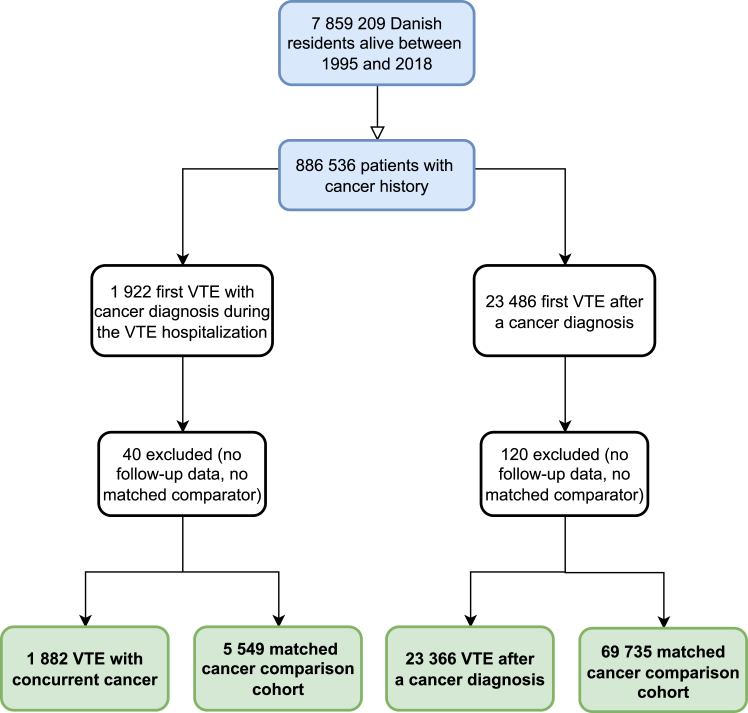
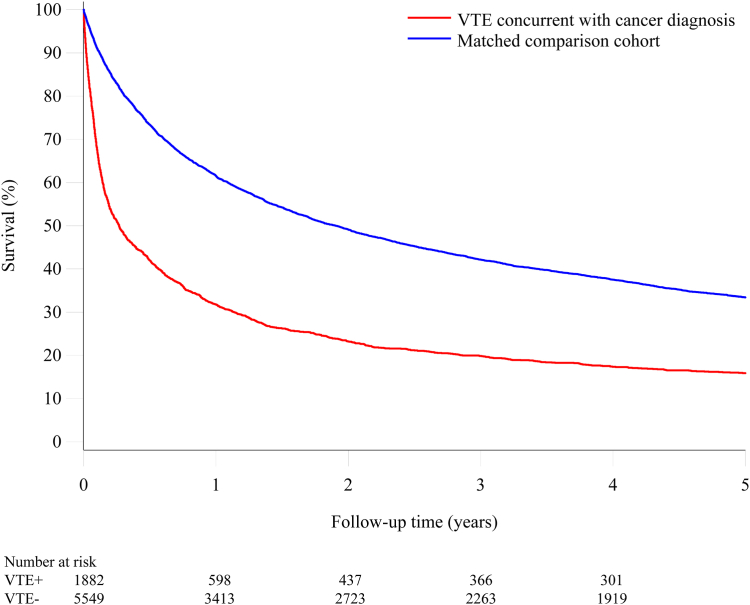
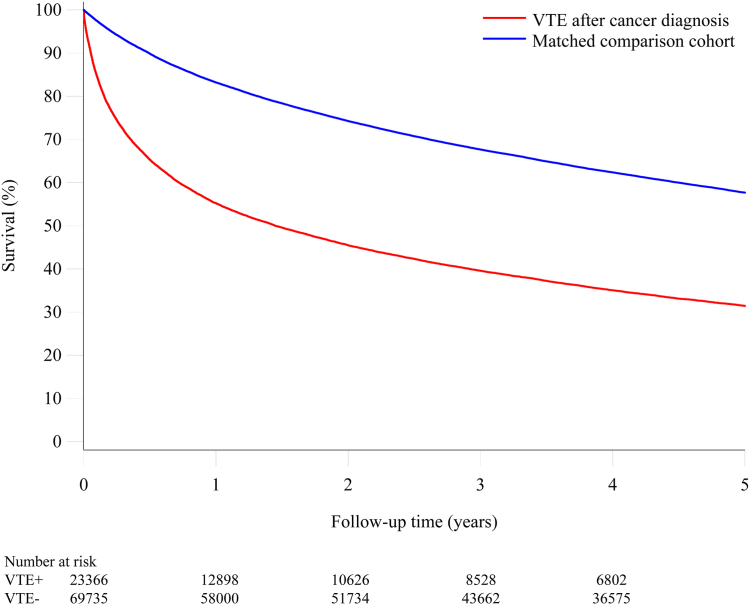
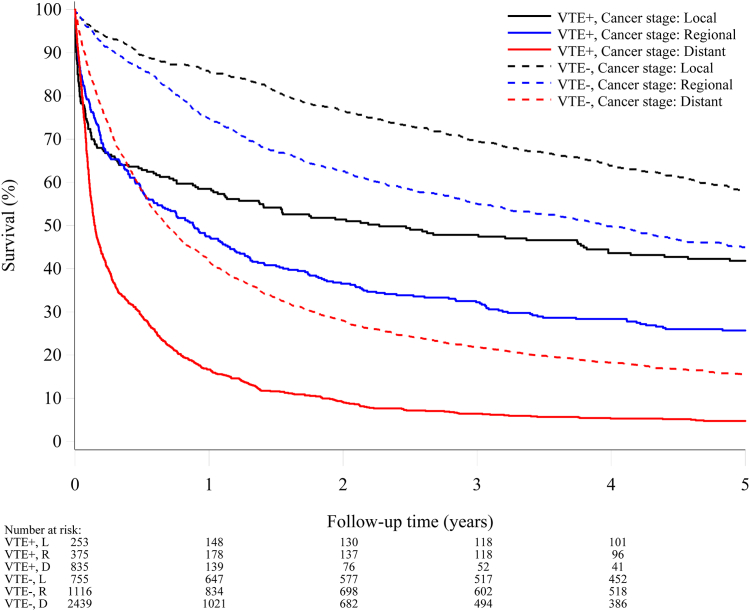
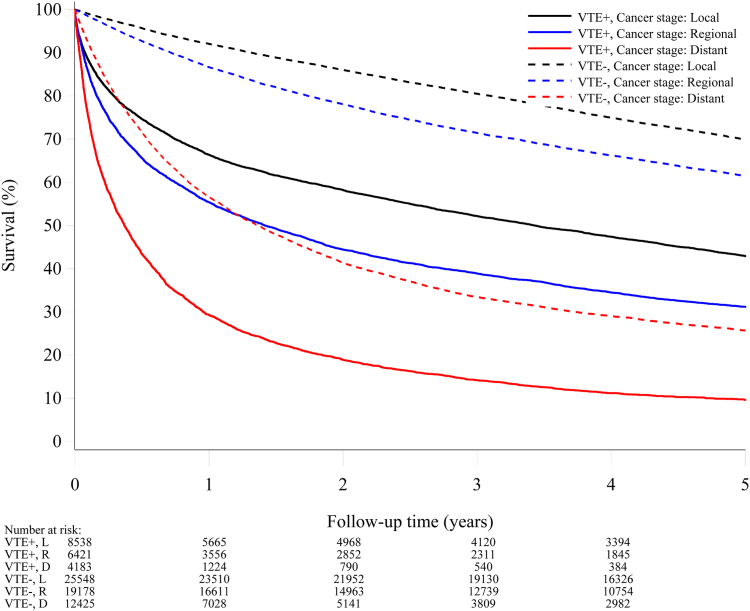
Findings: During the study period, 886,536 patients were diagnosed with cancer. Of 1882 cancer patients diagnosed at the time of their venous thromboembolism, 44.4% (835/1882) had distant metastases. In this cohort, the one- and five-year mortality cumulative incidences were 68% (1284/1882) and 84% (1578/1882), respectively, in contrast to 38% (2135/5549) and 67% (3653/5549) in the comparison cohort. The mortality rate ratio was 4.34 (95% confidence interval [CI], 3.95-4.78) for the first year of follow-up and 3.44 (95% CI 3.17-3.73) for the five-year follow-up period. Of the 23,366 patients diagnosed with venous thromboembolism after cancer diagnosis, 18% (4183/23,366) had distant metastases at the time of cancer diagnosis. The cumulative incidence of death at one year was 45% (10,465/23,366; mortality rate ratio 3.48, 95% CI 3.37-3.60) and at five years 69% (15,669/23,366; mortality rate ratio 2.57, 95% CI 2.50-2.63).
Interpretation: Despite improved cancer treatment, venous thromboembolism in cancer patients is strongly associated with a poor prognosis.
Funding: The study was supported by grants from the Independent Research Fund Denmark (record no. 3101-00102B) and the Karen Elise Jensen Foundation.
Keywords: Cancer; Cohort study; Prognosis; Pulmonary embolism; Venous thrombosis.
© 2023 The Author(s).
Conflict of interest statement
The Department of Clinical Epidemiology, Aarhus University, receives funding for other studies from companies in the form of research grants to (and administered by) Aarhus University. None of these studies have any relation to the present study.
Figures
References
-
- Bouillaud S., Bouillaud J. De l’obliteration des veines et de son influence sur la formation des hydropisies partielles: consideration sur la hydropisies passive et general. Arch Gen Med. 1823;1:188–204.
-
- Mulder F.I., Horvath-Puho E., van Es N., et al. Venous thromboembolism in cancer patients: a population-based cohort study. Blood. 2021;137(14):1959–1969. - PubMed
-
- Prandoni P., Lensing A.W., Piccioli A., et al. Recurrent venous thromboembolism and bleeding complications during anticoagulant treatment in patients with cancer and venous thrombosis. Blood. 2002;100(10):3484–3488. - PubMed
-
- Weitz J.I., Haas S., Ageno W., et al. Cancer associated thrombosis in everyday practice: perspectives from GARFIELD-VTE. J Thromb Thrombolysis. 2020;50(2):267–277. - PubMed
LinkOut - more resources
Full Text Sources
