. 2023 Sep 20:14:1220130.
doi: 10.3389/fimmu.2023.1220130. eCollection 2023.

T helper cell responses in adult diarrheal patients following natural infection with enterotoxigenic Escherichia coli are primarily of the Th17 type

Affiliations

T helper cell responses in adult diarrheal patients following natural infection with enterotoxigenic Escherichia coli are primarily of the Th17 type

Marjahan Akhtar et al. Front Immunol. .

Abstract

Background: Infection with enterotoxigenic Escherichia coli (ETEC) gives rise to IgA antibodies against both the heat labile toxin (LT) and colonization factors (CFs), which are considered to synergistically protect against ETEC diarrhea. Since the development of ETEC-specific long lived plasma cells and memory B cells is likely to be dependent on T helper (Th) cells, we investigated if natural ETEC diarrhea elicits ETEC-specific Th cells and their relation to IgA responses.

Methods: Th cell subsets were analyzed in adult Bangladeshi patients hospitalized due to ETEC diarrhea by flow cytometric analysis of peripheral blood mononuclear cells (PBMCs) isolated from blood collected day 2, 7, 30 and 90 after hospitalization as well as in healthy controls. The LT- and CF-specific Th responses were determined by analysis of IL-17A and IFN-γ in antigen stimulated PBMC cultures using ELISA. ETEC-specific IgA secreted by circulating antibody secreting cells (plasmablasts) were analyzed by using the antibodies in lymphocyte supernatants (ALS) ELISA-based method and plasma IgA was also measured by ELISA.

Results: ETEC patients mounted significant ALS and plasma IgA responses against LTB and CFs on day 7 after hospitalization. ETEC patients had significantly elevated proportions of memory Th cells with a Th17 phenotype (CCR6+CXCR3-) in blood compared to controls, while frequencies of Th1 (CCR6-CXCR3+) or Th2 (CCR6-CXCR3-) cells were not increased. Antigen stimulation of PBMCs revealed IL-17A responses to LT, most clearly observed after stimulation with double mutant heat labile toxin (dmLT), but also with LT B subunit (LTB), and to CS6 in samples from patients with LT+ or CS6+ ETEC bacteria. Some individuals also mounted IFN-γ responses to dmLT and LTB. Levels of LTB specific IgA antibodies in ALS, but not plasma samples correlated with both IL-17A (r=0.5, p=0.02) and IFN-γ (r=0.6, p=0.01) responses to dmLT.

Conclusions: Our results show that ETEC diarrhea induces T cell responses, which are predominantly of the Th17 type. The correlations between IL-17A and IFN-g and intestine-derived plasmablast responses support that Th responses may contribute to the development of protective IgA responses against ETEC infection. These observations provide important insights into T cell responses that need to be considered in the evaluation of advanced ETEC vaccine candidates.

Keywords: ETEC; IFN-γ; IL-17A; T helper cell; Th1; Th17.


Conflict of interest statement

The authors declare that the research was conducted in the absence of any commercial or financial relationships that could be construed as a potential conflict of interest.

Figures
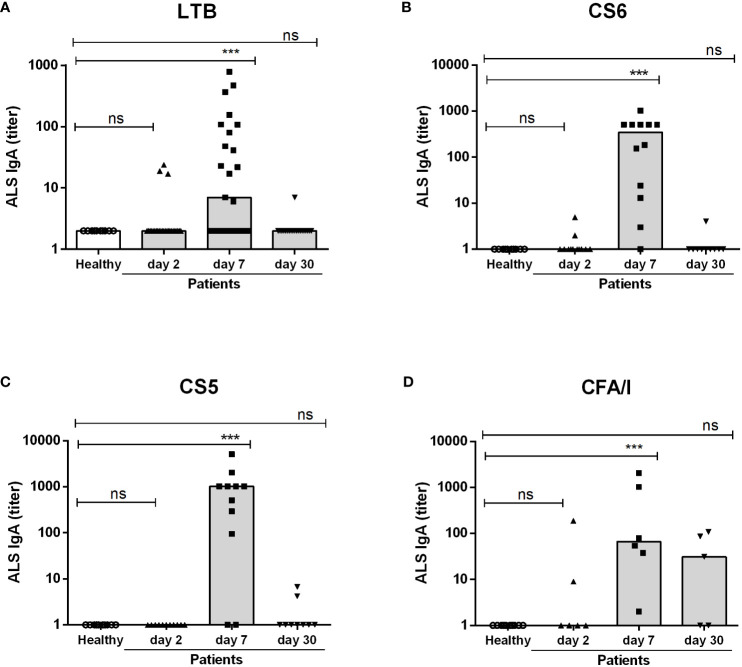
Figure 1
Figure 1
ALS IgA antibody responses to LTB and CFs in ETEC infected patients and healthy adults. (A) LTB-, (B) CS6-, (C) CS5- and (D) CFA/I-specific IgA titers were analyzed in ALS samples in healthy adults (n=10) and diarrheal patients on day 2, 7 and 30 after hospitalization (A); n=20-26, (B); n=10-12, (C); 9-11 and (D); n=5-6. Each symbol represents one individual, and bars indicate median values. Statistical analysis was performed using the Kruskal Wallis test with Dunn’s multiple comparison post test. *** P <0.001, ns, not significant; P >0.05.
Figure 2
Figure 2
Plasma IgA antibody responses to LTB and CFs in ETEC infected patients and healthy adults. (A) LTB-, (B) CS6-, (C) CS5- and (D) CFA/I-specific IgA titers were analyzed in plasma samples in healthy adults (n=10) and diarrheal patients on day 2, 7, 30 and 90 after hospitalization (A); n=19-26, (B); n=8-12, (C); 7-11 and (D); n=3-6. Each symbol represents one individual, and bars indicate median values. Statistical analysis was performed using the Kruskal Wallis test with Dunn’s multiple comparison post test. * P <0.05, ** P <0.01, *** P <0.001, ns, not significant; P >0.05.
Figure 3
Figure 3
Frequencies of CD4+ memory Th cells and Th17, Th1 and Th2 subsets in peripheral blood of ETEC infected patients and healthy adults. Frequencies of (A, B) memory Th cells (CD4+CD45RO+) within lymphocytes, and (C) Th17 (CCR6+CXCR3-), (D) Th1 (CCR6-CXCR3+) and (E) Th2 (CCR6-CXCR3-) populations within CD4+ cells in PBMCs isolated from healthy adults (n=8) and ETEC infected patients on day 2, 7, 30 and 90 after hospitalization (n=8-16). (A, C E) Frequencies at each individual time point. Each symbol represents the percentage of cells for one individual, and bars indicate median values. (B, F) Maximum frequencies at any time point. Bars represent median + 95% confidence interval. Statistical analysis was performed by the Kruskal Wallis test with Dunn’s multiple comparison post test (A, C, E) or the Mann-Whitney test (B, F). * P <0.05, ** P <0.01, *** P <0.001, ns, not significant; P >0.05.
Figure 4
Figure 4
IL-17A and IFN-γ responses to dmLT and LTB in PBMCs from ETEC infected patients and healthy adults. IL-17A (A, C, E) and IFN-γ (B, D, F) concentrations in cultures with PBMCs stimulated with dmLT (A, B) and LTB (C, D) in healthy controls (n=5-9) and diarrheal patients on day 2, 7, 30 and 90 after hospitalization (A, B); n=16-23 and (C, D); n=16-22. (A-D) Responses at each individual time point. Each symbol represents one individual, and bars indicate median values. (E, F) Maximum responses at any time point. Bars represent median + 95% confidence interval. Statistical analysis was performed using the Kruskal Wallis test with Dunn’s multiple comparison post test (A-D) or Mann-Whitney test (E, F). * P <0.05, ** P <0.01, *** P <0.001, ns; not significant; P >0.05.
Figure 5
Figure 5
IL-17A and IFN-γ responses to CFs in PBMCs from ETEC infected patients and healthy adults. IL-17A (A, C, E, G) and IFN-γ (B, D, F, H) concentrations in cultures with PBMCs stimulated with CS6 (A, B), CS5 (C, D) and CFA/I (E, F) in healthy controls (n=7) and diarrheal patients (A, B); n=7-10, (C, D); n=4-7, (E, F); n=2-5) on day 7, 30 and 90 after hospitalization. (A-F) Responses at each individual time point. Each symbol represents one individual, and bars indicate median values. (G, H) Maximum responses at any time point. Bars represent median + 95% confidence interval. Statistical analysis was performed using the Kruskal Wallis test with Dunn’s multiple comparison post test (A-F) or the Mann-Whitney test (G, H). * P <0.05, ** P <0.01, ns, not significant; P >0.05.
Figure 6
Figure 6
Correlation between IL-17A and IFN-γ responses to dmLT and IgA responses to LTB in ALS and plasma. Correlation between the fold-increases in cytokines and IgA levels (maximum responses at any time point divided by the response on day 2). (A) IL-17A response to dmLT vs. ALS IgA to LTB, (B) IL-17A response to dmLT vs plasma IgA to LTB, (C) IFN-γ response to dmLT vs. ALS IgA to LTB and (D) IFN-γ response to dmLT vs. plasma IgA to LTB. Statistical analysis was performed using the Spearman test.

References

    1. Lanata CF, Black RE. Estimating the true burden of an enteric pathogen: enterotoxigenic Escherichia coli and Shigella spp. Lancet Infect Dis (2018) 18(11):1165–6. doi: 10.1016/s1473-3099(18)30546-2 - DOI - PubMed
    1. Qadri F, Svennerholm AM, Faruque AS, Sack RB. Enterotoxigenic Escherichia coli in developing countries: epidemiology, microbiology, clinical features, treatment, and prevention. Clin Microbiol Rev (2005) 18(3):465–83. doi: 10.1128/CMR.18.3.465-483.2005 - DOI - PMC - PubMed
    1. Begum YA, Baby NI, Faruque AS, Jahan N, Cravioto A, Svennerholm AM, et al. Shift in phenotypic characteristics of enterotoxigenic Escherichia coli (ETEC) isolated from diarrheal patients in Bangladesh. PloS Negl Trop Dis (2014) 8(7):e3031. doi: 10.1371/journal.pntd.0003031 - DOI - PMC - PubMed
    1. Vidal RM, Muhsen K, Tennant SM, Svennerholm AM, Sow SO, Sur D, et al. Colonization factors among enterotoxigenic Escherichia coli isolates from children with moderate-to-severe diarrhea and from matched controls in the Global Enteric Multicenter Study (GEMS). PloS Negl Trop Dis (2019) 13(1):e0007037. doi: 10.1371/journal.pntd.0007037 - DOI - PMC - PubMed
    1. Evans DG, Evans DJ, Jr., Tjoa WS, DuPont HL. Detection and characterization of colonization factor of enterotoxigenic Escherichia coli isolated from adults with diarrhea. Infect Immun (1978) 19(2):727–36. doi: 10.1128/iai.19.2.727-736.1978 - DOI - PMC - PubMed

Publication types
