


ChatGPT Surpasses 1000 Publications on PubMed: Envisioning the Road Ahead
- PMID: 37809155
- PMCID: PMC10557088
- DOI: 10.7759/cureus.44769
ChatGPT Surpasses 1000 Publications on PubMed: Envisioning the Road Ahead
Abstract
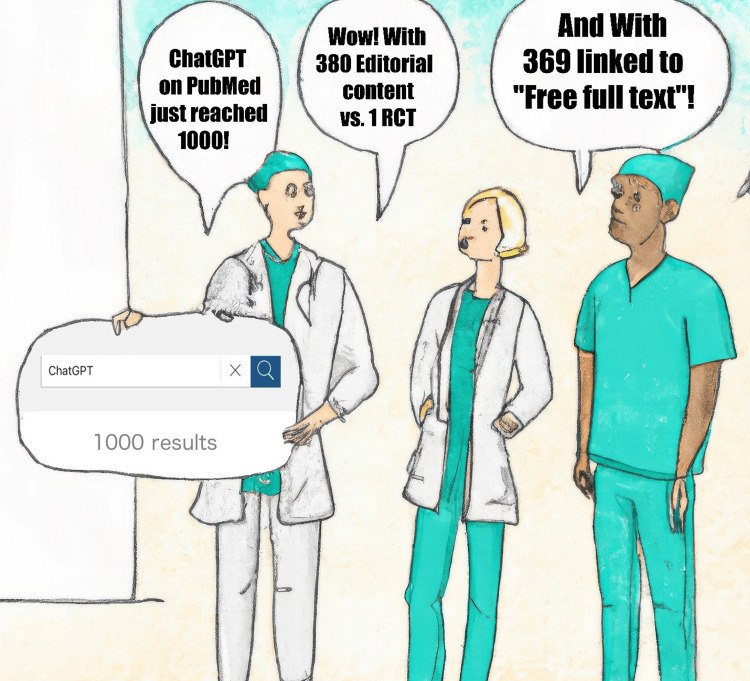
The exponential growth of ChatGPT in medical literature, amassing over 1000 PubMed citations by August 2023, underscores a pivotal juncture in the convergence of artificial intelligence (AI) and healthcare. This remarkable rise not only showcases its potential to revolutionize medical academia but also indicates its impending influence on patient care and healthcare systems. Notwithstanding this enthusiasm, one-third of these citations are editorials or commentaries, stressing a gap in empirical research. Alongside its potential, there are concerns about ChatGPT becoming a "Weapon of Mass Deception" and the need for rigorous evaluations to counter inaccuracies. The World Association of Medical Editors has released guidelines emphasizing that AI tools should not be manuscript co-authors and advocates for clear disclosures in AI-assisted academic works. Interestingly, ChatGPT achieved its citation milestone within nine months, compared to Google's 14 years. As Large Language Models (LLMs), like ChatGPT, become more integral in healthcare, issues surrounding data protection, patient privacy, and ethical implications gain prominence. As the future of LLM research unfolds, key areas of interest include its efficacy in clinical settings, its role in telemedicine, and its potential in medical education. The journey ahead necessitates a harmonious partnership between the medical community and AI developers, emphasizing both technological advancements and ethical considerations.
Keywords: ai chatbot; artificial intelligence (ai); chatgpt; ethical implications; llms in healthcare; medical education; published in pubmed journal; pubmed; randomized controlled trial (rct); telemedicine.
Copyright © 2023, Temsah et al.
Conflict of interest statement
The authors have declared that no competing interests exist.
Figures
References
Publication types
LinkOut - more resources
Full Text Sources
Research Materials
Miscellaneous