


Maternal positive coparenting and adolescent ego-identity: the chain mediating role of fathers' marital satisfaction and adolescent peer relationships
- PMID: 37809300
- PMCID: PMC10556660
- DOI: 10.3389/fpsyg.2023.1227941
Maternal positive coparenting and adolescent ego-identity: the chain mediating role of fathers' marital satisfaction and adolescent peer relationships
Abstract
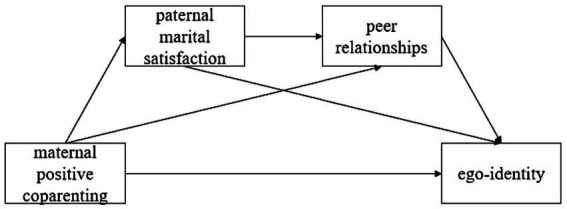
Introduction: Based on the ecological systems theory and the family systems theory, this study explores the mechanisms underlying the effects of maternal positive coparenting on adolescent ego-identity.
Methods: This study employed the Maternal Positive Coparenting Scale to assess mothers, the Father Marital Satisfaction Scale to examine fathers, and the Adolescent Peer Relationship Scale, along with the Ego-Identity Scale, to evaluate adolescents. This comprehensive approach involved investigating 522 families, encompassing both parents and adolescents.
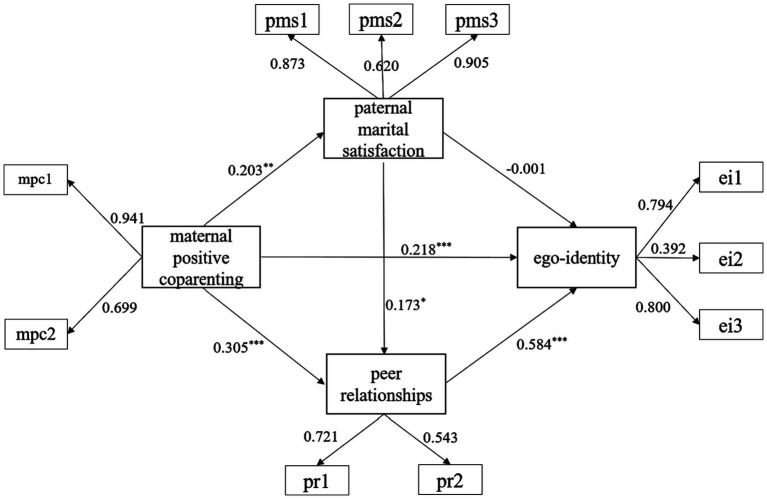
Results: The results obtained indicate a significant positive correlation between maternal positive coparenting and adolescent ego-identity. Peer relationships mediated the relationship between maternal positive coparenting and adolescent ego-identity. Father marital satisfaction mediated the relationship between maternal positive coparenting and adolescent ego-identity insignificantly. Paternal marital satisfaction and adolescent peer relationship have a chain mediating role between maternal positive coparenting and adolescent ego-identity. The study contributes by offering insights from the perspectives of family and peer relationships for further enhancing the development of adolescent ego-identity.
Keywords: adolescents; coparenting; ego-identity; marital satisfaction; peer relationships.
Copyright © 2023 Ji, Lan, Ma, Zhang and Fan.
Conflict of interest statement
The authors declare that the research was conducted in the absence of any commercial or financial relationships that could be construed as a potential conflict of interest.
Figures
References
-
- Abu-Rayya H. M. (2010). Ethnic identity, ego identity, and psychological well-being among mixed-ethnic Arab-European adolescents in Israel. Br. J. Dev. Psychol. 24, 669–679. doi: 10.1080/13674670802387330 - DOI
-
- Årseth A. K., Kroger J., Martinussen M., Marcia J. E. (2009). Meta-analytic studies of identity status and the relational issues of attachment and intimacy. Identity 9, 1–32. doi: 10.1080/15283480802579532 - DOI
-
- Avci R., Adiguzel A., Zeybek S. U., Çolakkadıoğlu O. (2021). The role of post-divorce parental conflict in predicting aggression, anger, and symptoms of anxiety and depression among university students. J. Divorce Remarr 62, 199–215. doi: 10.1080/10502556.2021.1871830 - DOI
-
- Bandura A. (1973). Aggression: a social learning analysis by albert bandura. Am. J. Sociol. 26, 1101–1109.
-
- Becht A. I., Nelemans S. A., Van Dijk M. P., Branje S. J., Van Lier P. A., Denissen J. J., et al. (2017). Clear self, better relationships: adolescents’ self-concept clarity and relationship quality with parents and peers across 5 years. Child Dev. 88, 1823–1833. doi: 10.1111/cdev.12921, PMID: - DOI - PubMed
LinkOut - more resources
Full Text Sources
