


What does it mean to follow? A critique of the followership literature and a conceptual model of the emergence of downward following
- PMID: 37809307
- PMCID: PMC10556708
- DOI: 10.3389/fpsyg.2023.1072800
What does it mean to follow? A critique of the followership literature and a conceptual model of the emergence of downward following
Abstract
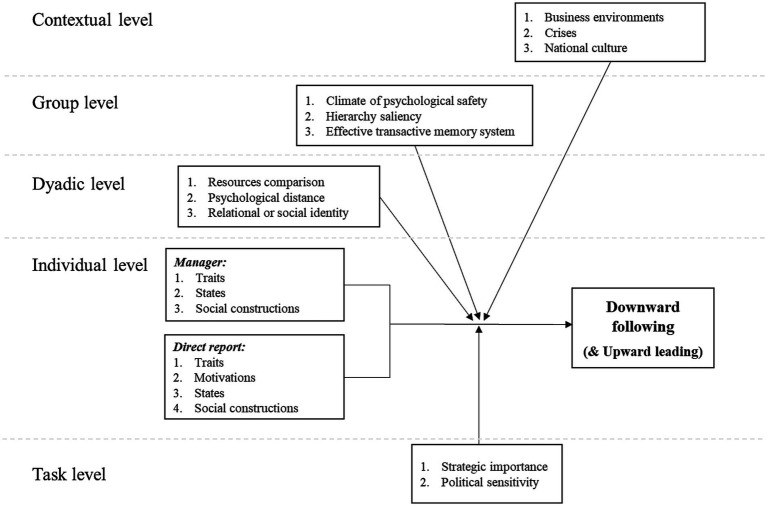
What does it mean to follow? In this paper, we systematically review the followership literature for the period 2017-2021. Our review shows that the followership literature suffers from three major issues that limit its validity. The followership field is dominated by a role-based approach equating direct reports with followers; empirical studies fail to study actual following behaviors, and there are no studies of downward following, which we define as any behavior or effort aimed at achieving a shared goal, carried out by an individual in a position of formal power who is influenced by one or more individuals in a position of inferior authority. Our manuscript builds on the process approach to study what it means to follow. We argue that the followership field needs to study actual followership behaviors at the micro "interaction episodes" and rely on quantitative behavioral coding. We then propose a conceptual, multi-level model that details antecedents and boundary conditions of the emergence of downward following. We conclude by discussing the organizational implications of our approach and model.
Keywords: downward following; follower; process approach; shared goals; social influence process; upward leading.
Copyright © 2023 Bastardoz and Adriaensen.
Conflict of interest statement
The authors declare that the research was conducted in the absence of any commercial or financial relationships that could be construed as a potential conflict of interest.
Figures
References
-
- Acton B. P., Foti R. J., Lord R. G., Gladfelter J. A. (2019). Putting emergence Back in leadership emergence: a dynamic, multilevel, process-oriented framework. Leadersh. Q. 30, 145–164. doi: 10.1016/J.Leaqua.2018.07.002 - DOI
-
- Ahmad M. G., Loch C. (2020). What do the followers want? The Core functions of leadership. Leadersh. Q. 31:101293. doi: 10.1016/J.Leaqua.2019.04.003 - DOI
-
- Aime F., Humphrey S., Derue D. S., Paul J. B. (2014). The riddle of Heterarchy: power transitions in cross-functional teams. Acad. Manag. J. 57, 327–352. doi: 10.5465/Amj.2011.0756 - DOI
-
- Alvesson M., Sveningsson S. (2003). Managers doing leadership: the extra-Ordinarization of the mundane. Hum. Relat. 56, 1435–1459. doi: 10.1177/00187267035612001 - DOI
-
- Antonakis J., Bastardoz N., Jacquart P., Shamir B. (2016). Charisma: an ill-defined and ill-measured gift. Annu. Rev. Organ. Psych. Organ. Behav. 3, 293–319. doi: 10.1146/annurev-orgpsych-041015-062305 - DOI
Publication types
LinkOut - more resources
Full Text Sources
