. 2022 Dec 9;2(12):2657-2667.
doi: 10.1021/acsestwater.2c00400. Epub 2022 Nov 10.

Measured and Modeled Comparisons of Chemical and Microbial Contaminants in Tap and Bottled Water in a US-Mexico Border Community

Affiliations

Measured and Modeled Comparisons of Chemical and Microbial Contaminants in Tap and Bottled Water in a US-Mexico Border Community

Amanda M Wilson et al. ACS ES T Water. .

Abstract

Tap water quality concerns and advertisements often drive increased bottled water consumption, especially in communities with historical tap water quality problems (e.g., Nogales, Arizona). The study objective was to assess contamination of municipal tap and bottled water in Nogales, Arizona. Bottled (sealed, open/partially consumed bottles, and reusable containers for vended water) and tap water samples were collected from 30 homes and analyzed for chemical and microbial contaminants. Fisher exact tests and Wilcoxon rank sum tests were used to compare proportions of positive samples and contaminant concentrations between tap and bottled water samples. While none of the chemical contaminants were above MCLs, there were statistically significantly greater concentrations and proportions of positive samples for some contaminants, including arsenic, in tap vs. bottled water. E. coli concentrations were >0 CFU/100mL in some unsealed bottled water samples but not for sealed bottles. This study demonstrates that 1) the measured concentrations in tap and bottled water likely pose low risks, as they are below the MCLs, 2) more education in this community on hygiene maintenance of refillable or opened bottled water containers is needed, and 3) using tap water over bottled water is advantageous due to likely lower E. coli risk and lower cost.

Keywords: Drinking water contaminants; E. coli; disinfection by-products; maximum contaminant level; water containers.


Conflict of interest statement

CONFLICTS OF INTEREST The authors have no conflicts of interest to report.

Figures

Figure 1.
Figure 1.
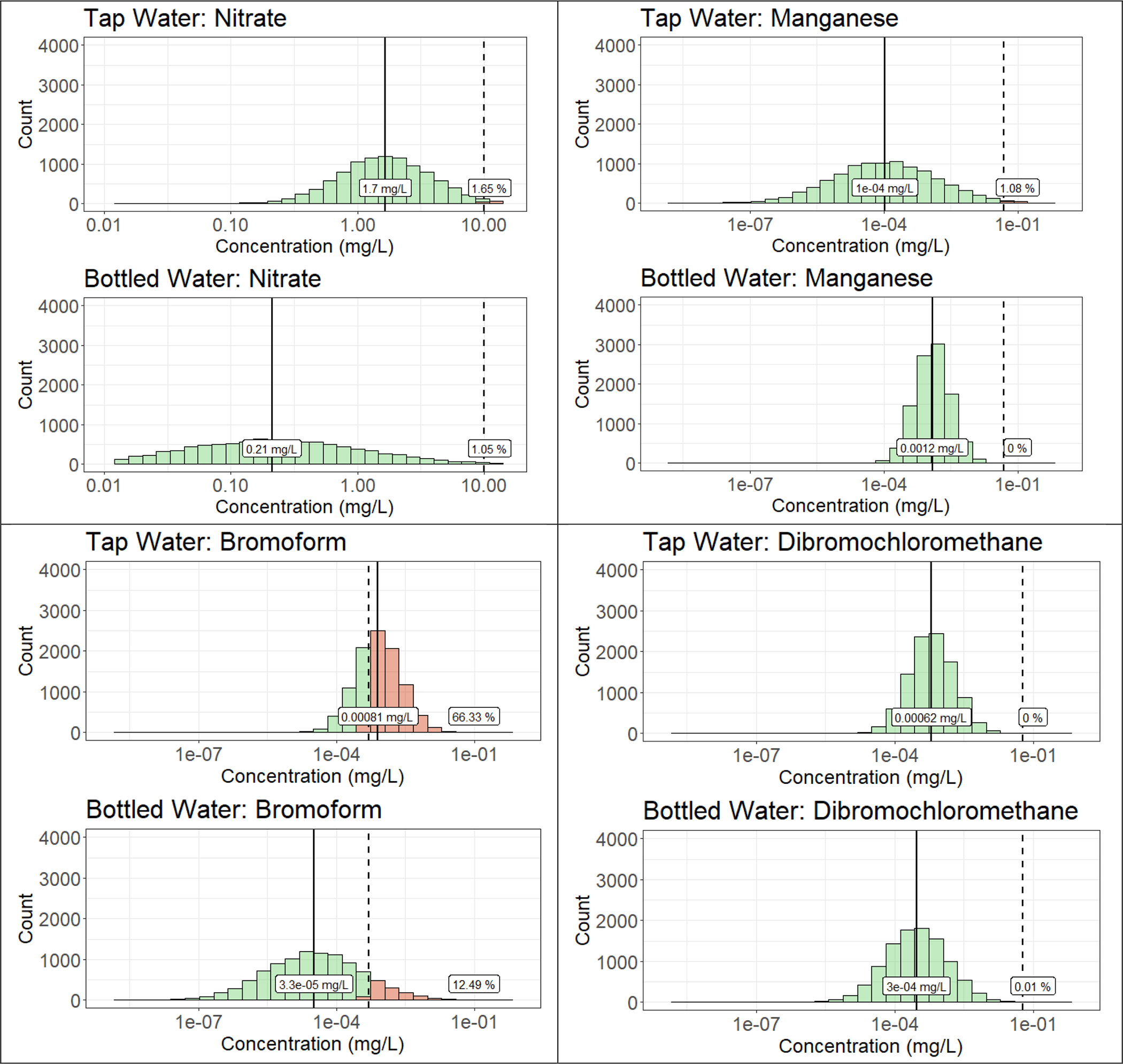
Example of one simulated data set (n=10,000) of tap and bottled water samples and concentrations (mg/L or CFU/100mL) of drinking water contaminants: arsenic, lead, chromium, fluoride, nitrate, manganese, bromoform, dibromochloromethane, bromodichloromethane, and E. coli.* *Fractions of simulated data above the MCL, MCLG, or limit of detection are shown, where vertical dashed lines represent these thresholds, and far-right labels with percentages indicate the percentage of simulated data per set above these thresholds. The solid black lines and far-left labels indicate geometric mean location and concentration. The results here are for one iteration of 10,000 simulated data sets. Uncertainty bounds around the estimated fraction above the threshold can be found in the supplemental materials (Table S1).
Figure 1.
Figure 1.
Example of one simulated data set (n=10,000) of tap and bottled water samples and concentrations (mg/L or CFU/100mL) of drinking water contaminants: arsenic, lead, chromium, fluoride, nitrate, manganese, bromoform, dibromochloromethane, bromodichloromethane, and E. coli.* *Fractions of simulated data above the MCL, MCLG, or limit of detection are shown, where vertical dashed lines represent these thresholds, and far-right labels with percentages indicate the percentage of simulated data per set above these thresholds. The solid black lines and far-left labels indicate geometric mean location and concentration. The results here are for one iteration of 10,000 simulated data sets. Uncertainty bounds around the estimated fraction above the threshold can be found in the supplemental materials (Table S1).
Figure 1.
Figure 1.
Example of one simulated data set (n=10,000) of tap and bottled water samples and concentrations (mg/L or CFU/100mL) of drinking water contaminants: arsenic, lead, chromium, fluoride, nitrate, manganese, bromoform, dibromochloromethane, bromodichloromethane, and E. coli.* *Fractions of simulated data above the MCL, MCLG, or limit of detection are shown, where vertical dashed lines represent these thresholds, and far-right labels with percentages indicate the percentage of simulated data per set above these thresholds. The solid black lines and far-left labels indicate geometric mean location and concentration. The results here are for one iteration of 10,000 simulated data sets. Uncertainty bounds around the estimated fraction above the threshold can be found in the supplemental materials (Table S1).

References

    1. Benedict KM, Reses H, Vigar M, et al. Surveillance for Waterborne Disease Outbreaks Associated with Drinking Water — United States, 2013–2014. 2017;66(44):1216–1221. - PMC - PubMed
    1. McClung RP, Roth DM, Vigar M, et al. Waterborne disease outbreaks associated with environmental and undetermined exposures to water - United States, 2013–2014. MMWR 2017;66(44):1222–1225. doi:10.15585/mmwr.mm6644a4 - DOI - PMC - PubMed
    1. Victory KR, Wilson AM, Cabrera NL, et al. Risk perceptions of drinking bottled vs. tap water in a low-income Latino community in Nogales, Arizona. BMC Public Health. 2022;22:1712. - PMC - PubMed
    1. Hu Z, Morton LW, Mahler RL. Bottled Water: United States Consumers and Their Perceptions of Water Quality. IJERPH. 2011;8(2):565–578. doi:10.3390/ijerph8020565 - DOI - PMC - PubMed
    1. Aslani H, Pashmtab P, Shaghaghi A, Mohammadpoorasl A, Taghipour H, Zarei M. Tendencies towards bottled drinking water consumption: Challenges ahead of polyethylene terephthalate (PET) waste management. Health Promot Perspect. 2021;11(1):60–68. doi:10.34172/hpp.2021.09 - DOI - PMC - PubMed

LinkOut - more resources