Review
. 2024 Jun;40(6):777-794.
doi: 10.1007/s12264-023-01129-3. Epub 2023 Oct 9.

Memory Trace for Fear Extinction: Fragile yet Reinforceable

Affiliations
Review

Memory Trace for Fear Extinction: Fragile yet Reinforceable

Ying Liu et al. Neurosci Bull. 2024 Jun.

Abstract

Fear extinction is a biological process in which learned fear behavior diminishes without anticipated reinforcement, allowing the organism to re-adapt to ever-changing situations. Based on the behavioral hypothesis that extinction is new learning and forms an extinction memory, this new memory is more readily forgettable than the original fear memory. The brain's cellular and synaptic traces underpinning this inherently fragile yet reinforceable extinction memory remain unclear. Intriguing questions are about the whereabouts of the engram neurons that emerged during extinction learning and how they constitute a dynamically evolving functional construct that works in concert to store and express the extinction memory. In this review, we discuss recent advances in the engram circuits and their neural connectivity plasticity for fear extinction, aiming to establish a conceptual framework for understanding the dynamic competition between fear and extinction memories in adaptive control of conditioned fear responses.

Keywords: Basolateral amygdala; Fear extinction memory; Fear relapse; Insular cortex; Medial prefrontal cortex; Memory trace; Synaptic adaptations; Ventral hippocampus.


Conflict of interest statement

The authors declare that the research was conducted in the absence of any commercial or financial relationships that could be construed as a potential conflict of interest.

Figures
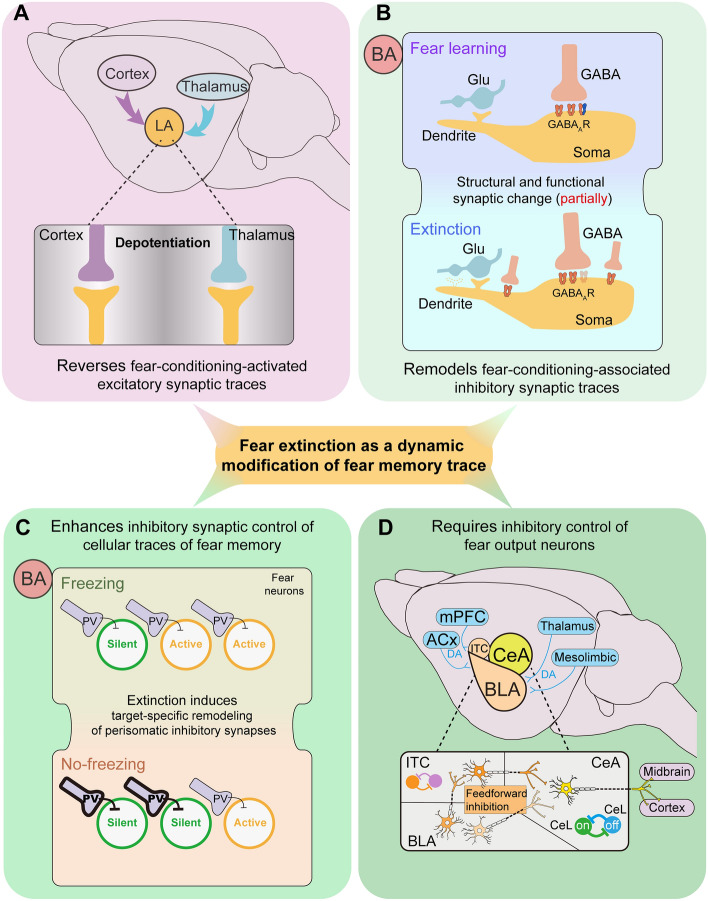
Fig. 1
Fig. 1
Schematic illustrating fear extinction as a dynamic modification of the fear memory trace. A Fear extinction reverses fear-conditioning-activated excitatory synaptic traces. Based on the findings shown in [29, 30], fear extinction involves different forms of depotentiation at LA synapses to tune the synaptic traces of fear memory for the expression of cue-induced non-fear behaviors. B Fear extinction remodels fear-conditioning-associated inhibitory synaptic traces. Based on the finding shown in [39], fear conditioning and extinction sculpt inhibitory synapses to regulate the inhibition of active neuronal networks to tune the amygdala circuit responses to threats. C Fear extinction enhances inhibitory synaptic control of cellular traces of fear memory. Based on the finding shown in [40], fear extinction entails target-specific alterations in perisomatic inhibitory synapses to sculpt activation patterns in fear circuits through which conditioned fear responses can be reduced. D Fear extinction requires inhibitory control of fear output neurons. ACx, auditory cortex; BA, basal amygdala; BLA, basolateral amygdala; CeA, central amygdala; CeL, lateral division of central amygdala; DA, dopamine; GABA, γ-aminobutyric acid; GABAAR, type A GABA receptor; Glu, glutamate; LA, lateral amygdala; ITC, intercalated; mPFC, medial prefrontal cortex. Please see the text for more details
Fig. 2
Fig. 2
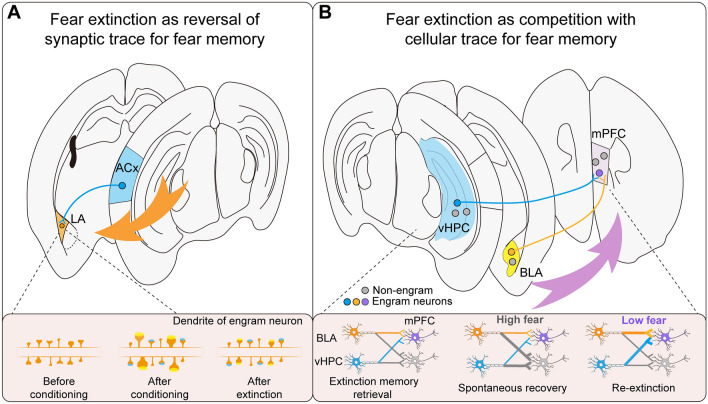
Schematic representation of fear extinction as the reversal of the synaptic trace for fear memory or competition with cellular trace for fear memory. A Fear extinction reverses the synaptic trace for fear memory. Based on the finding shown in [27], the synaptic trace, represented by activated spines, is enhanced by fear conditioning and subsequently decreased by extinction. B Schematic representation of the independent extinction engram construct, which consists of multiple synaptic traces generated by extinction learning and designed to compete with fear memory traces. Based on the finding shown in [16], the unidirectional connectivity of new memory engram neurons from BLA and vHPC to mPFC is established during the formation of extinction memory, providing a tripartite construct of circuitry for the extinction memory encoding and storage. Dynamic remodeling of specific engram connectivity dictates both the validity and instability of fear extinction memory, allowing for a longitudinal transformation of memory fate from fear to extinction, relapse, and re-extinction. ACx, auditory cortex; BLA, basolateral amygdala; mPFC, medial prefrontal cortex
Fig. 3
Fig. 3
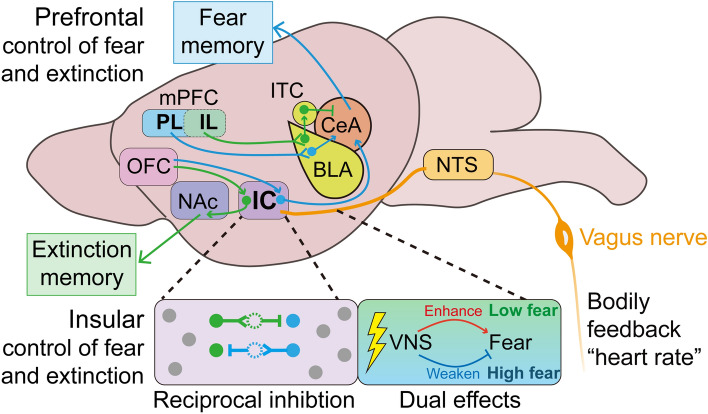
Comparison between prefrontal and insular control of fear and extinction memories. Upper Connections between the mPFC and amygdala encode fear and extinction memories. The PL/mPFC is thought to mediate fear responses (blue), whereas the IL/mPFC mediates extinction (green). For the expression of fear memory, PL inputs to the BLA drive glutamatergic neurons that project to the CeA, and outputs from the CeA drive the fear response. For the expression of extinction memory, IL inputs to the BLA drive glutamatergic neurons that project to the ITC, which mediates feedforward inhibition of neurons in the CeA. Lower IC circuits as an executive gateway to decipher fear or extinction memory via distinct subcortical pathways. Based on the finding shown in [22], there are two distinct populations of IC neurons, defined by their differential long-range connectivities, coordinate respective fear and extinction memories. IC-CeA and IC-NAc projectors encode fear and extinction memories, respectively. The reciprocal inhibitions of IC-CeA and IC-NAc projectors via local interneurons drive memory-guided behaviors in opposite directions, and their activities undertake distinct modifications during threat and extinction learning. Moreover, the orbitofrontal cortex (OFC)→IC→NAc circuit selectively engages extinction memory and thereby strengthens the specificity of distinct populations of IC neurons defined by their long-range connectivity. Based on the findings shown in [136, 138], the IC integrates predictive sensory and interoceptive signals to provide graded and bidirectional teaching signals that gate fear extinction and tune emotional or affective states. BLA, basolateral amygdala; CeA, central amygdala; IC, insular cortex; IL, infralimbic subdivision; ITC, intercalated; mPFC, medial prefrontal cortex; NAc, nucleus accumbens; NTS, nucleus tractus solitarius; OFC, orbitofrontal cortex; PL, prelimbic subdivision
Fig. 4
Fig. 4
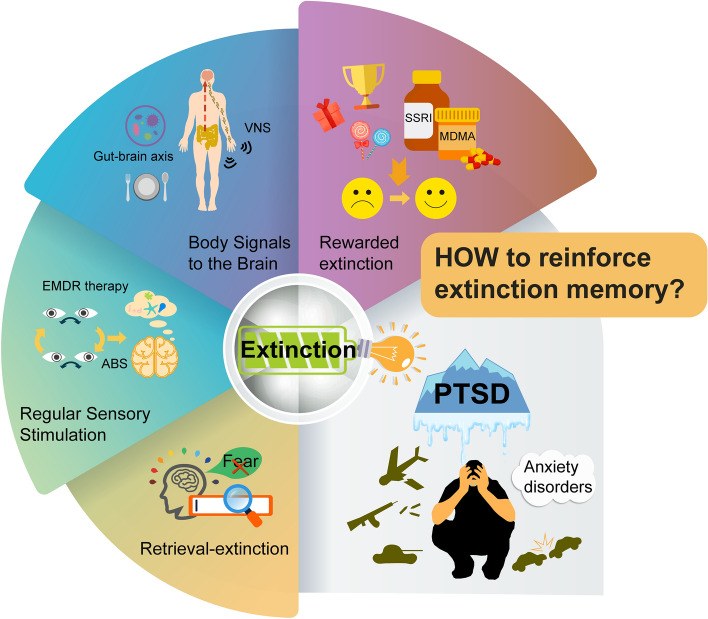
Schematic representation of behavioral strategies for reinforcing fear extinction memory. (1) Retrieval-extinction procedure to destroy the original fear memory trace. (2) Regular sensory stimulation for enhancing fear extinction. EMDR, eye movement desensitization and reprocessing; ABS, alternating bilateral sensory stimulation. (3) Body signals to the brain contribute to fear extinction. VNS, vagus nerve stimulation. (4) Rewarded extinction stabilizes the long-term extinction memory trace. MDMA, 3,4-methylenedioxymethamphetamine; PTSD, post-traumatic stress disorder; SSRI, serotonin selective reuptake inhibitor. Please see the text for more details

References

    1. Dunsmoor JE, Niv Y, Daw N, Phelps EA. Rethinking extinction. Neuron. 2015;88:47–63. doi: 10.1016/j.neuron.2015.09.028. - DOI - PMC - PubMed
    1. Bouton ME, Maren S, McNally GP. Behavioral and neurobiological mechanisms of Pavlovian and instrumental extinction learning. Physiol Rev. 2021;101:611–681. doi: 10.1152/physrev.00016.2020. - DOI - PMC - PubMed
    1. Myers KM, Davis M. Mechanisms of fear extinction. Mol Psychiatry. 2007;12:120–150. doi: 10.1038/sj.mp.4001939. - DOI - PubMed
    1. Lebois LAM, Seligowski AV, Wolff JD, Hill SB, Ressler KJ. Augmentation of extinction and inhibitory learning in anxiety and trauma-related disorders. Annu Rev Clin Psychol. 2019;15:257–284. doi: 10.1146/annurev-clinpsy-050718-095634. - DOI - PMC - PubMed
    1. Beckers T, Hermans D, Lange I, Luyten L, Scheveneels S, Vervliet B. Understanding clinical fear and anxiety through the lens of human fear conditioning. Nat Rev Psychol. 2023;2:233–245. doi: 10.1038/s44159-023-00156-1. - DOI - PMC - PubMed