Review
. 2023 Oct 30;29(4):419-427.
doi: 10.5056/jnm23125.

Modern Achalasia: Diagnosis, Classification, and Treatment

Affiliations
Review

Modern Achalasia: Diagnosis, Classification, and Treatment

Marcella Pesce et al. J Neurogastroenterol Motil. .

Abstract

Achalasia is a major esophageal motor disorder featured by the altered relaxation of the esophagogastric junction in the absence of effective peristaltic activity. As a consequence of the esophageal outflow obstruction, achalasia patients present with clinical symptoms of dysphagia, chest pain, weight loss, and regurgitation of indigested food. Other less specific symptoms can also present including heartburn, chronic cough, and aspiration pneumonia. The delay in diagnosis, particularly when the presenting symptoms mimic those of gastroesophageal reflux disease, may be as long as several years. The widespread use of high-resolution manometry has permitted earlier detection and uncovered achalasia phenotypes which can have prognostic and therapeutic implications. Other tools have also emerged to help define achalasia severity and which can be used as objective measures of response to therapy including the timed barium esophagogram and the functional lumen imaging probe. Such diagnostic innovations, along with the increased awareness by clinicians and patients due to the availability of alternative therapeutic approaches (laparoscopic and robotic Heller myotomy, and peroral endoscopic myotomy) have radically changed the natural history of the disorder. Herein, we report the most recent advances in the diagnosis, classification, and management of esophageal achalasia and underline the still-grey areas that needs to be addressed by future research to reach the goal of personalizing treatment.

Keywords: Barium; Esophageal achalasia; Heller myotomy.


Conflict of interest statement

Conflicts of interest: None.

Figures

Figure 1
Figure 1
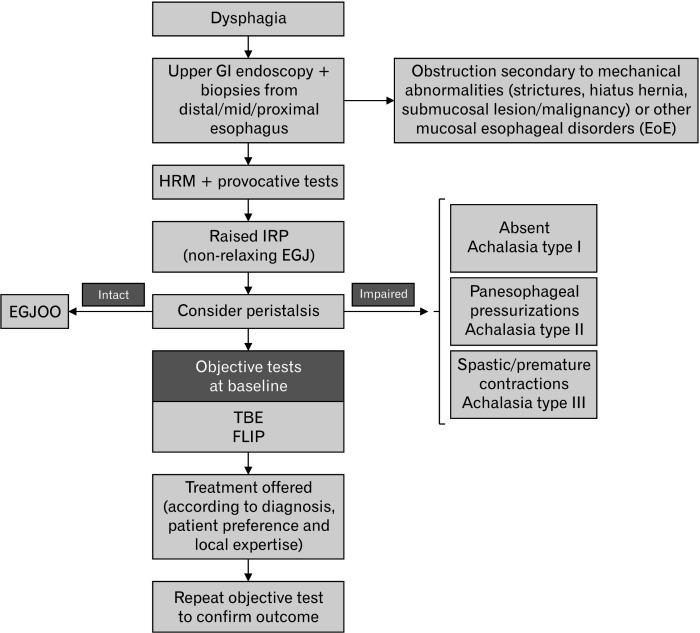
Diagnostic algorithm in patients with suspected esophageal motility disorders. All dysphagia patients should be investigated with a prompt endoscopy to exclude obstruction due to mechanical/organic diseases, including esophageal cancer. Even with a normal endoscopic evaluation, differential esophageal biopsies should be obtained to exclude eosinophilic esophagitis (EoE). The presence of a disorder of the outflow obstruction is confirmed by the presence of a persistently raised integrated relaxation pressure (IRP) at supine and upright swallows and on provocative tests at high-resolution manometry (HRM) study. The presence and the severity of the obstruction should also be confirmed by additional diagnostic tests (functional luminal imaging probe [FLIP] and timed barium esophagogram [TBE]) prior to referring patients to treatment. EGJOO, esophagogastric junction outflow obstruction; GI, gastrointestinal.
Figure 2
Figure 2
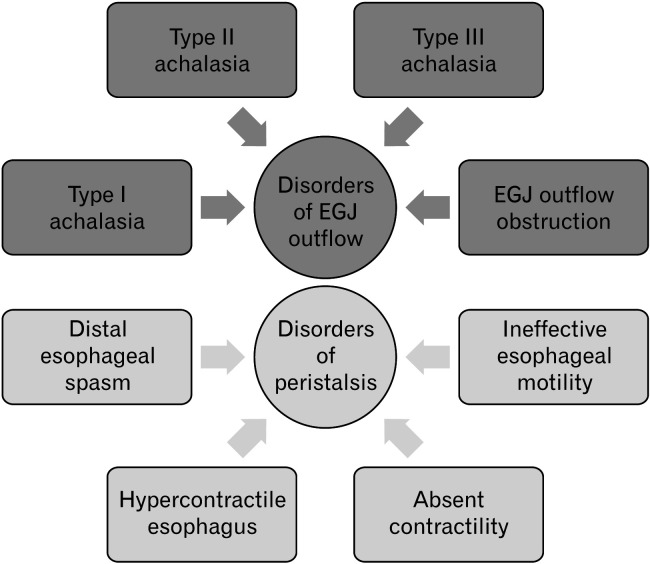
Hierarchical classification for esophageal motility disorders according to Chicago classification version 4.0. According to the latest version of the Chicago classification, motility disorders can be classified into 2 main subcategories based on the manometric parameter, expressing the relaxation of the esophago-gastric junction, the integrated relaxation pressure. If raised, patients are categorized into the disorders of the esophagogastric junction (EGJ) outflow, comprising achalasia and EGJ outflow obstruction.
Figure 3
Figure 3
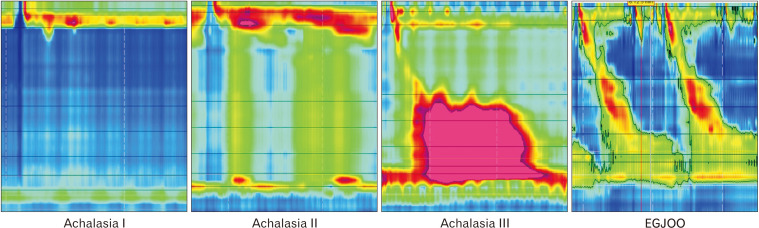
Representative pictures of achalasia subtypes and esophagogastric junction outflow obstruction (EGJOO) at high resolution manometry. In all conditions, the common manometric feature is the impaired relaxation of the esophago-gastric junction, as evaluated by a raised IRP. However, in achalasia peristalsis is never intact and it can be either absent (type I), with pan-esophageal pressurizations in at least 20% of wet swallows (type II) or with spastic/premature contractions (type III) in at least 20% of wet swallows (distal latency < 4.5 seconds), while EGJOO patients show normal/intact peristalsis.

References

    1. Boeckxstaens GE, Zaninotto G, Richter JE. Achalasia. Lancet. 2014;383:83–93. doi: 10.1016/S0140-6736(13)60651-0. - DOI - PubMed
    1. Harvey PR, Coupland B, Mytton J, Evison F, Patel P, Trudgill NJ. Outcomes of pneumatic dilatation and heller's myotomy for achalasia in England between 2005 and 2016. Gut. 2019;68:1146–1151. doi: 10.1136/gutjnl-2018-316544. - DOI - PubMed
    1. Gaber CE, Eluri S, Cotton CC, et al. Epidemiologic and economic burden of achalasia in the United States. Clin Gastroenterol Hepatol. 2022;20:342–352. e5. doi: 10.1016/j.cgh.2021.02.035. - DOI - PMC - PubMed
    1. Sarnelli G, D'Alessandro A, Pesce M, Palumbo I, Cuomo R. Genetic contribution to motility disorders of the upper gastrointestinal tract. World J Gastrointest Pathophysiol. 2013;4:65–73. doi: 10.4291/wjgp.v4.i4.65. - DOI - PMC - PubMed
    1. Savarino E, Bhatia S, Roman S, et al. Achalasia. Nat Rev Dis Primers. 2022;8:28. doi: 10.1038/s41572-022-00356-8. - DOI - PubMed