Review
. 2024 Jan;20(1):709-727.
doi: 10.1002/alz.13490. Epub 2023 Oct 9.

Senescence, brain inflammation, and oligomeric tau drive cognitive decline in Alzheimer's disease: Evidence from clinical and preclinical studies

Affiliations
Review

Senescence, brain inflammation, and oligomeric tau drive cognitive decline in Alzheimer's disease: Evidence from clinical and preclinical studies

Sagar Gaikwad et al. Alzheimers Dement. 2024 Jan.

Abstract

Aging, tau pathology, and chronic inflammation in the brain play crucial roles in synaptic loss, neurodegeneration, and cognitive decline in tauopathies, including Alzheimer's disease. Senescent cells accumulate in the aging brain, accelerate the aging process, and promote tauopathy progression through their abnormal inflammatory secretome known as the senescence-associated secretory phenotype (SASP). Tau oligomers (TauO)-the most neurotoxic tau species-are known to induce senescence and the SASP, which subsequently promote neuropathology, inflammation, oxidative stress, synaptic dysfunction, neuronal death, and cognitive dysfunction. TauO, brain inflammation, and senescence are associated with heterogeneity in tauopathy progression and cognitive decline. However, the underlying mechanisms driving the disease heterogeneity remain largely unknown, impeding the development of therapies for tauopathies. Based on clinical and preclinical evidence, this review highlights the critical role of TauO and senescence in neurodegeneration. We discuss key knowledge gaps and potential strategies for targeting senescence and TauO to treat tauopathies. HIGHLIGHTS: Senescence, oligomeric Tau (TauO), and brain inflammation accelerate the aging process and promote the progression of tauopathies, including Alzheimer's disease. We discuss their role in contributing to heterogeneity in tauopathy and cognitive decline. We highlight strategies to target senescence and TauO to treat tauopathies while addressing key knowledge gaps.

Keywords: Alzheimer's disease; aging; cognitive deficits; inflammation; senescence-associated secretory phenotype; senescent cells; tau; tauopathies.


Conflict of interest statement

The authors declare that there are no conflicts of financial interest related to this publication. Author disclosures are available in the supporting information.

Figures
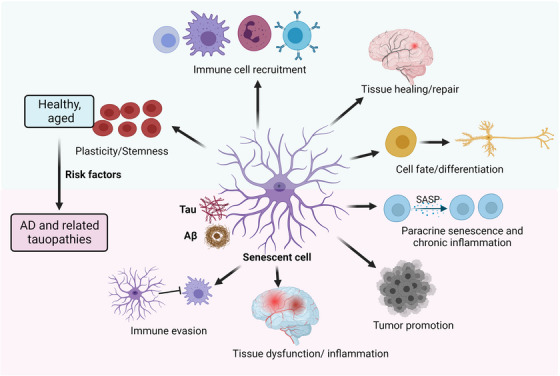
FIGURE 1
FIGURE 1
Cellular senescence as a component of healthy aging and AD. Recent studies suggest that increased inflammation in the brain of AD patients is driven by increased cellular senescence triggered by tau pathology and/or Aβ. Similarly, aging facilitates the accumulation of senescent cells, which contributes to chronic inflammation through SASP. Senescence‐induced inflammation may increase the risk of AD alongside additional genetic and/or environmental factors. Aβ, amyloid beta; AD, Alzheimer's disease; SASP, senescence‐associated secretory phenotype.
FIGURE 2
FIGURE 2
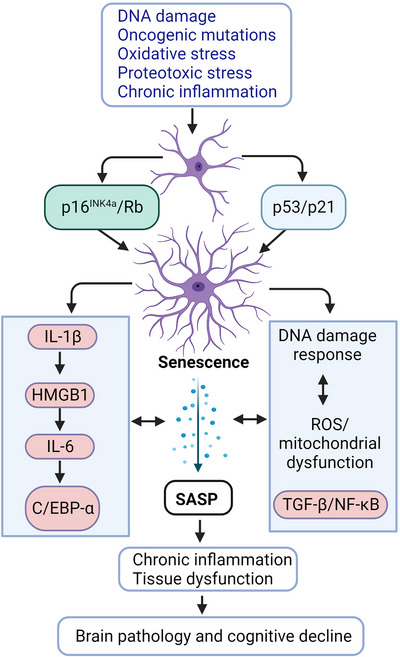
Several inducers alone or in combination can trigger senescence through p16INK4a/Rb and p53/p21 pathways. Senescence‐triggering signals may involve DNA damage (eg, telomere shortening), oncogenic mutation (eg, Myc, Ras), oxidative stress (eg, ROS), and proteotoxic stress (eg, Aβ and tau protein aggregation and protein misfolding). These senescence‐inducers contribute to chromatin remodeling and alterations in gene expression that underlie senescence‐associated cell cycle arrest and SASP. Intracellular autocrine signaling reinforces senescence and initiation of SASP. Senescence not only negatively impacts progenitor/stem cells but also contributes to tissue dysfunction, AD pathology, and subsequent cognitive decline through SASP, chronic inflammation, and loss of extracellular matrix. Aβ, amyloid beta; AD, Alzheimer's disease; ROS, reactive oxygen species; SASP, senescence‐associated secretory phenotype.
FIGURE 3
FIGURE 3
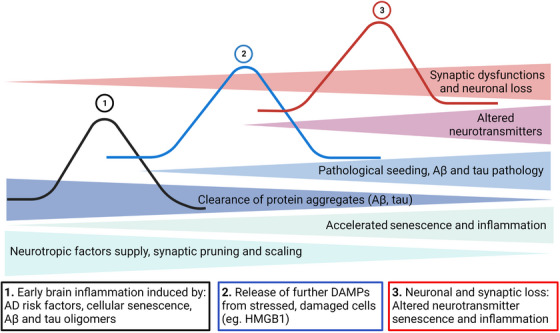
Three‐wave model showing chronology of pathological events in AD. Multiple intermingling cellular and molecular processes could influence the onset and progression of AD. For example, recognition of pathological protein aggregates (Aβ and tau oligomers) by glial cells is followed by induction of the inflammatory response and release of endogenous DAMPs (eg, HMGB1) that aggravate AD progression. Aβ and tau oligomers impair proteasome functions that compromise the clearance of protein aggregates and facilitate their release into the extracellular space, which causes pathological seeding and propagation of AD pathology and further fuels the inflammatory response. Chronic inflammatory responses, in turn, trigger neuronal dysfunction and death. Aβ, amyloid beta; AD, Alzheimer's disease; DAMPs, damage‐associated molecular patterns.
FIGURE 4
FIGURE 4
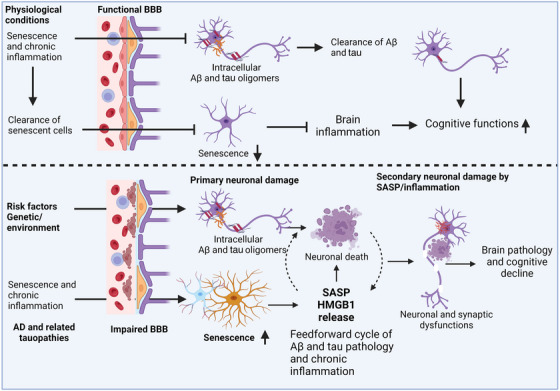
Schematic diagram of AD pathogenesis. Several risk factors, such as aging, genetics, sleep deprivation, stress, diet, and head injury, can influence AD progression via chronic immune activation and cellular senescence. This, in turn, leads to aging‐associated chronic inflammatory responses, also known as inflammaging, which allows penetration of inflammatory molecules (pathogen‐ and/or damage‐associated molecular patterns, eg, lipopolysaccharide and HMGB1) through the BBB via glial senescence. In the brain, risk factors and inflammation impact neuronal homeostasis and induce Aβ and tau aggregation to form oligomers that cause neuronal insults, which further fuels brain inflammation. Additionally, disruption of the BBB facilitates the entry of peripheral inflammatory molecules and cells into the brain, which promotes gliosis and glial senescence followed by chronic brain inflammation. These events lead to the progression of AD pathology, neuronal and synaptic dysfunction, and cognitive decline. Aβ, amyloid beta; AD, Alzheimer's disease; BBB, blood‐brain barrier; SASP, senescence‐associated secretory phenotype.
FIGURE 5
FIGURE 5
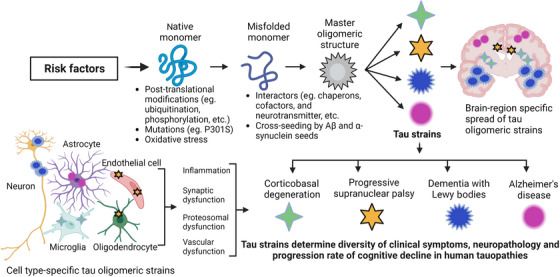
Schematic diagram showing potential mechanism for the formation of TauO strains and their implications in disease heterogeneity, diversity of clinical symptoms, neuropathology, and progression rate of cognitive decline in human tauopathies. Various risk factors (eg, aging, genetic background) induce post‐translational modifications (eg, ubiquitination, phosphorylation) and oxidative stress that triggers tau misfolding. This misfolded tau can interact with Aβ and α‐synuclein seeds, chaperons, co‐factors, and neurotransmitters, resulting in the formation of distinct misfolded monomers that aggregate and form different TauO strains. Distinct conformations of TauO strains lead to different seeding activities as well as brain region and cell type specificity. As a result, tau strains differentially induce inflammation, synaptic dysfunction, proteasomal impairment, and vascular dysfunction, which contributes to diversity in human tauopathies. Aβ, amyloid beta; TauO, tau oligomers.
FIGURE 6
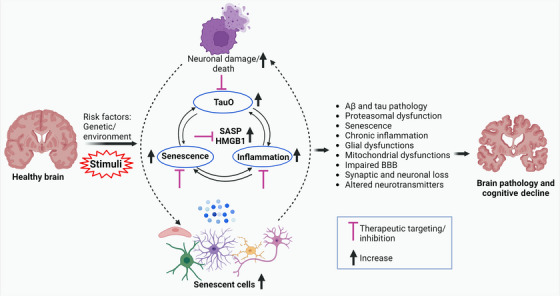
FIGURE 6
An overview diagram illustrating the role of senescence, brain inflammation, and TauO in AD and potential therapeutic targets. Various risk factors, including aging, can trigger senescence, inflammation, and TauO production, resulting in impaired synaptic and neuronal function loss, which are essential for learning and memory. This also induces the release of HMGB1 and initiates the SASP which lead to Aβ and tau pathology, proteasomal dysfunction, glial dysfunctions, mitochondrial dysfunctions, impaired BBB, synaptic and neuronal loss. Senescence, brain inflammation, and TauO can interact with each other and contribute to AD pathogenesis through several mechanisms. For example, TauO can trigger senescence and inflammation in the brain, which can impair the clearance of TauO and promote their aggregation and propagation. Senescence and inflammation can also impair the BBB functions, allowing more peripheral inflammatory factors to enter the brain and worsen neurodegeneration. Therefore, targeting senescence, inflammation, and TauO in combination may be a promising therapeutic strategy for AD. Aβ, amyloid beta; AD, Alzheimer's disease; BBB, blood‐brain barrier; SASP, senescence‐associated secretory phenotype; TauO, tau oligomers.

References

    1. Guzman‐Martinez L, Maccioni RB, Andrade V, Navarrete LP, Pastor MG, Ramos‐Escobar N. Neuroinflammation as a common feature of neurodegenerative disorders. Front Pharmacol. 2019;10:1008. - PMC - PubMed
    1. Kent SA, Spires‐Jones TL, Durrant CS. The physiological roles of tau and Abeta: implications for Alzheimer's disease pathology and therapeutics. Acta Neuropathol. 2020;140:417‐447. - PMC - PubMed
    1. Arriagada PV, Growdon JH, Hedley‐Whyte ET, Hyman BT. Neurofibrillary tangles but not senile plaques parallel duration and severity of Alzheimer's disease. Neurology. 1992;42:631‐639. - PubMed
    1. Giannakopoulos P, Herrmann FR, Bussiere T, et al. Tangle and neuron numbers, but not amyloid load, predict cognitive status in Alzheimer's disease. Neurology. 2003;60:1495‐1500. - PubMed
    1. Gao YL, Wang N, Sun FR, Cao XP, Zhang W, Yu JT. Tau in neurodegenerative disease. Ann Transl Med. 2018;6:175. - PMC - PubMed

Publication types