


Human-induced pluripotent stem cell-derived ovarian support cell co-culture improves oocyte maturation in vitro after abbreviated gonadotropin stimulation
- PMID: 37815487
- PMCID: PMC10694404
- DOI: 10.1093/humrep/dead205
Human-induced pluripotent stem cell-derived ovarian support cell co-culture improves oocyte maturation in vitro after abbreviated gonadotropin stimulation
Abstract
Study question: Can in vitro maturation (IVM) and developmental competence of human oocytes be improved by co-culture with ovarian support cells (OSCs) derived from human-induced pluripotent stem cells (hiPSCs)?
Summary answer: OSC-IVM significantly improves the rates of metaphase II (MII) formation and euploid Day 5 or 6 blastocyst formation, when compared to a commercially available IVM system.
What is known already: IVM has historically shown highly variable performance in maturing oocytes and generating oocytes with strong developmental capacity, while limited studies have shown a positive benefit of primary granulosa cell co-culture for IVM. We recently reported the development of OSCs generated from hiPSCs that recapitulate dynamic ovarian function in vitro.
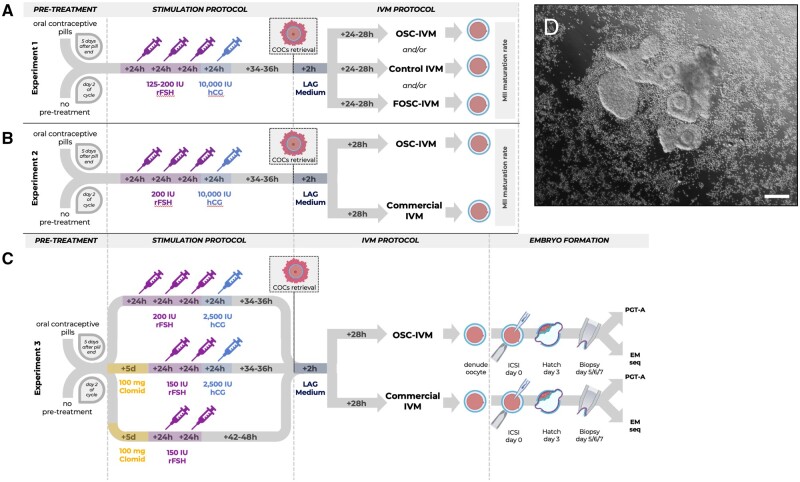
Study design, size, duration: The study was designed as a basic science study, using randomized sibling oocyte specimen allocation. Using pilot study data, a prospective sample size of 20 donors or at least 65 oocytes per condition were used for subsequent experiments. A total of 67 oocyte donors were recruited to undergo abbreviated gonadotropin stimulation with or without hCG triggers and retrieved cumulus-oocyte complexes (COCs) were allocated between the OSC-IVM or control conditions (fetal-like OSC (FOSC)-IVM or media-only IVM) in three independent experimental design formats. The total study duration was 1 April 2022 to 1 July 2023.
Participants/materials, setting, methods: Oocyte donors between the ages of 19 and 37 years were recruited for retrieval after informed consent, with assessment of anti-Mullerian hormone, antral follicle count, age, BMI and ovarian pathology used for inclusion and exclusion criteria. In experiment 1, 27 oocyte donors were recruited, in experiment 2, 23 oocyte donors were recruited, and in experiment 3, 17 oocyte donors and 3 sperm donors were recruited. The OSC-IVM culture condition was composed of 100 000 OSCs in suspension culture with hCG, recombinant FSH, androstenedione, and doxycycline supplementation. IVM controls lacked OSCs and contained either the same supplementation, FSH and hCG only (a commercial IVM control), or FOSCs with the same supplementation (Media control). Experiment 1 compared OSC-IVM, FOSC-IVM, and a Media control, while experiments 2 and 3 compared OSC-IVM and a commercial IVM control. Primary endpoints in the first two experiments were the MII formation (i.e. maturation) rate and morphological quality assessment. In the third experiment, the fertilization and embryo formation rates were assessed with genetic testing for aneuploidy and epigenetic quality in blastocysts.
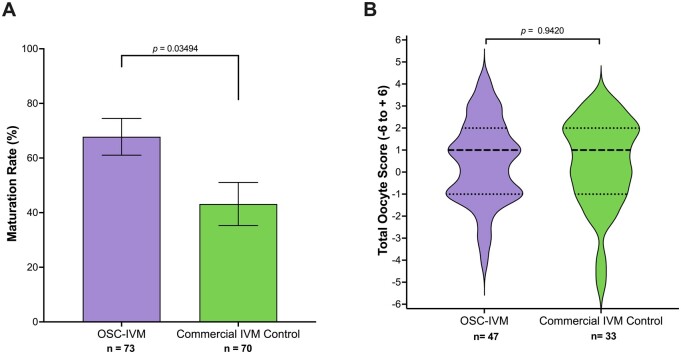
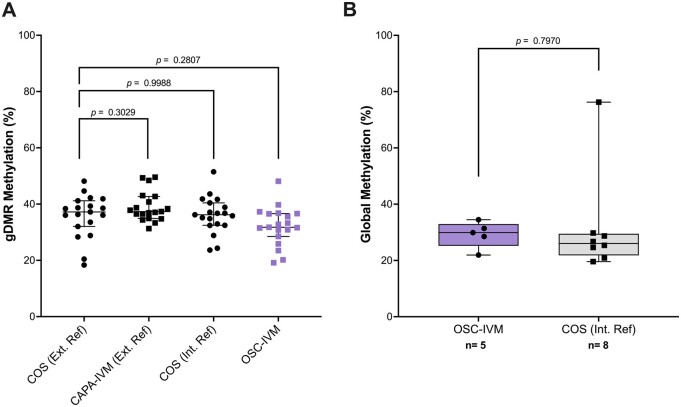
Main results and the role of chance: We observed a statistically significant improvement (∼1.5×) in maturation outcomes for oocytes that underwent IVM with OSCs compared to control Media-IVM and FOSC-IVM in experiment 1. More specifically, the OSC-IVM group yielded a MII formation rate of 68% ± 6.83% SEM versus 46% ± 8.51% SEM in the Media control (P = 0.02592, unpaired t-test). FOSC-IVM yielded a 51% ± 9.23% SEM MII formation rate which did not significantly differ from the media control (P = 0.77 unpaired t-test). Additionally, OSC-IVM yielded a statistically significant ∼1.6× higher average MII formation rate at 68% ± 6.74% when compared to 43% ± 7.90% in the commercially available IVM control condition (P = 0.0349, paired t-test) in experiment 2. Oocyte morphological quality between OSC-IVM and the controls did not significantly differ. In experiment 3, OSC-IVM oocytes demonstrated a statistically significant improvement in Day 5 or 6 euploid blastocyst formation per COC compared to the commercial IVM control (25% ± 7.47% vs 11% ± 3.82%, P = 0.0349 logistic regression). Also in experiment 3, the OSC-treated oocytes generated blastocysts with similar global and germline differentially methylated region epigenetic profiles compared commercial IVM controls or blastocysts after either conventional ovarian stimulation.
Large scale data: N/A.
Limitations, reasons for caution: While the findings of this study are compelling, the cohort size remains limited and was powered on preliminary pilot studies, and the basic research nature of the study limits generalizability compared to randomized control trials. Additionally, use of hCG-triggered cycles results in a heterogenous oocyte cohort, and potential differences in the underlying maturation state of oocytes pre-IVM may limit or bias findings. Further research is needed to clarify and characterize the precise mechanism of action of the OSC-IVM system. Further research is also needed to establish whether these embryos are capable of implantation and further development, a key indication of their clinical utility.
Wider implications of the findings: Together, these findings demonstrate a novel approach to IVM with broad applicability to modern ART practice. The controls used in this study are in line with and have produced similar to findings to those in the literature, and the outcome of this study supports findings from previous co-culture studies that found benefits of primary granulosa cells on IVM outcomes. The OSC-IVM system shows promise as a highly flexible IVM approach that can complement a broad range of stimulation styles and patient populations. Particularly for patients who cannot or prefer not to undergo conventional gonadotropin stimulation, OSC-IVM may present a viable path for obtaining developmentally competent, mature oocytes.
Study funding/competing interest(s): A.D.N., A.B.F., A.G., B.P., C.A., C.C.K., F.B., G.R., K.S.P., K.W., M.M., P.C., S.P., and M.-J.F.-G. are shareholders in the for-profit biotechnology company Gameto Inc. P.R.J.F. declares paid consultancy for Gameto Inc. P.C. also declares paid consultancy for the Scientific Advisory Board for Gameto Inc. D.H.M. has received consulting services from Granata Bio, Sanford Fertility and Reproductive Medicine, Gameto, and Buffalo IVF, and travel support from the Upper Egypt Assisted Reproduction Society. C.C.K., S.P., M.M., A.G., B.P., K.S.P., G.R., and A.D.N. are listed on a patent covering the use of OSCs for IVM: U.S. Provisional Patent Application No. 63/492,210. Additionally, C.C.K. and K.W. are listed on three patents covering the use of OSCs for IVM: U.S. Patent Application No. 17/846,725, U.S Patent Application No. 17/846,845, and International Patent Application No.: PCT/US2023/026012. C.C.K., M.P.S., and P.C. additionally are listed on three patents for the transcription factor-directed production of granulosa-like cells from stem cells: International Patent Application No.: PCT/US2023/065140, U.S. Provisional Application No. 63/326,640, and U.S. Provisional Application No. 63/444,108. The remaining authors have no conflicts of interest to declare.
Keywords: in vitro maturation; abbreviated stimulation; blastocysts; embryos; euploidy; granulosa cells; oocyte quality; ovarian support cells; stem cells.
© The Author(s) 2023. Published by Oxford University Press on behalf of European Society of Human Reproduction and Embryology.
Conflict of interest statement
A.D.N., A.B.F., A.G., B.P., C.A., C.C.K., F.B., G.R., K.S.P., K.W., M.M., P.C., S.P., and M.-J.F.-G. are shareholders in the for-profit biotechnology company Gameto Inc. P.R.J.F. declares paid consultancy for Gameto Inc. P.C. also declares paid consultancy for the Scientific Advisory Board for Gameto Inc. D.H.M. has received consulting services from Granata Bio, Sanford Fertility and Reproductive Medicine, Gameto, and Buffalo IVF, and travel support from the Upper Egypt Assisted Reproduction Society. C.C.K., S.P., M.M., A.G., B.P., K.S.P., G.R., and A.D.N. are listed on a patent covering the use of OSCs for IVM: U.S. Provisional Patent Application No. 63/492,210. Additionally, C.C.K. and K.W. are listed on three patents covering the use of OSCs for IVM: U.S. Patent Application No. 17/846,725, U.S Patent Application No. 17/846,845, and International Patent Application No.: PCT/US2023/026012. C.C.K., M.P.S., and P.C. additionally are listed on three patents for the TF-directed production of granulosa-like cells from stem cells: International Patent Application No.: PCT/US2023/065140, U.S. Provisional Application No. 63/326,640, and U.S. Provisional Application No. 63/444,108. The remaining authors have no conflicts of interest to declare.
Figures


References
-
- Akin N, Le AH, Ha UDT, Romero S, Sanchez F, Pham TD, Nguyen MHN, Anckaert E, Ho TM, Smitz J. et al. Positive effects of amphiregulin on human oocyte maturation and its molecular drivers in patients with polycystic ovary syndrome. Hum Reprod 2021;37:30–43. - PubMed
-
- de Boer KA, Catt JW, Jansen RPS, Leigh D, McArthur S.. Moving to blastocyst biopsy for preimplantation genetic diagnosis and single embryo transfer at Sydney IVF. Fertil Steril 2004;82:295–298. - PubMed
Publication types
MeSH terms
Substances
Grants and funding
LinkOut - more resources
Full Text Sources
Medical
Research Materials
Miscellaneous
