


e-Consent in UK academic-led clinical trials: current practice, challenges and the need for more evidence
- PMID: 37817277
- PMCID: PMC10565982
- DOI: 10.1186/s13063-023-07656-8
e-Consent in UK academic-led clinical trials: current practice, challenges and the need for more evidence
Abstract
Background: During the COVID-19 pandemic, in-person healthcare visits were reduced. Consequently, trial teams needed to consider implementing remote methods for conducting clinical trials, including e-Consent. Although some clinical trials may have implemented e-Consent prior to the pandemic, anecdotes of uptake for this method increased within academic-led trials. When the increased use of this process emerged, representatives from several large academic clinical trial groups within the UK collaborated to discuss ways in which trialists can learn from one another when implementing e-Consent.
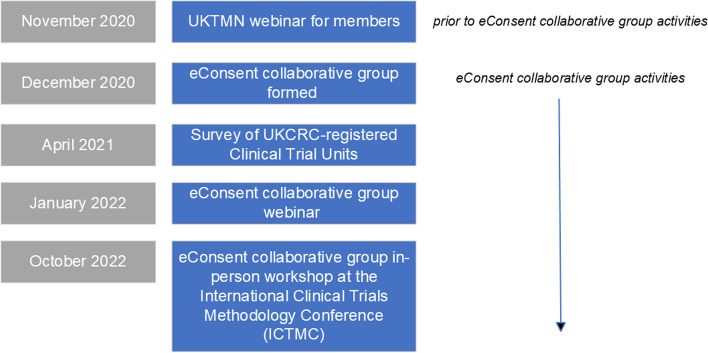
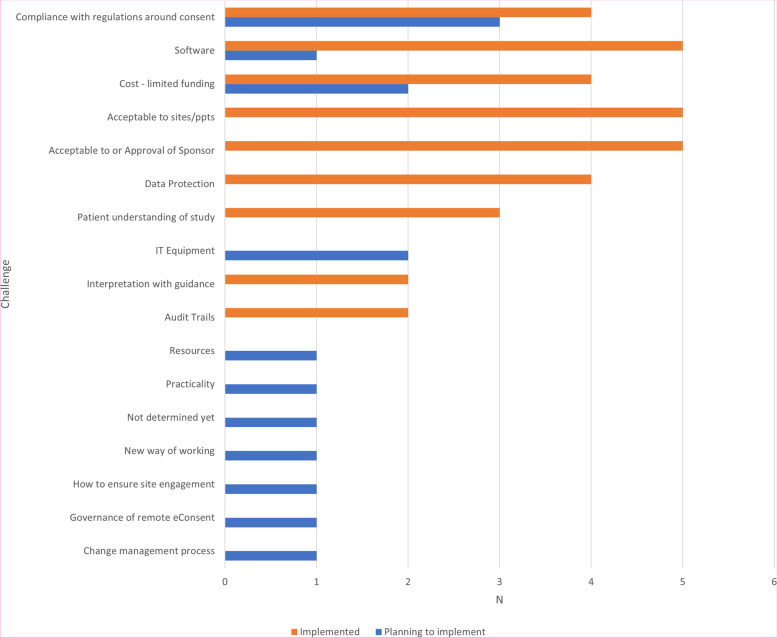
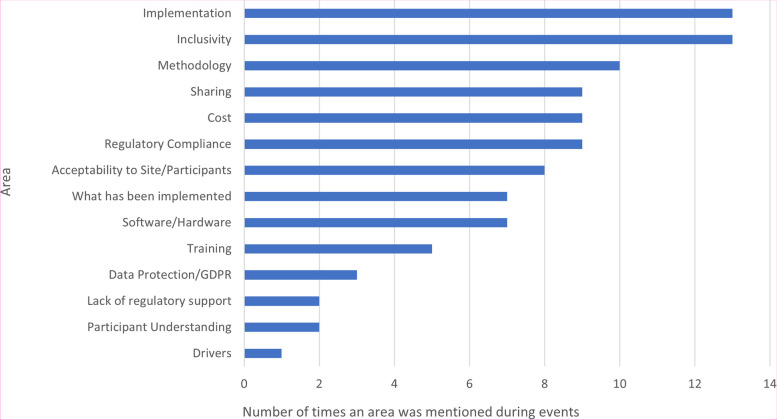
Methods: A survey of UKCRC-registered Clinical Trials Units (CTUs) was undertaken in April-June 2021 to understand the implementation of and their views on the use of e-Consent and experiences from the perspectives of systems programmers and quality assurance staff on the use of e-Consent. CTUs not using e-Consent were asked to provide any reasons/barriers (including no suitable trials) and any plans for implementing it in the future. Two events for trialists and patient and public involvement (PPI) representatives were then held to disseminate findings, foster discussion, share experiences and aid in the identification of areas that the academic CTU community felt required more research.
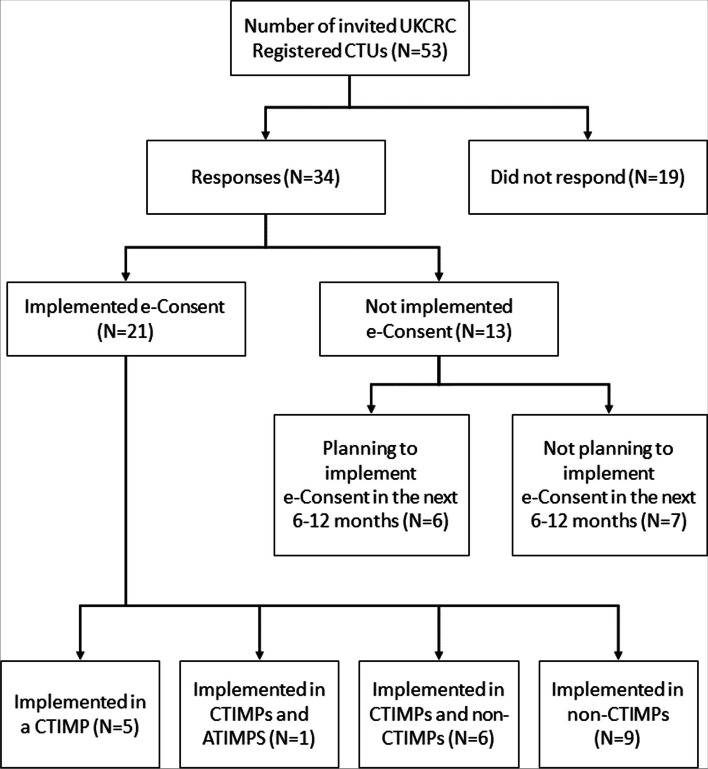
Results: Thirty-four (64%) of 53 CTUs responded to the survey, with good geographical representation across the UK. Twenty-one (62%) of the responding CTUs had implemented e-Consent in at least one of their trials, across different types of trials, including CTIMPs (Clinical Trial of Investigational Medicinal Product), ATIMPs (Advanced Therapy Medicinal Products) and non-CTIMPs. One hundred ninety-seven participants attended the two workshops for wide-ranging discussions.
Conclusion: e-Consent is increasingly used in academic-led trials, yet uncertainties remain amongst trialists, patients and members of the public. Uncertainties include a lack of formal, practical guidance and a lack of evidence to demonstrate optimal or appropriate methods to use. We strongly encourage trialists to continue to share their own experiences of the implementation of e-Consent.
Keywords: Clinical trial; Consent; e-Consent.
© 2023. BioMed Central Ltd., part of Springer Nature.
Conflict of interest statement
KH is a UKCRC-registered CTU Director. The other authors declare that they have no competing interests.
Figures
References
-
- International Council for Harmonisation of Technical Requirements for Pharmaceuticals for Human Use (ICH). Integrated addendum to ICH E6(R1): Guideline for Good Clinical Practice E6(R2). Current Step 4 version 1994 [cited 2023 13 February 2023]. Available from: https://www.ich.org/page/ich-guidelines.
-
- Declaration of Helsinki: ethical principles for medical research involving human subjects. World Medical Association; 2013 [cited 2023 13 February 2023]. Available from: https://www.wma.net/policies-post/wma-declaration-of-helsinki-ethical-pr....
-
- The Medicines for Human Use (Clinical Trials) Regulations 2004. https://www.legislation.gov.uk/: The National Archives; 2004.
MeSH terms
Grants and funding
LinkOut - more resources
Full Text Sources
Miscellaneous
