


Nanohydroxyapatite in dentistry: A comprehensive review
- PMID: 37817794
- PMCID: PMC10562112
- DOI: 10.1016/j.sdentj.2023.05.018
Nanohydroxyapatite in dentistry: A comprehensive review
Abstract
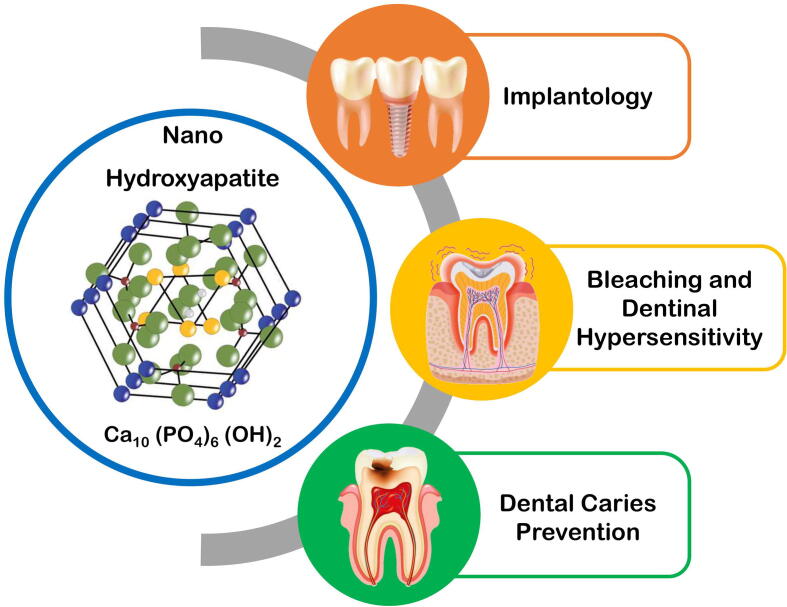
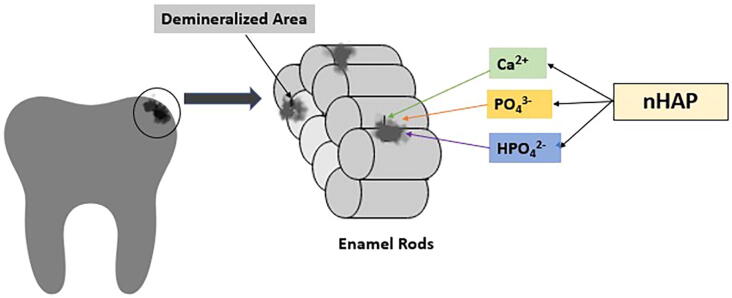
Enamel, being the hardest and the highest mineralized tissue of the human body, contains nearly 96% inorganic components and 4% organic compounds and water. Dentin contains 65% inorganic components and 35% organic and water content. The translucency and white appearance of enamel are attributed to Hydroxyapatite (HA), which constitutes the major part of the inorganic component of dental hard tissue. With the advent of nanotechnology, the application of Nanohydroxyapatite (nHA) has piqued interest in dentistry due to its excellent mechanical, physical, and chemical properties. Compared to HA, nHA is found to have superior properties such as increased solubility, high surface energy and better biocompatibility. This is due to the morphological and structural similarity of nanosized hydroxyapatite particles to tooth hydroxyapatite crystals. These nanoparticles have been incorporated into various dental formulations for different applications to ensure comprehensive oral healthcare. To prevent dental caries, several nHA based dentifrices, mouth rinsing solutions and remineralizing pastes have been developed. nHA-based materials, such as nanocomposites, nano impression materials, and nanoceramics, have proven to be very effective in restoring tooth deformities (decay, fracture, and tooth loss). The nHA coating on the surface of the dental implant helps it bind to the bone by forming a biomimetic coating. A recent innovative strategy involves using nHA to reduce dentinal hypersensitivity and to reconstruct periodontal bone defects. The purpose of the present review is to discuss the different applications of nHA in dentistry, especially in preventive and restorative dentistry, dental implantology, bleaching and dentine hypersensitivity management.
Keywords: Bleaching; Dental Implantology; Dental caries; Hydroxyapatite; Nanohydroxyapatite; Nanoparticles; Remineralization.
© 2023 The Authors. Production and hosting by Elsevier B.V. on behalf of King Saud University.
Conflict of interest statement
The authors declare that they have no known competing financial interests or personal relationships that could have appeared to influence the work reported in this paper.
Figures
References
-
- Abdulkareem E.H., Memarzadeh K., Allaker R.P., Huang J., Pratten J., Spratt D. Anti-biofilm activity of zinc oxide and hydroxyapatite nanoparticles as dental implant coating materials. J. Dent. 2015 Dec;43(12):1462–1469. - PubMed
-
- Abidi S.S.A., Murtaza Q. Synthesis and characterization of nano-hydroxyapatite powder using wet chemical precipitation reaction. J. Mater. Sci. Technol. 2014 Apr;30(4):307–310.
-
- Ahmadzadeh H., Isfahani T., Kharazi A.Z. Modified mechanical coating technique for the preparation of Nanohydroxyapatite coated Ti–6Al–4V dental implants. Prot. Met. Phys. Chem. 2020;56(4):766–771.
-
- Al-Ahmady HH, Abd Elazeem AF, Bellah Ahmed NE moataz, Shawkat WM, Elmasry M, Abdelrahman MA, et al. Combining autologous bone marrow mononuclear cells seeded on collagen sponge with Nano Hydroxyapatite, and platelet-rich fibrin: Reporting a novel strategy for alveolar cleft bone regeneration. Journal of Cranio-Maxillofacial Surgery. 2018 Sep;46(9):1593–600.8. - PubMed
-
- Alatawi R.A.S., Elsayed N.H., Mohamed W.S. Influence of hydroxyapatite nanoparticles on the properties of glass ionomer cement. J. Mater. Res. Technol. 2019 Jan;8(1):344–349.
LinkOut - more resources
Full Text Sources
