


Understanding patient non-transport decision theories in the pre-hospital setting: a narrative review
- PMID: 37821810
- PMCID: PMC10566180
- DOI: 10.1186/s12245-023-00528-7
Understanding patient non-transport decision theories in the pre-hospital setting: a narrative review
Abstract
Background: In pre-hospital emergency care, decisions regarding patient non-conveyance emerged as significant determinants of healthcare outcomes and resource utilization. These complex decisions became integral to the progress of emergency medical services, thus warranting an evolving exploration within the medical discourse.
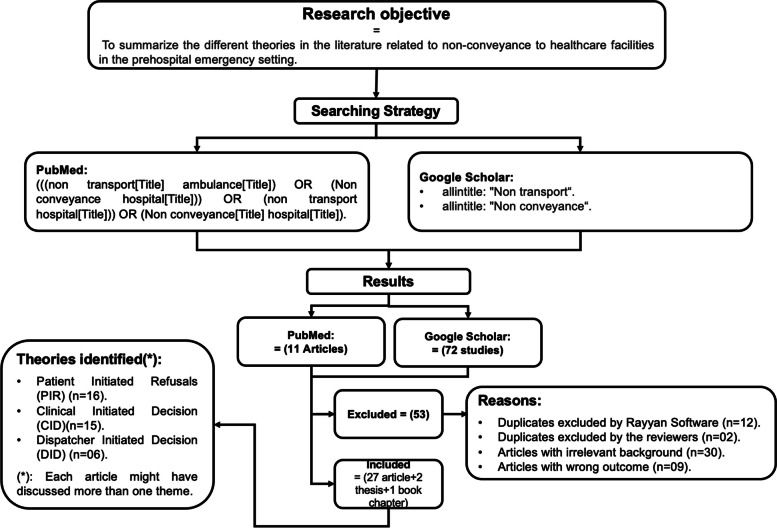
Objectives and methods: This narrative review aimed to synthesize and critically evaluate various theoretical stances on patient non-conveyance in the pre-hospital emergency. The focus on studies published between January 2012 and August 2022 was intentional to capture contemporary practices and insights. PubMed and Google Scholar served as the primary databases for the investigation, while the AL-Rayyan® software facilitated a thorough screening process.
Results and discussion: Twenty-nine studies-encompassing articles, books, and theses-were discovered through our search, each presenting unique perspectives on patient non-transport, thus highlighting its criticality as a healthcare concern. Predominant factors influencing non-transport decisions were classified into patient-initiated refusals (PIR), clinician-initiated decisions (CID), and dispatcher-initiated decisions (DID).
Conclusions: The issue of patient non-conveyance to hospitals continues to pose a crucial challenge to the seamless operation of emergency healthcare systems, warranting increased attention from various healthcare entities. To comprehend and pinpoint potential areas of improvement, a comprehensive analysis of pre-hospital non-transport events is imperative. A well-informed, strategic approach could prevent resource waste while ensuring patients receive the required and definitive care.
Key messages: Why is this topic important? Some studies have suggested that non-transport to hospitals following emergency calls is safe. However, it is a concerning issue for health systems. It is also considered a key performance metric for health systems. What does this review attempt to show? This review aimed to map the various factors discussed in the literature regarding the decisions not to transport patients following emergency calls in a pre-hospital setting. What are the key findings? The existing theories regarding non-transport to hospitals after the provision of emergency care in the pre-hospital setting were identified. Non-transport due to non-clinical decisions jeopardizes emergency care outcomes for paediatric and elderly patients in particular. Hence, further research is required to identify and control the factors governing these decisions. How is patient care impacted? The decisions regarding patient transport following emergency calls in a pre-hospital setting are crucial for patient outcomes. They could impact the pre-hospital emergency care outcomes as well as patient safety. They can also affect the emergency services resources' ability to respond to other critical emergencies.
Keywords: Ambulance service; Non-conveyance; Non-transport; Prehospital care; Transport refusal.
© 2023. Springer-Verlag GmbH Germany, part of Springer Nature.
Conflict of interest statement
The authors declare no competing interests.
References
-
- Alinier G, Wilson P, Reimann T, Morris B. Influential factors on urban and rural response times for emergency ambulances in Qatar. Mediterr J Emerg Med. 2018;26:8–13.
-
- Clwason JJ, Dernocoeur KB, Murray C. Principles of Emergency Medical Dispatch, 5th edition. 5. USA: The International Academy of EMD; 2014.
-
- Alinier G, Meyer J, Farhat H, Bayoumy A, Gonzales E, Ragbheer S, et al. Initial results from a driving safety survey distributed to ambulance paramedics in Qatar. J Local Glob Health Sci. 2015 Nov 12;2015(Proceedings of the 24th World International Traffic Medicine Association Congress, Qatar 2015):59.
-
- Farhat H, Laughton J, Gangaram P, El Aifa K, Khenissi MC, Zaghouani O, et al. Hazardous material and chemical, biological, radiological, and nuclear incident readiness among prehospital care professionals in the State of Qatar. Glob Secur Health Sci Policy. 2022;7(1):24–36. doi: 10.1080/23779497.2022.2069142. - DOI
Publication types
Grants and funding
LinkOut - more resources
Full Text Sources
