Review
. 2024 May 1;36(5):1205-1226.
doi: 10.1093/plcell/koad260.

Complementing model species with model clades

Affiliations
Review

Complementing model species with model clades

Makenzie E Mabry et al. Plant Cell. .

Abstract

Model species continue to underpin groundbreaking plant science research. At the same time, the phylogenetic resolution of the land plant tree of life continues to improve. The intersection of these 2 research paths creates a unique opportunity to further extend the usefulness of model species across larger taxonomic groups. Here we promote the utility of the Arabidopsis thaliana model species, especially the ability to connect its genetic and functional resources, to species across the entire Brassicales order. We focus on the utility of using genomics and phylogenomics to bridge the evolution and diversification of several traits across the Brassicales to the resources in Arabidopsis, thereby extending scope from a model species by establishing a "model clade." These Brassicales-wide traits are discussed in the context of both the model species Arabidopsis and the family Brassicaceae. We promote the utility of such a "model clade" and make suggestions for building global networks to support future studies in the model order Brassicales.


Conflict of interest statement

Conflict of interest statement. None declared.

Figures
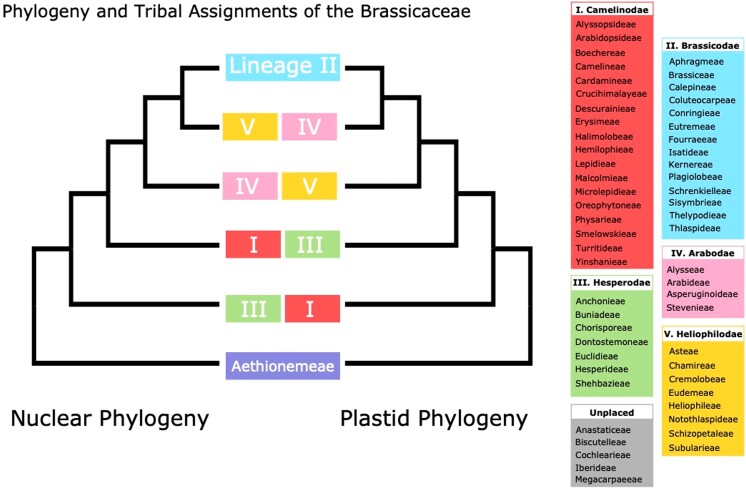
Figure 1.
Figure 1.
Phylogeny indicating the lineage relationships of the Brassicaceae using nuclear and plastid data. Placed tribes are noted with corresponding color and numbering. Summary, classification, and relationships based on Hendriks et al. (2023).
Figure 2.
Figure 2.
Phylogeny of 17 families in the Brassicales and character trait matrix. The presence of a given trait is marked by a filled dark-green square. Traits that are unknown or absent are in light green. Possible locations of At-β are marked in blue stars, with family-specific whole-genome duplications in orange. Traits displayed are: A) C4, B) extremophytism, C) glucosinolates, D) ancestral woodiness, and E) dioecy. Additional proposed families, which are not included here, still need to be analyzed using multiple single-copy nuclear genes (e.g. Tiganophytaceae and Borthwickiaceae). Areas of the phylogeny with no or low support are indicated by thin branch lines. Topology and support based on Edger et al. (2018a).
Figure 3.
Figure 3.
Whole-genome synteny of chromosome-scale Brassicaceae genomes. The synteny plot was generated using GENESPACE v0.9.1 (Lovell et al. 2022) with “diamondMode” and “orthofinderMode” set to fast, using A. thaliana (Arabidopsideae; Lamesch et al. 2012), A. arenosa (Arabidopsideae; Barragan et al. 2021), B. rapa (Brassiceae; v1.3; downloaded from Phytozome), Camelina sativa (Camelineae; Kagale et al. 2014), Cardamine hirsuta (Cardamineae; Gan et al. 2016), and A. alpina (Arabideae; Willing et al. 2015) genome annotations. The 4 diploid genomes (A. arenosa, A. thaliana, A. alpina, and C. hirsuta) show 1:3 syntenic relationships with the younger hexaploid C. sativa genome (n = 20) and evolutionarily older hexaploid genome of B. rapa (n = 10).
Figure 4.
Figure 4.
Light microscope cross sections through Brassicales stems showing the difference between: herbaceous A) and woody stems B–D). Double-pointed arrows indicate the wood cylinder. All images are at the same magnification (scale bar = 500 µm). A) Basal inflorescence stem part of A. thaliana (Brassicaceae). B)Reseda sp. (Resedaceae). C)C. spinosa (Capparaceae). D)Sinapidendron angustifolium (Brassicaceae).

References

    1. Abrahams RS, Pires JC, Schranz ME. Genomic origin and diversification of the glucosinolate MAM locus. Front Plant Sci. 2020:11:711. 10.3389/fpls.2020.00711 - DOI - PMC - PubMed
    1. Akagi T, Henry IM, Ohtani H, Morimoto T, Beppu K, Kataoka I, Tao R. A Y-encoded suppressor of feminization arose via lineage-specific duplication of a cytokinin response regulator in kiwifruit. Plant Cell. 2018:30(4):780–795. 10.1105/tpc.17.00787 - DOI - PMC - PubMed
    1. Al-Shehbaz IA. The tribes of Cruciferae (Brassicaceae) in the southeastern United States. J Arnold Arbor. 1984:65(3):343–373. 10.5962/p.36696 - DOI
    1. Andersson L, Andersson S. A molecular phylogeny of Tropaeolaceae and its systematic implications. Taxon. 2000:49(4):721–736. 10.2307/1223973 - DOI
    1. Antonelli A, Clarkson JJ, Kainulainen K, Maurin O, Brewer GE, Davis AP, Epitawalage N, Goyder DJ, Livshultz T, Persson C, et al. . Settling a family feud: a high-level phylogenomic framework for the Gentianales based on 353 nuclear genes and partial plastomes. Am J Bot. 2021:108(7):1143–1165. 10.1002/ajb2.1697 - DOI - PubMed

Publication types