. 2023 Dec;4(12):e994-e1004.
doi: 10.1016/S2666-5247(23)00219-7. Epub 2023 Oct 9.

Antimicrobial susceptibility of Treponema pallidum subspecies pallidum: an in-vitro study

Affiliations

Antimicrobial susceptibility of Treponema pallidum subspecies pallidum: an in-vitro study

Lauren C Tantalo et al. Lancet Microbe. 2023 Dec.

Abstract

Background: The increasing incidence of syphilis and the limitations of first-line treatment with penicillin, particularly in neurosyphilis, neonatal syphilis, and pregnancy, highlight the need to expand the therapeutic repertoire for effective management of this disease. We assessed the in-vitro efficacy of 18 antibiotics from several classes on Treponema pallidum subspecies pallidum (T pallidum), the syphilis bacteria.

Methods: Using the in-vitro culture system for T pallidum, we exposed the pathogen to a concentration range of each tested antibiotic. After a 7-day incubation, the treponemal burden was evaluated by quantitative PCR targeting the T pallidum tp0574 gene. The primary outcome was the minimum inhibitory concentration (MIC) at which the quantitative PCR values were not significantly higher than the inoculum wells. We also investigated the susceptibility of macrolide-resistant strains to high concentrations of azithromycin, and the possibility of developing resistance to linezolid, a proposed candidate for syphilis treatment.

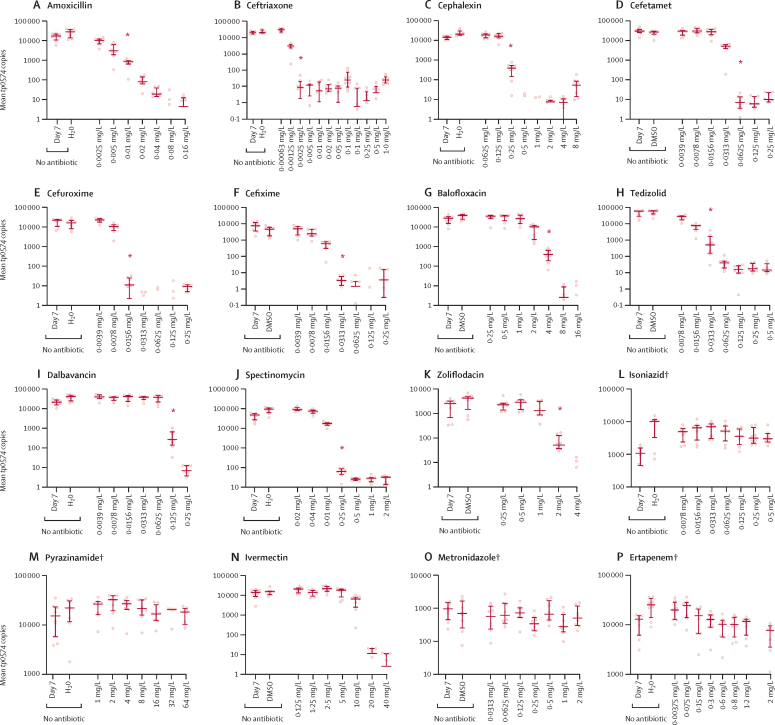
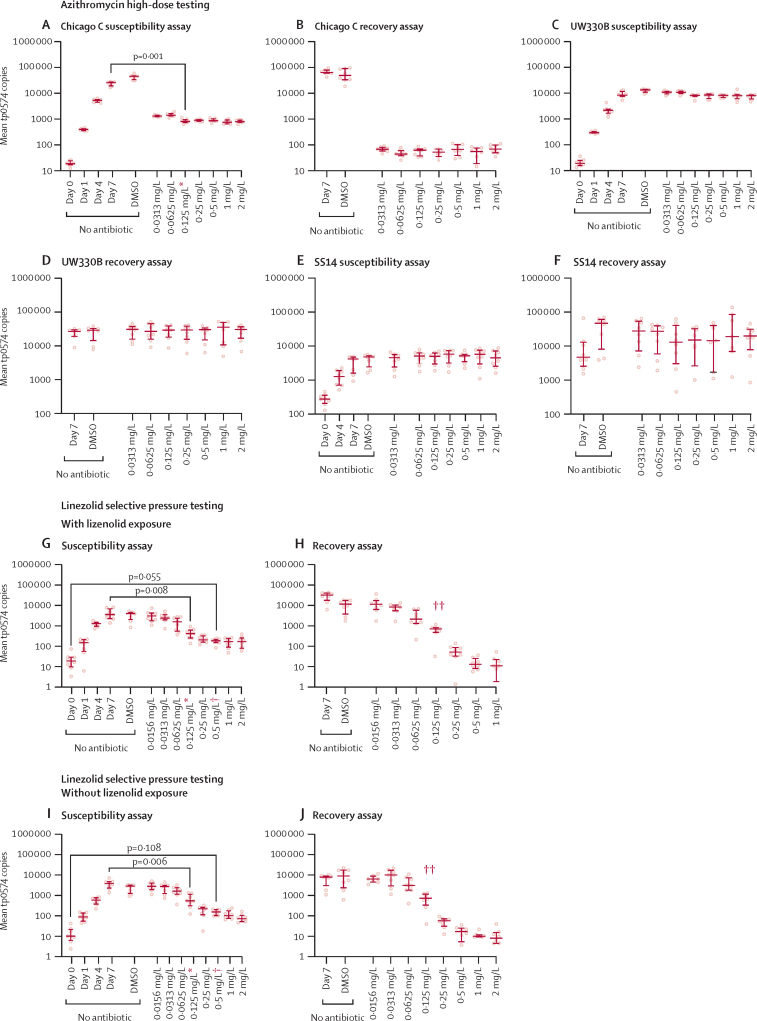
Findings: Amoxicillin, ceftriaxone, several oral cephalosporins, tedizolid, and dalbavancin exhibited anti-treponemal activity at concentrations achievable in human plasma following regular dosing regimens. The experiments revealed a MIC for amoxicillin at 0·02 mg/L, ceftriaxone at 0·0025 mg/L, cephalexin at 0·25 mg/L, cefetamet and cefixime at 0·0313 mg/L, cefuroxime at 0·0156 mg/L, tedizolid at 0·0625 mg/L, spectinomycin at 0·1 mg/L, and dalbavancin at 0·125 mg/L. The MIC for zoliflodacin and balofloxacin was 2 mg/L. Ertapenem, isoniazid, pyrazinamide, and metronidazole had either a poor or no effect. Azithromycin concentrations up to 2 mg/L (64 times the MIC) were ineffective against strains carrying mutations associated to macrolide resistance. Exposure to subtherapeutic doses of linezolid for 10 weeks did not induce phenotypic or genotypic resistance.

Interpretation: Cephalosporins and oxazolidinones are potential candidates for expanding the current therapeutic repertoire for syphilis. Our findings warrant testing efficacy in animal models and, if successful, clinical assessment of efficacy.

Funding: European Research Council.


Conflict of interest statement

Declaration of interests We declare no competing interests.

Figures
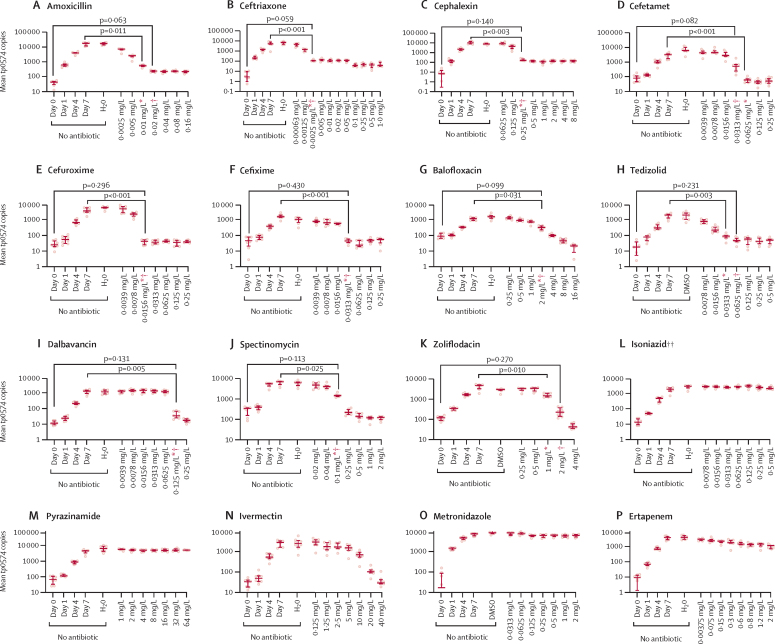
Figure 1
Figure 1
Treponema pallidum susceptibility to antimicrobials Non-antibiotic control wells represent treponemal growth in the absence of antibiotic from day 0 (inoculum) to day 7 after plate inoculation. DMSO and H2O bars are relative to Sf1Ep cell cultures to which the compound solvent was added instead of the tested antibiotic. In the bar chart, the middle line represents the median tp0574 gene copies per unit of volume from eight biological replicates, the length of the bar represents the IQR, and the dots represent the individual values. *Secondary MIC: p values (for the Dunn's test) are provided for the comparison between the lowest antibiotic dilution at which the tp0574 qPCR values were significantly lower than the positive control (day 7 control group). †Primary MIC: p values (for the Dunn's test) are provided for the comparison between the lowest antibiotic dilution at which the tp0574 qPCR values were not significantly higher than the inoculum wells (day 0 control group). DMSO=dimethyl sulfoxide. MIC=minimum inhibitory concentration. ‡Isoniazid, pyrazinamide, metronidazole, and ertapenem do not have p values because the MIC was unattained (ie, the MIC value is higher than the highest concentration tested). In the case of ivermectin, we showed that the reduction in the growth of T pallidum at a concentration of 10 mg/L or higher actually reflects toxicity to Sf1Ep cells and therefore cannot be considered an MIC.
Figure 2
Figure 2
Recovery assays following antibiotic removal In the bar chart, the middle line represents median tp0574 gene copies per unit of volume from eight biological replicates, the length of the bar represents the IQR, and the dots represent the individual values. DMSO=dimethyl sulfoxide. MBC=minimum bactericidal concentration. MIC=minimum inhibitory concentration. *MBC. †Isoniazid, pyrazinamide, metronidazole, and ertapenem do not have p values because the MIC was unattained (ie, the MIC value was higher than the highest concentration tested). In the case of ivermectin, we showed that the reduction in the growth of T pallidum at a concentration of 10 mg/L or higher actually reflects toxicity to Sf1Ep cells and therefore cannot be considered an MIC.
Figure 3
Figure 3
Susceptibility and recovery assays of Chicago C, UW330B, and SS14 to azithromycin, and susceptibility and recovery assays with and without linezolid exposure Non-antibiotic control wells represent treponemal growth in absence of antibiotic from day 0 (inoculum) to day 7 after plate inoculation. DMSO bars are relative to Sf1Ep cell cultures to which the compound solvent was added instead of the tested antibiotic. Susceptibility and recovery assays of the SS14 strain propagated in the presence of subtherapeutic concentration of linezolid (G, H), or absence of antibiotic (I, J). In the bar chart, the middle line represents the median tp0574 gene copies per unit of volume from eight biological replicates, the length of the bar represents the IQR, and the dots represent the individual values. DMSO=dimethyl sulfoxide. MBC=minimum bactericidal concentration. *Secondary MIC: p values (for the Dunn's test) are provided for the comparison between the lowest antibiotic dilution at which the tp0574 qPCR values were significantly lower than the positive control (day 7 control group). †Primary MIC: p values (for the Dunn's test) are provided for the comparison between the lowest antibiotic dilution at which the tp0574 qPCR values were not significantly higher than the inoculum wells (day 0 control group). ‡MBC.

Comment in

References

    1. WHO Prevalence and incidence of selected sexually transmitted infections, Chlamydia trachomatis, Neisseria gonorrhoeae, syphilis and Trichomonas vaginalis: methods and results used by WHO to generate 2005 estimates. 2011. https://apps.who.int/iris/handle/10665/44735
    1. Newman L, Rowley J, Vander Hoorn S, et al. Global estimates of the prevalence and incidence of four curable sexually transmitted infections in 2012 based on systematic review and global reporting. PLoS One. 2015;10 - PMC - PubMed
    1. Vos T, Abajobir AA, Abate KH, et al. Global, regional, and national incidence, prevalence, and years lived with disability for 328 diseases and injuries for 195 countries, 1990–2016: a systematic analysis for the Global Burden of Disease Study 2016. Lancet. 2017;390:1211–1259. - PMC - PubMed
    1. Savage EJ, Hughes G, Ison C, Lowndes CM, the European Surveillance of Sexually Transmitted Infections network Syphilis and gonorrhoea in men who have sex with men: a European overview. Euro Surveill. 2009;14 - PubMed
    1. Tucker JD, Cohen MS. China's syphilis epidemic: epidemiology, proximate determinants of spread, and control responses. Curr Opin Infect Dis. 2011;24:50–55. - PMC - PubMed

Publication types

MeSH terms