. 2023 Sep 26:14:1244493.
doi: 10.3389/fgene.2023.1244493. eCollection 2023.

The draft genome of the microscopic Nemertoderma westbladi sheds light on the evolution of Acoelomorpha genomes

Affiliations

The draft genome of the microscopic Nemertoderma westbladi sheds light on the evolution of Acoelomorpha genomes

Samuel Abalde et al. Front Genet. .

Abstract

Background: Xenacoelomorpha is a marine clade of microscopic worms that is an important model system for understanding the evolution of key bilaterian novelties, such as the excretory system. Nevertheless, Xenacoelomorpha genomics has been restricted to a few species that either can be cultured in the lab or are centimetres long. Thus far, no genomes are available for Nemertodermatida, one of the group's main clades and whose origin has been dated more than 400 million years ago. Methods: DNA was extracted from a single specimen and sequenced with HiFi following the PacBio Ultra-Low DNA Input protocol. After genome assembly, decontamination, and annotation, the genome quality was benchmarked using two acoel genomes and one Illumina genome as reference. The gene content of three cnidarians, three acoelomorphs, four deuterostomes, and eight protostomes was clustered in orthogroups to make inferences of gene content evolution. Finally, we focused on the genes related to the ultrafiltration excretory system to compare patterns of presence/absence and gene architecture among these clades. Results: We present the first nemertodermatid genome sequenced from a single specimen of Nemertoderma westbladi. Although genome contiguity remains challenging (N50: 60 kb), it is very complete (BUSCO: 80.2%, Metazoa; 88.6%, Eukaryota) and the quality of the annotation allows fine-detail analyses of genome evolution. Acoelomorph genomes seem to be relatively conserved in terms of the percentage of repeats, number of genes, number of exons per gene and intron size. In addition, a high fraction of genes present in both protostomes and deuterostomes are absent in Acoelomorpha. Interestingly, we show that all genes related to the excretory system are present in Xenacoelomorpha except Osr, a key element in the development of these organs and whose acquisition seems to be interconnected with the origin of the specialised excretory system. Conclusion: Overall, these analyses highlight the potential of the Ultra-Low Input DNA protocol and HiFi to generate high-quality genomes from single animals, even for relatively large genomes, making it a feasible option for sequencing challenging taxa, which will be an exciting resource for comparative genomics analyses.

Keywords: HiFi; Osr; Ultra-Low DNA Input; Xenacoelomorpha; excretory system; gene content.


Conflict of interest statement

The authors declare that the research was conducted in the absence of any commercial or financial relationships that could be construed as a potential conflict of interest.

Figures
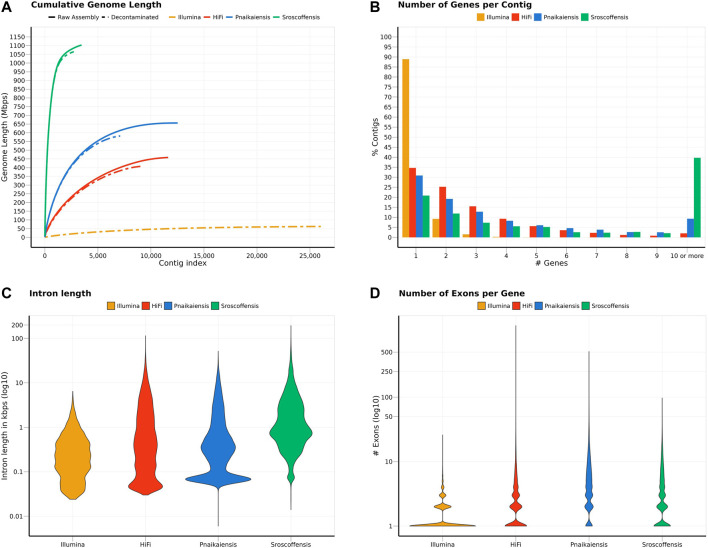
FIGURE 1
FIGURE 1
Summary of the statistics calculated for the two N. westbladi genomes (sequenced with Illumina or HiFi), P. naikaiensis, and S. roscoffensis. (A) Cumulative genome length, sorted from the longest to the shortest contig, separating the raw assembly from the BlobTools decontamination. Due to the large number of contigs in the raw assembly, only the decontaminated version of the N. westbladi genome sequenced with Illumina is shown. (B) Summary of the number of genes per contig, (C) distribution of the intron length per species, and (D) number of exons per gene.
FIGURE 2
FIGURE 2
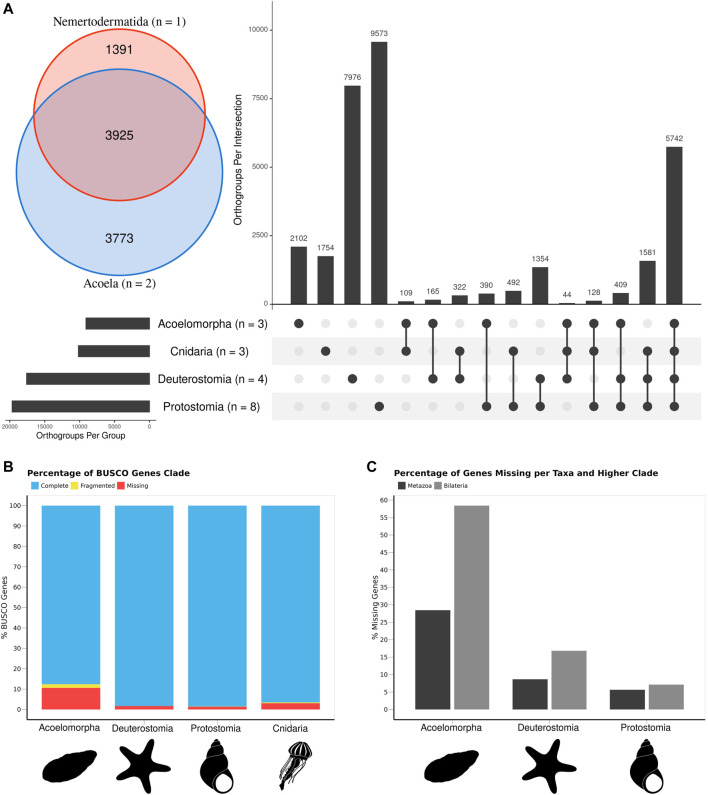
The gene content of the three acoelomorph genomes was compared to 15 genomes from several phyla, including three cnidarians, four deuterostomes (three chordates and one echinoderm), and eight protostomes. (A) Number of unique and shared genes among acoelomorphs, cnidarians, deuterostomes, and protostomes. In the inset, the number of shared genes between the two acoel genomes and N. westbladi. (B) BUSCO scores of each of the four main clades. (C) Percentage of missing genes observed in acoelomorphs, deuterostomes, and protostomes. The set of “metazoan genes” was defined as all genes shared between at least one cnidarian and one bilaterian species; whereas the “bilaterian genes” are those shared between at least two of the three bilaterian clades. The silhouettes in (B,C) were downloaded from PhyloPic (Nemertodermatida, Andreas Hejnol; Chrysaora, Levi Simons; Asteroidea, Fernando Carezzano; and Tricolia, Tauana Cunha).
FIGURE 3
FIGURE 3
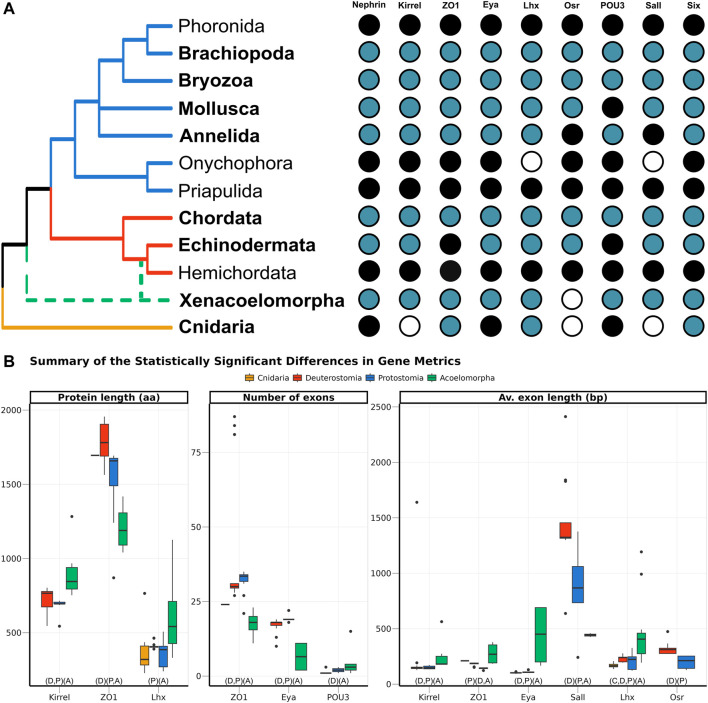
(A) Presence of the nine genes related to the ultrafiltration excretory system annotated in this study (blue), complemented with information from GenBank (black). The phyla investigated here are highlighted in bold, whereas the others were studied in Gąsiorowski et al. (2021). The cladogram topology is based on (Giribet and Edgecombe, 2020), including the two alternative positions of Xenacoelomorpha as a dashed line. (B) Boxplot comparing the three metrics related to gene architecture, separating the four main clades analysed per colour. Only the comparisons significantly different are shown, but the full result is included in Supplementary Figure S5. In the X-axis, below the boxplots, the brackets summarise the pairwise comparisons, clustering the clades with no significant differences within the same brackets.

References

    1. Albertin C. B., Simakov O., Mitros T., Wang Z. Y., Pungor J. R., Edsinger-Gonzales E., et al. (2015). The octopus genome and the evolution of cephalopod neural and morphological novelties. Nature 524, 220–224. 10.1038/nature14668 - DOI - PMC - PubMed
    1. Alonge M., Lebeigle L., Kirsche M., Aganezov S., Wang X., Lippman Z. B., et al. (2022). Automated assembly scaffolding using RagTag elevates a new tomato system for high-throughput genome editing. Genome Biol. 23, 258. 10.1186/s13059-022-02823-7 - DOI - PMC - PubMed
    1. Andrikou C., Thiel D., Ruiz-Santiesteban J. A., Hejnol A. (2019). Active mode of excretion across digestive tissues predates the origin of excretory organs. PLoS Biol. 17, e3000408–e3000422. 10.1371/journal.pbio.3000408 - DOI - PMC - PubMed
    1. Arimoto A., Hikosaka-Katayama T., Hikosaka A., Tagawa K., Inoue T., Ueki T., et al. (2019). A draft nuclear-genome assembly of the acoel flatworm Praesagittifera naikaiensis. Gigascience 8, 1–8. 10.1093/gigascience/giz023 - DOI - PMC - PubMed
    1. Bali N., Lee H. K., Zinn K. (2022). Sticks and Stones, a conserved cell surface ligand for the Type IIa RPTP Lar, regulates neural circuit wiring in Drosophila. Elife 11, 714699–e71530. 10.7554/eLife.71469 - DOI - PMC - PubMed