. 2023 Oct 17;120(42):e2304139120.
doi: 10.1073/pnas.2304139120. Epub 2023 Oct 13.

2-thiouridine is a broad-spectrum antiviral nucleoside analogue against positive-strand RNA viruses

Affiliations

2-thiouridine is a broad-spectrum antiviral nucleoside analogue against positive-strand RNA viruses

Kentaro Uemura et al. Proc Natl Acad Sci U S A. .

Abstract

Severe acute respiratory syndrome coronavirus 2 (SARS-CoV-2) infections are causing significant morbidity and mortality worldwide. Furthermore, over 1 million cases of newly emerging or re-emerging viral infections, specifically dengue virus (DENV), are known to occur annually. Because no virus-specific and fully effective treatments against these or many other viruses have been approved, there is an urgent need for novel, effective therapeutic agents. Here, we identified 2-thiouridine (s2U) as a broad-spectrum antiviral ribonucleoside analogue that exhibited antiviral activity against several positive-sense single-stranded RNA (ssRNA+) viruses, such as DENV, SARS-CoV-2, and its variants of concern, including the currently circulating Omicron subvariants. s2U inhibits RNA synthesis catalyzed by viral RNA-dependent RNA polymerase, thereby reducing viral RNA replication, which improved the survival rate of mice infected with DENV2 or SARS-CoV-2 in our animal models. Our findings demonstrate that s2U is a potential broad-spectrum antiviral agent not only against DENV and SARS-CoV-2 but other ssRNA+ viruses.

Keywords: RNA-dependent RNA polymerase; SARS-CoV-2; antiviral; dengue virus; positive-strand RNA viruses.


Conflict of interest statement

The authors K.U., H.N., A.S., S.T., and S. Kusakabe are employees of Shionogi & Co., Ltd. The other authors declared no conflict of interest. We have filed an application with the Japanese patent office.

Figures
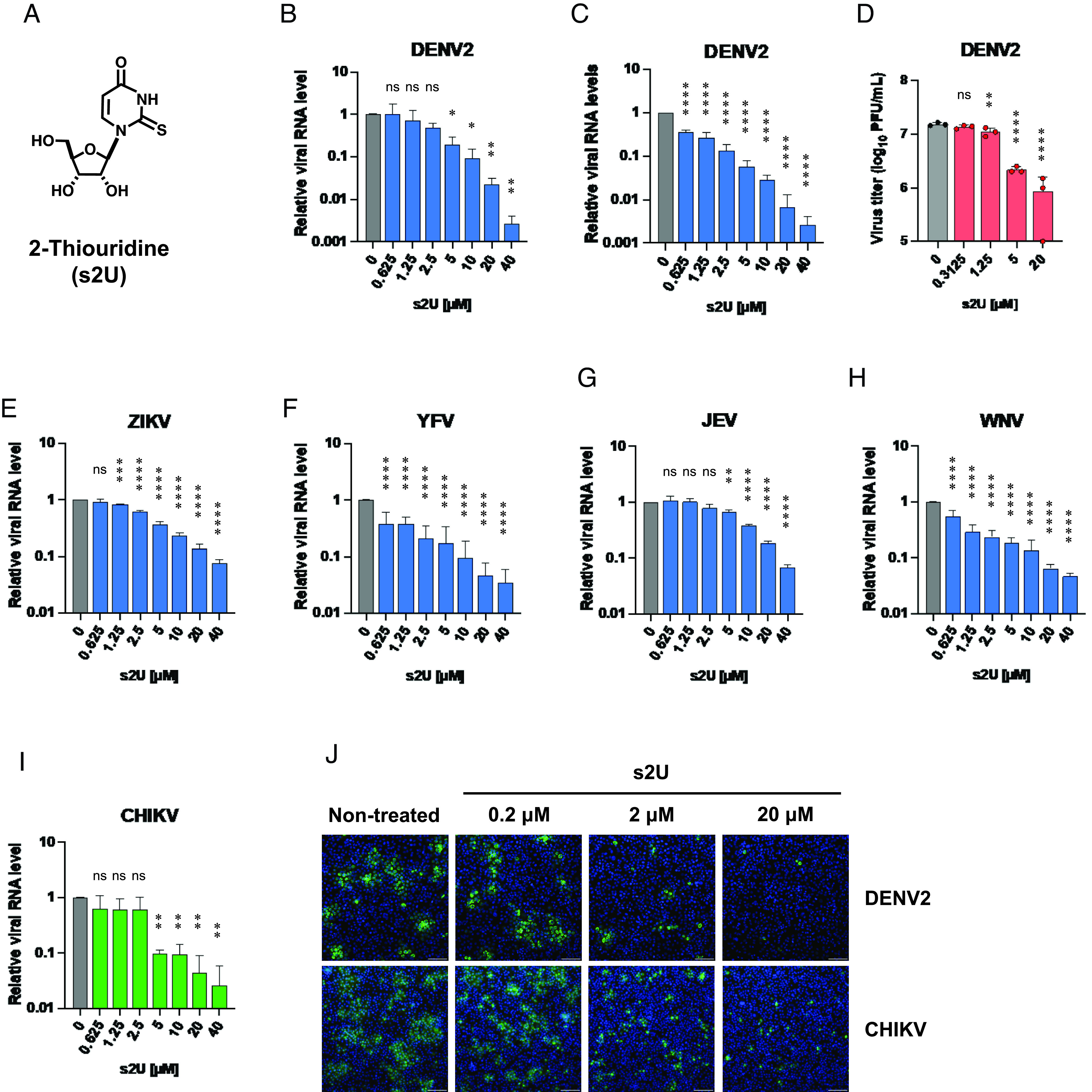
Fig. 1.
Fig. 1.
Broad-spectrum antiviral activities of s2U against Flaviviruses and CHIKV. (A) Chemical structure of 2-thiouridine (s2U). (B and C) Dose-response inhibition of DENV2 replication by s2U in VeroE6 (B) and Huh7 (C) cells. Cell lysates were collected for viral RNA determination, and viral RNA levels were determined relative to ACTB transcripts. (D) Dose-response inhibition of DENV2 propagation by s2U. Supernatants of DENV2-infected BHK-21 cells were collected at 72 hours post-infection (hpi), and dilutions were used to inoculate BHK-21 cells. Four days after inoculation, viral titers were determined by the plaque assay. (EI) Dose-response inhibition of ZIKV (E), YFV (F), JEV (G), WNV (H), and CHIKV (I) by s2U. Cell lysates were collected for viral RNA determination, and viral RNA levels were determined relative to ACTB transcripts. (J) Dose-response inhibition of viral protein expression in the DENV2- and CHIKV- infected cells. Cells were stained with viral-specific antibodies (green, DENV2: Envelope protein, CHIKV: E1 protein) and counterstained with Hoechst 33342 nuclear dye (blue). (Scale bars indicate 200 μm.) Data are presented as mean values of biological triplicates from one of the experiments, and error bars indicate SD. Statistically significant differences were determined using a one-way ANOVA followed by Dunnett’s multiple comparisons test to compare with non-treated cells; *P < 0.01, **P < 0.005, ***P < 0.0005, and ****P < 0.0001.
Fig. 2.
Fig. 2.
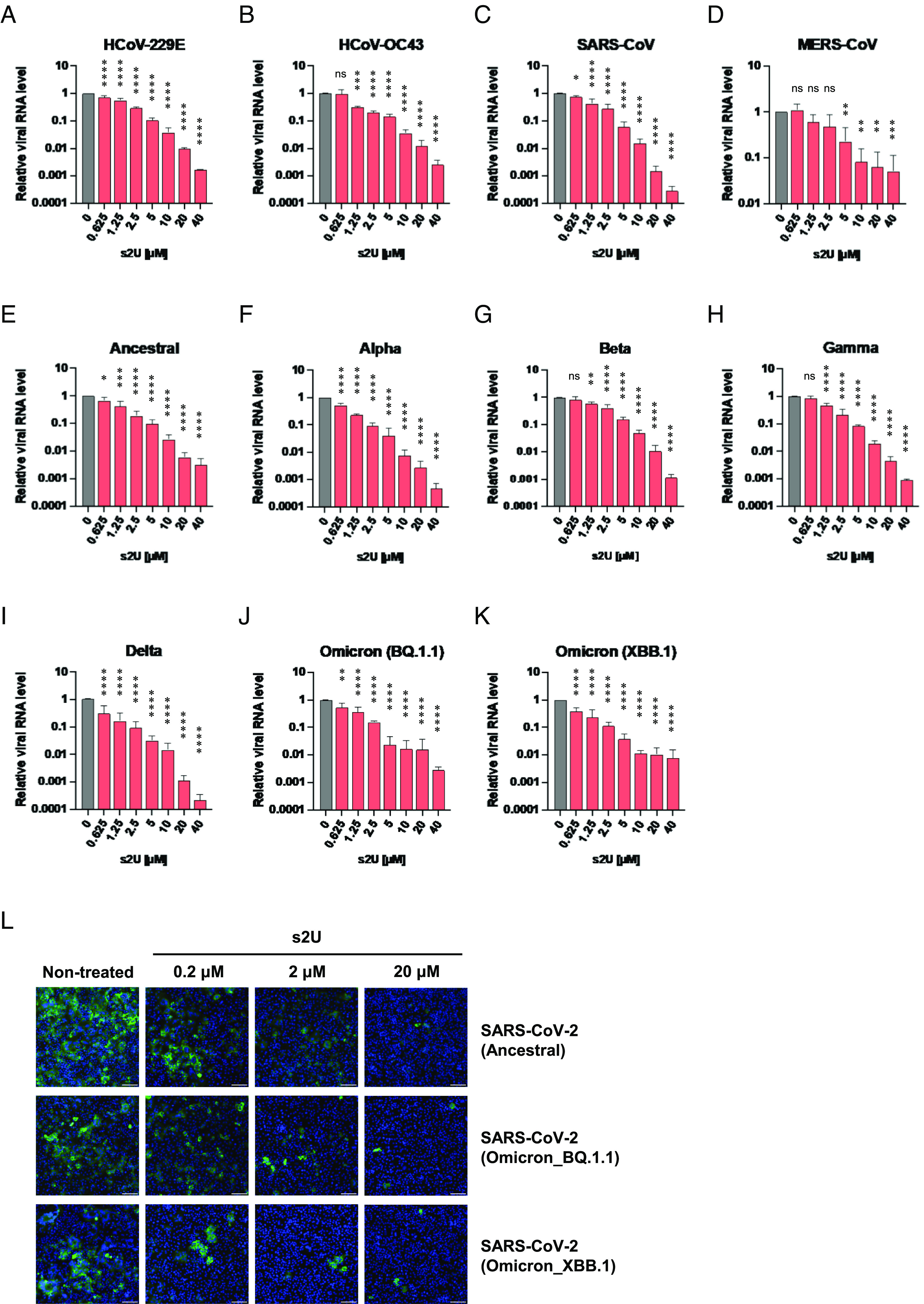
Broad-spectrum antiviral activities of s2U against human coronaviruses, including SARS-CoV-2. (AK) Dose-response inhibition of HCoV-229E (A), HCoV-OC43 (B), SARS-CoV (C), MERS-CoV (D), and several SARS-CoV-2 variants (EK) by s2U. Cell lysates were collected for viral RNA determination, and viral RNA levels were determined relative to ACTB transcripts. (L) Dose-response inhibition of viral protein expression in the SARS-CoV-2-infected cells. Cells were stained with viral-specific antibodies (green, Nucleocapsid) and counterstained with Hoechst 33342 nuclear dye (blue). (Scale bars indicate 200 μm.) Data are presented as mean values of biological triplicates from one of the experiments, and error bars indicate the SD. Statistically significant differences were determined using a one-way ANOVA followed by Dunnett’s multiple comparisons test to compare with non-treated cells; *P < 0.01, **P < 0.005, ***P < 0.0005, and ****P < 0.0001.
Fig. 3.
Fig. 3.
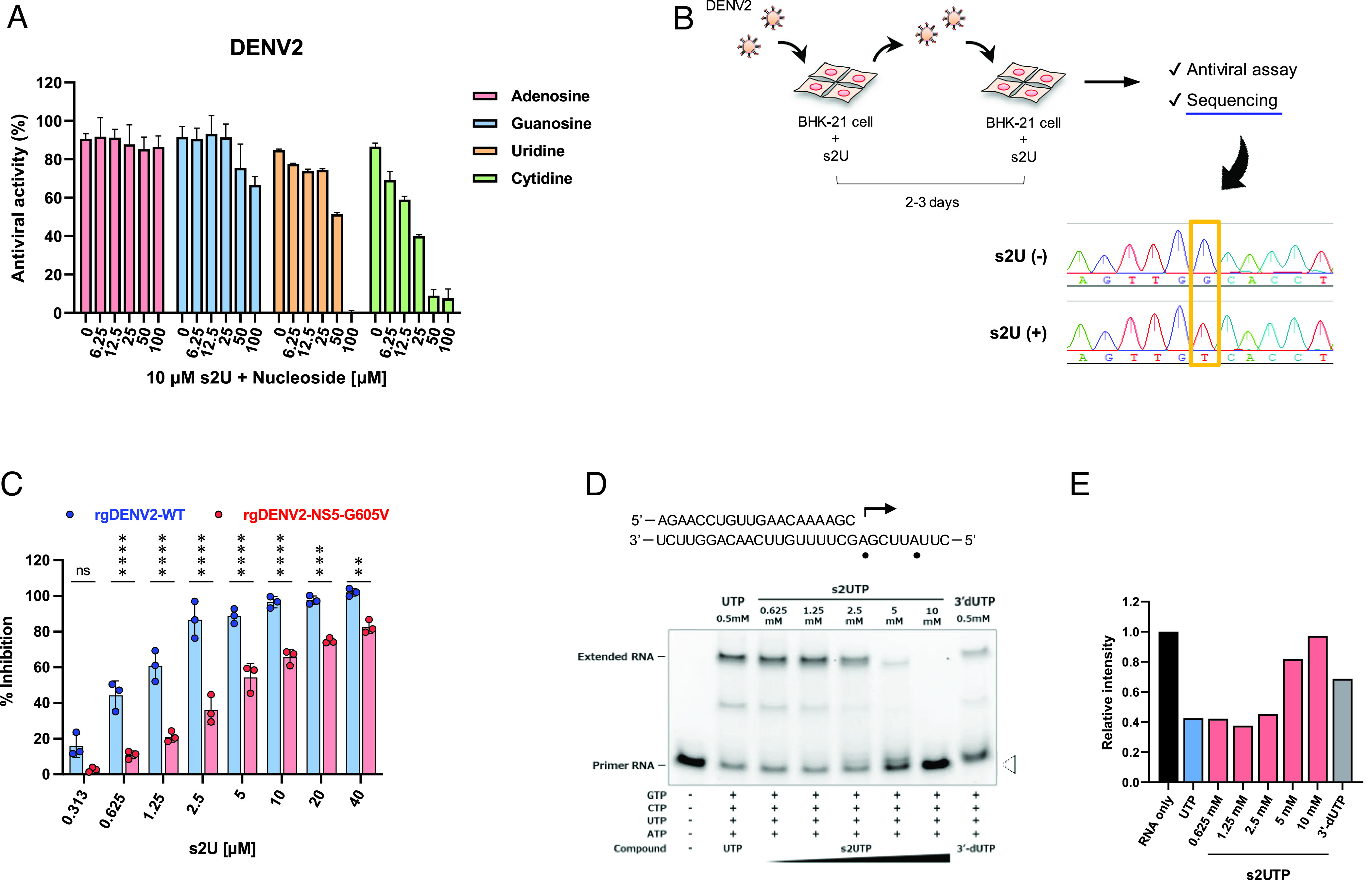
Molecular target and mechanism of action of s2U. (A) Ribonucleoside competition of DENV2 inhibition by s2U. DENV2 [multiplicity of infection (MOI) = 0.01]-infected BHK-21 cells were treated with 10 μM of s2U and serial dilutions of exogenous nucleosides. A resazurin reduction assay was performed at 4 days post-infection (dpi). (B) Schematic presentation of the experimental design for drug-escape mutant selection and sequence result. BHK-21 cells were infected with DENV2 in the presence of s2U. The passage of infected cells or culture supernatant was performed every 2 to 3 d. Base substitution was detected using Sanger sequencing. (C) Effect of s2U resistance mutation on anti-DENV2 activity of s2U. BHK-21 cells were infected with rgDENV2-WT or rgDENV2-NS5-G605V (MOI = 0.1) containing a serially diluted compound. A resazurin reduction assay was performed at 4 dpi. (D) Analysis of viral RdRp stalling by s2U 5′-triphosphate (s2UTP). Denaturing polyacrylamide gel electrophoresis fraction of RNA transcripts produced through primer extension by ZIKV RdRp in the presence of the indicated nucleotides. The RNA primer/template sequence used in this assay is indicated at the top (small black circles indicate the incorporation sites of UTP). (E) Relative band intensities of fluorescently labeled RNA primers. Relative fluorescence intensities of each RNA primer (white arrowhead in Fig. 3D) were normalized by the RNA sample without UTP or s2UTP (black bar, RNA only). Anti-DENV2 activities (%; A and C) are expressed relative to the values for the DMSO-treated, infected samples and non-infected samples. Data are presented as mean values, and error bars indicate SD. Statistically significant differences between wildtype and G605V viruses (C) were determined using a two-way ANOVA followed by Bonferroni’s multiple comparisons tests; *P < 0.01, **P < 0.005, ***P < 0.0005, and ****P < 0.0001.
Fig. 4.
Fig. 4.
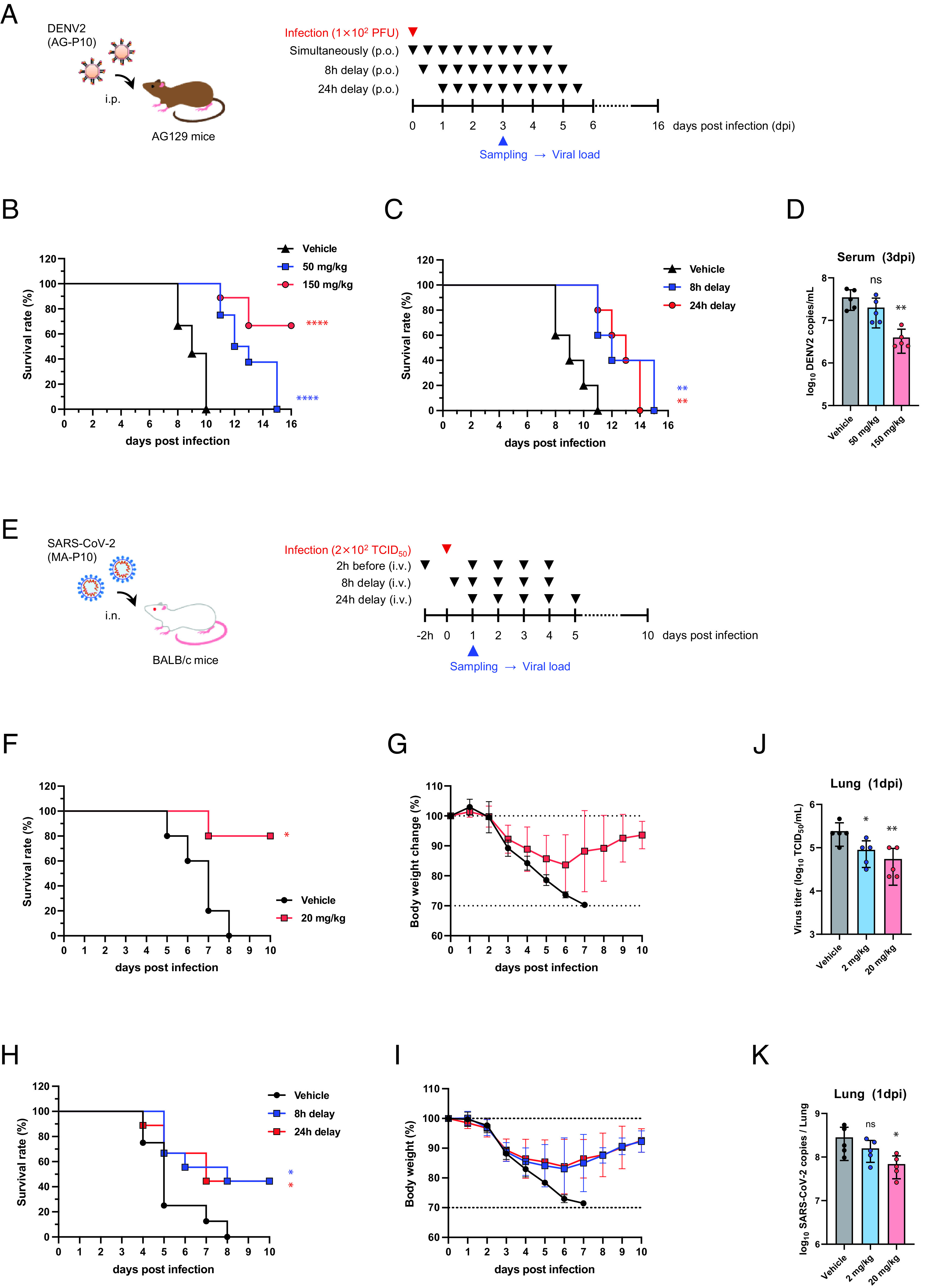
In vivo efficacy of s2U in the DENV2 and SARS-CoV-2 mouse model. (A) Schematic representation of the survival and viremia studies using AG129 mice and strain DENV2 AG-P10. (B) Effect of s2U on survival of DENV2 AG-P10-infected (1 × 10² plaque-forming units (PFU)] mice (7-wk-old, female) orally treated twice daily with s2U (50 or 150 mg/kg) compared with vehicle-treated mice. Treatment started immediately after infection. Data are from two independent studies with 9 (in total, vehicle and 150 mg/kg) or 8 (in total, 50 mg/kg) mice per group. (C) Effect of s2U on survival of DENV2 AG-P10-infected (1 × 10² PFU) mice (7-wk-old, female) orally treated twice daily with s2U (150 mg/kg) compared with vehicle-treated mice. Treatment started 8 or 24 h after infection (n = 5 per group). (D) Effect of s2U on viremia at 3 dpi in mice treated twice daily with s2U (50 or 150 mg/kg) compared with vehicle-treated mice (n = 5 per group, 7-wk-old, male). Viral RNA copies/mL of serum samples were quantified using qRT-PCR. (E) Schematic representation of the survival and viremia studies using BALB/c mice and SARS-CoV-2 MA-P10. (FI) Effect of s2U on survival and body weight change in SARS-CoV-2 MA-P10-infected [2 × 10² 50% tissue culture infection dose (TCID50)] mice intravenously administered 20 mg/kg s2U daily compared with vehicle-treated mice [n = 5 (F and G), n = 8 (H and I, vehicle), and n = 9 (H and I, s2U) per group, 30- to 50-wk-old, female]. Treatment was started 2 h before (F) and 8 or 24 h after (H) infection. Survival (F and H) and body weight (G and I) of the mice were monitored daily. (J and K) Effect of s2U on viremia at 1 dpi in mice intravenously administered 2 or 20 mg/kg s2U daily compared with vehicle-treated mice (n = 5 per group, 5-wk-old, female). Virus titers in lung samples (J) were quantified by a standard TCID50 assay using VeroE6/TMPRSS2 cells. Viral RNA copies/mL in lung samples (K) were quantified using qRT-PCR. Data are presented as mean values, and error bars indicate SD. Statistically significant differences between the s2U-treated and vehicle-treated groups were determined using a log-rank (Mantel–Cox) test (B, F, and H) and one-way ANOVA followed by Dunnett’s multiple comparisons tests (D, J, and K); *P < 0.01, **P < 0.005, and ****P < 0.0001.

References

    1. COVID-19 Dashboard by the Center for Systems Science and Engineering at Johns Hopkins University. https://coronavirus.jhu.edu/map.html. Accessed 13 March 2023.
    1. Pierson T. C., Diamond M. S., The continued threat of emerging flaviviruses. Nat. Microbiol. 5, 796–812 (2020). - PMC - PubMed
    1. Zaid A., et al. , Arthritogenic alphaviruses: Epidemiological and clinical perspective on emerging arboviruses. Lancet Infect. Dis. 21, e123–e133 (2021). - PubMed
    1. Witkowski J. T., Robins R. K., Sidwell R. W., Simon L. N., Design, synthesis, and broad spectrum antiviral activity of 1-(β-D-ribofuranosyl-1,2,4-triazole-3-carboxamidef and related nucleosides. J. Med. Chem. 15, 1150–1154 (1972). - PubMed
    1. Huggins J. W., Prospects for treatment of viral hemorrhagic fevers with ribavirin, a broad-spectrum antiviral drug. Rev. Infect. Dis. 11, 750–761 (1989). - PubMed

Publication types