. 2023 Oct 13;13(1):17337.
doi: 10.1038/s41598-023-44565-x.

BNT162b2 vaccine induced variant-specific immunity, safety and risk of Omicron breakthrough infection in children aged 5 to 11 years: a cohort study

Affiliations

BNT162b2 vaccine induced variant-specific immunity, safety and risk of Omicron breakthrough infection in children aged 5 to 11 years: a cohort study

Chee Fu Yung et al. Sci Rep. .

Abstract

There is little information on BNT162b2 vaccine-induced variant-specific immunogenicity, safety data and dynamics of breakthrough infections in pediatric populations. We addressed these questions using a prospective two dose BNT162b2 (10 mcg) vaccination cohort study of healthy children 5-11 years in Singapore. Follow up included blood samples at scheduled visits, daily vaccination symptom diary and confirmation of SARS-CoV-2 infection. Surrogate virus neutralization test (sVNT) and spike-specific T cell responses against SARS-CoV-2 variants were performed. The mean age of 127 participants was 8.27 years (SD 1.95) and 51.2% were males. The median sVNT level against original variant after 1 dose and 2 dose vaccination was 61.4% and 95.1% respectively (p < 0.0001). Neutralizing antibodies against the Omicron variant was the lowest, median 22.4% (IQR 16.5-30.8). However, T cell IFN-γ cytokine response against Omicron variant was high and remained so about 4 months after vaccination. Fever rate increased significantly from 4% (dose 1) to 11.5% (dose 2). The risk of Omicron breakthrough infection decreased by 7.8% for every 1% increase in sVNT inhibition level measured after dose 2 vaccination. BNT162b2 vaccines were safe, induced good T cell responses but poor neutralizing antibodies against Omicron in children. Low neutralizing antibody levels post-vaccination was predictive of subsequent breakthrough infection.


Conflict of interest statement

CFY has received funding to attend conferences and honorarium from Sanofi, Pfizer and Takeda outside the current work. All other authors report nil conflict of interest.

Figures
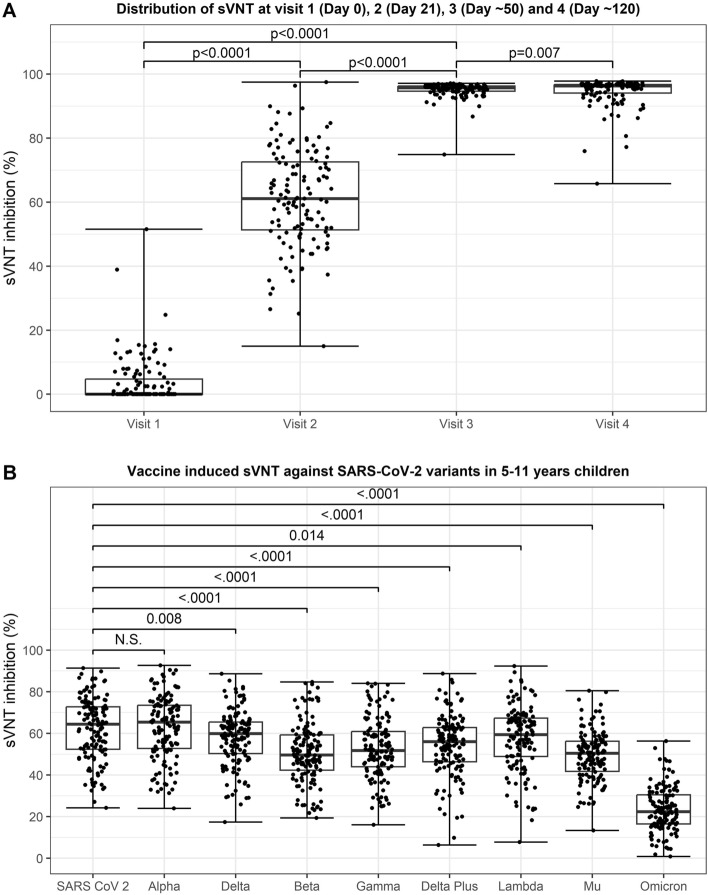
Figure 1
Figure 1
Surrogate virus neutralization test (sVNT) after vaccination in children 5–11 years. (A) Distribution of sVNT at visit 1 (Day 0), 2 (Day 21), 3 (Day ~50) and 4 (Day ~120). (B) Vaccine induced sVNT against SARS-CoV-2 variants after the second dose at Visit 3 (Day ~50) in 5–11 years children.
Figure 2
Figure 2
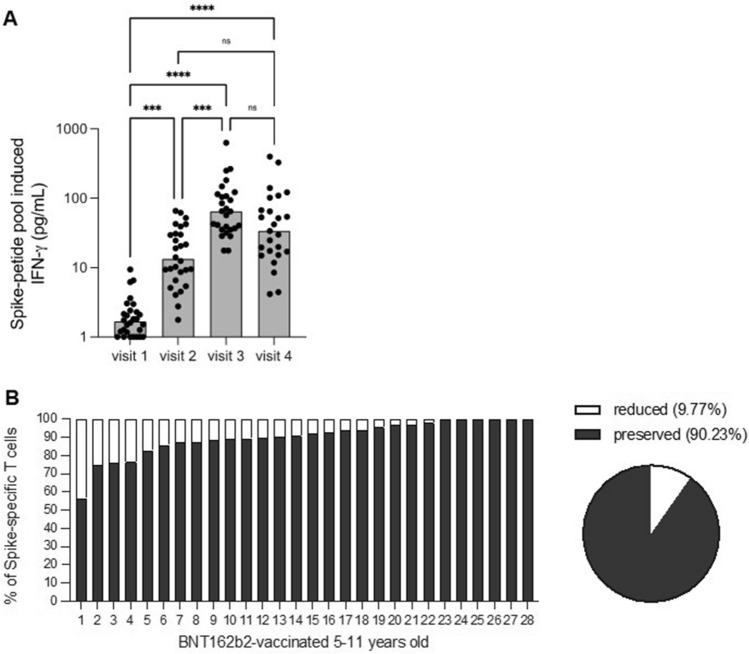
Spike-specific T cell responses in vaccinated children. (A) IFN-γ secretion profile of whole-blood cultures stimulated with Spike protein peptide pool compared at different time points of paired samples from vaccinated individuals (n = 28). The limit of detection for IFN‐γ = 1.7 pg/ml. Values below limit of detection levels were plotted as 1. The mean values of each group are represented by a red line and were at visit 1, 2, 3 and 4: 1.7 pg/ml, 13.3 pg/ml, 64.8 pg/ml and 33.8 pg/ml of IFN‐γ, respectively. (B) PBMC of 5–11 years old children (n = 28) were tested on day 49 for their ability to respond to the Omicron variant of SARS-CoV-2 using IFN-γ ELISpot assays. Bars represent each individual; pie chart shows the mean reduction in the T cell response to Omicron.
Figure 3
Figure 3
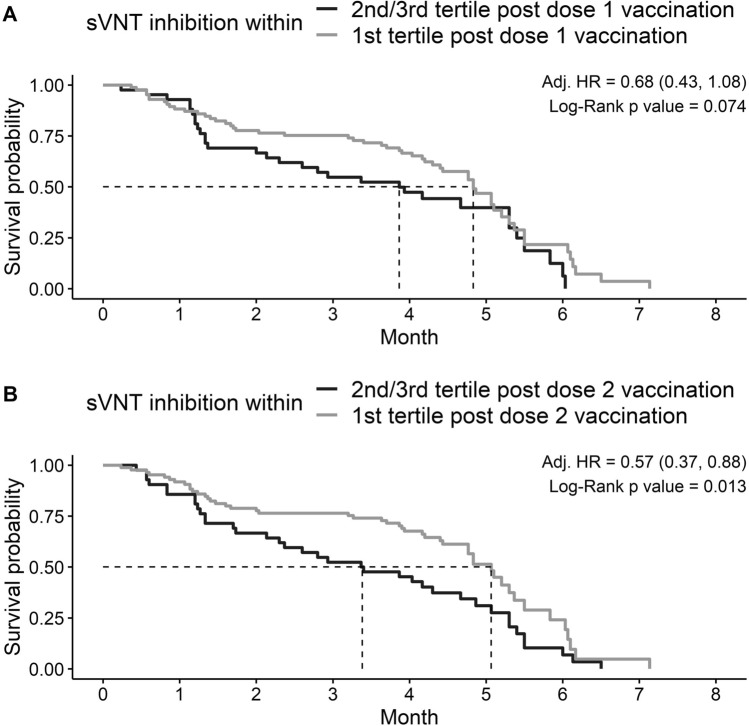
Kaplan–Meier plot of neutralizing antibodies (sVNT) post dose 1 (A) and dose 2 (B) versus time to SARS-CoV-2 infection.

References

    1. Wong JJM, Yung CF, PACCOVRA Investigators of the PACCMAN Research Group Comparative analysis of pediatric COVID-19 infection in Southeast Asia, South Asia, Japan, and China. Am. J. Trop. Med. Hyg. 2021;105:413–420. doi: 10.4269/ajtmh.21-0299. - DOI - PMC - PubMed
    1. Li J, et al. Comparative analysis of symptomatic and asymptomatic SARS-CoV-2 infection in children. Ann. Acad. Med. Singap. 2020;49:530–537. doi: 10.47102/annals-acadmedsg.2020257. - DOI - PubMed
    1. Viner RM, et al. Susceptibility to SARS-CoV-2 infection among children and adolescents compared with adults: A systematic review and meta-analysis. JAMA Pediatr. 2021;175:143–156. doi: 10.1001/jamapediatrics.2020.4573. - DOI - PMC - PubMed
    1. Nadua KD, et al. Multisystem inflammatory syndrome in children in Singapore. Ann. Acad. Med. Singap. 2022;51:669–676. doi: 10.47102/annals-acadmedsg.202283. - DOI - PubMed
    1. Barda N, et al. Effectiveness of a third dose of the BNT162b2 mRNA COVID-19 vaccine for preventing severe outcomes in Israel: An observational study. Lancet. 2021;398:2093–2100. doi: 10.1016/S0140-6736(21)02249-2. - DOI - PMC - PubMed

Publication types

Supplementary concepts