


Prognostic significance of the stress hyperglycemia ratio in critically ill patients
- PMID: 37833697
- PMCID: PMC10576399
- DOI: 10.1186/s12933-023-02005-0
Prognostic significance of the stress hyperglycemia ratio in critically ill patients
Erratum in
-
Correction to: Prognostic significance of the stress hyperglycemia ratio in critically ill patients.Cardiovasc Diabetol. 2024 Dec 6;23(1):434. doi: 10.1186/s12933-024-02528-0. Cardiovasc Diabetol. 2024. PMID: 39643894 Free PMC article. No abstract available.
Abstract
Background: The stress hyperglycemia ratio (SHR) has demonstrated a noteworthy association with unfavorable cardiovascular clinical outcomes and heightened in-hospital mortality. Nonetheless, this relationship in critically ill patients remains uncertain. This study aims to elucidate the correlation between SHR and patient prognosis within the critical care setting.
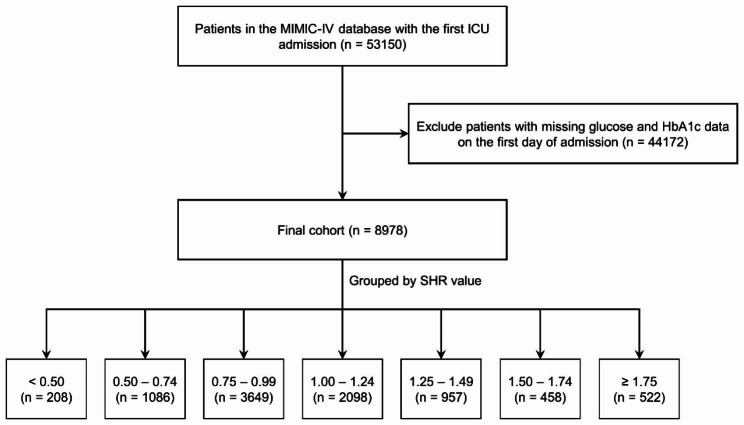
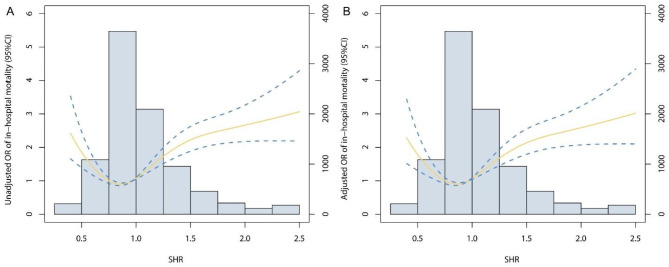
Methods: A total of 8978 patients admitted in intensive care unit (ICU) were included in this study. We categorized SHR into uniform groups and assessed its relationship with mortality using logistic or Cox regression analysis. Additionally, we employed the restricted cubic spline (RCS) analysis method to further evaluate the correlation between SHR as a continuous variable and mortality. The outcomes of interest in this study were in-hospital and 1-year all-cause mortality.
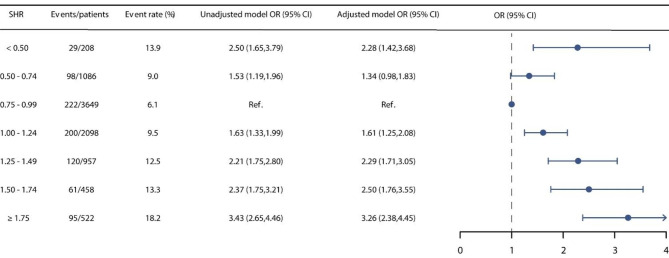
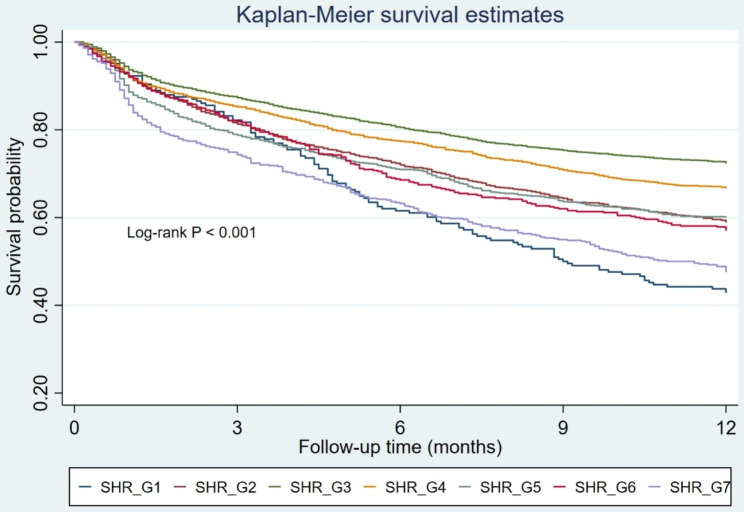
Results: In this investigation, a total of 825 (9.2%) patients experienced in-hospital mortality, while 3,130 (34.9%) individuals died within the 1-year follow-up period. After adjusting for confounding variables, we identified a U-shaped correlation between SHR and both in-hospital and 1-year mortality. Specifically, within the SHR range of 0.75-0.99, the incidence of adverse events was minimized. For each 0.25 increase in the SHR level within this range, the risk of in-hospital mortality rose by 1.34-fold (odds ratio [OR]: 1.34, 95% CI: 1.25-1.44), while a 0.25 decrease in SHR within 0.75-0.99 range increased risk by 1.38-fold (OR: 1.38, 95% CI: 1.10-1.75).
Conclusion: There was a U-shaped association between SHR and short- and long-term mortality in critical ill patients, and the inflection point of SHR for poor prognosis was identified at an SHR value of 0.96.
Keywords: Critical ill; Outcomes; Restricted cubic spline; Stress hyperglycemia ratio.
© 2023. BioMed Central Ltd., part of Springer Nature.
Conflict of interest statement
The authors declare no competing interests.
Figures
References
Publication types
MeSH terms
LinkOut - more resources
Full Text Sources
Medical
