


Metallic Nanoparticles: A Promising Arsenal against Antimicrobial Resistance-Unraveling Mechanisms and Enhancing Medication Efficacy
- PMID: 37834344
- PMCID: PMC10573543
- DOI: 10.3390/ijms241914897
Metallic Nanoparticles: A Promising Arsenal against Antimicrobial Resistance-Unraveling Mechanisms and Enhancing Medication Efficacy
Abstract
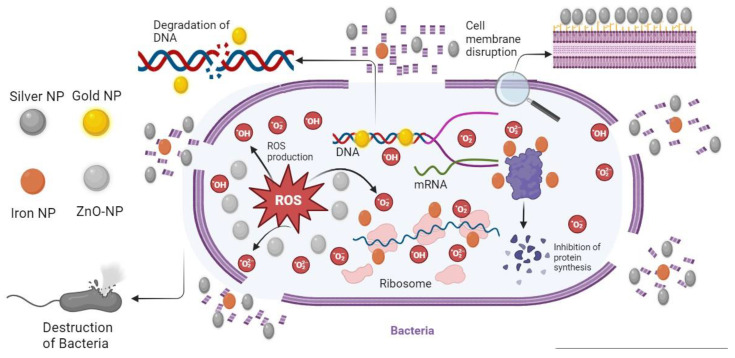
The misuse of antibiotics and antimycotics accelerates the emergence of antimicrobial resistance, prompting the need for novel strategies to combat this global issue. Metallic nanoparticles have emerged as effective tools for combating various resistant microbes. Numerous studies have highlighted their potential in addressing antibiotic-resistant fungi and bacterial strains. Understanding the mechanisms of action of these nanoparticles, including iron-oxide, gold, zinc oxide, and silver is a central focus of research within the life science community. Various hypotheses have been proposed regarding how nanoparticles exert their effects. Some suggest direct targeting of microbial cell membranes, while others emphasize the release of ions from nanoparticles. The most compelling proposed antimicrobial mechanism of nanoparticles involves oxidative damage caused by nanoparticles-generated reactive oxygen species. This review aims to consolidate knowledge, discuss the properties and mechanisms of action of metallic nanoparticles, and underscore their potential as alternatives to enhance the efficacy of existing medications against infections caused by antimicrobial-resistant pathogens.
Keywords: antibacterial resistance strains; antifungal resistance strains; metallic nanoparticles.
Conflict of interest statement
The authors declare no conflict of interest.
Figures
References
-
- Dhingra S., Rahman N.A.A., Peile E., Rahman M., Sartelli M., Hassali M.A., Islam T., Islam S., Haque M. Microbial Resistance Movements: An Overview of Global Public Health Threats Posed by Antimicrobial Resistance, and How Best to Counter. Front. Public Health. 2020;8:535668. doi: 10.3389/fpubh.2020.535668. - DOI - PMC - PubMed
Publication types
MeSH terms
Substances
Grants and funding
LinkOut - more resources
Full Text Sources
