Review
. 2023 Sep 22;12(19):6124.
doi: 10.3390/jcm12196124.

Exploring CAR-T Cell Therapy Side Effects: Mechanisms and Management Strategies

Affiliations
Review

Exploring CAR-T Cell Therapy Side Effects: Mechanisms and Management Strategies

Yugu Zhang et al. J Clin Med. .

Abstract

Chimeric antigen receptor (CAR) T cell therapy has revolutionized the treatment of malignancies, especially hematological tumors, but toxicities have tempered its success. The main impediments to the development of CAR-T cell therapies are the following: cytokine release syndrome (CRS), immune-effector-cell-associated neurotoxicity syndrome (ICANS), tumor lysis syndrome (TLS), and on-target/off-tumor toxicity (OTOT). This review summarizes these side effects' underlying mechanisms and manifestations over time. It provides potential prevention and treatment according to the consensus grading, stressing the significance of establishing strategies that anticipate, reduce, and navigate the beginning of these side effects. It is essential to fully comprehend the mechanisms underlying these toxicities to create efficient treatment and preventive approaches.

Keywords: CAR-T cell; cytokine release syndrome; immune-effector-cell-associated neurotoxicity syndrome; management; mechanisms; strategies.


Conflict of interest statement

The authors have no other relevant affiliations or financial involvement with any organization or entity with a financial interest in or financial conflict with the subject matter or materials discussed in the manuscript apart from those disclosed.

Figures
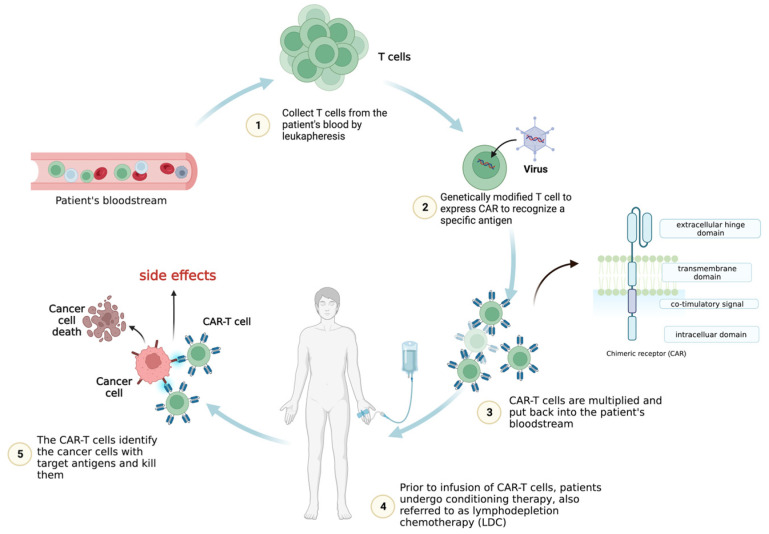
Figure 1
Figure 1
CAR-T cell therapy. The CAR-T cells are expanded before infusion into the patient’s bloodstream following lymphodepletion chemotherapy (LDC). Once in the body, the genetically modified chimeric antigen receptors (CARs) allow the T cells collected from the patient to recognize and attack cancer cells expressing specific antigens.
Figure 2
Figure 2
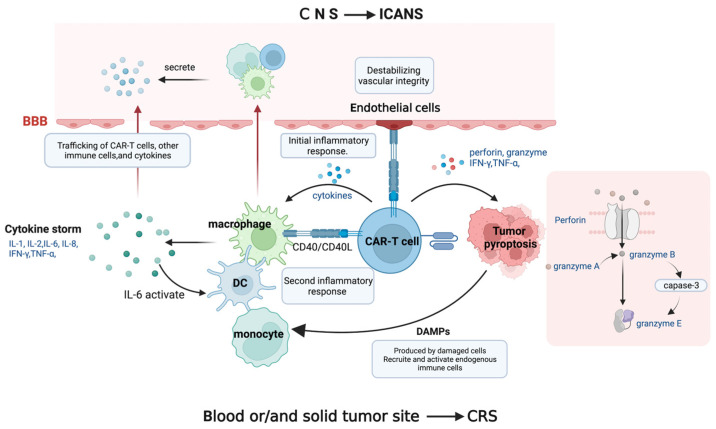
The underlying mechanisms of CRS and ICANS. CAR-T cells produce cytokine storm, which activates bystander immune cells. When CD40L on CAR-T cells interacts with CD40 on immune cells and endothelial cells, an inflammatory response occurs, with interleukin-6 (IL-6) playing a major role in the cytokine release positive feedback loop, compromising vascular integrity. The perforin produced by CAR-T cells induces tumor pyroptosis, releasing danger-associated molecular patterns (DAMPs). CAR-T cells, immune cells, and cytokines can penetrate the disrupted blood–brain barrier (BBB) and trigger inflammatory reactions in the central nervous system (CNS), resulting in neuronal injury.
Figure 3
Figure 3
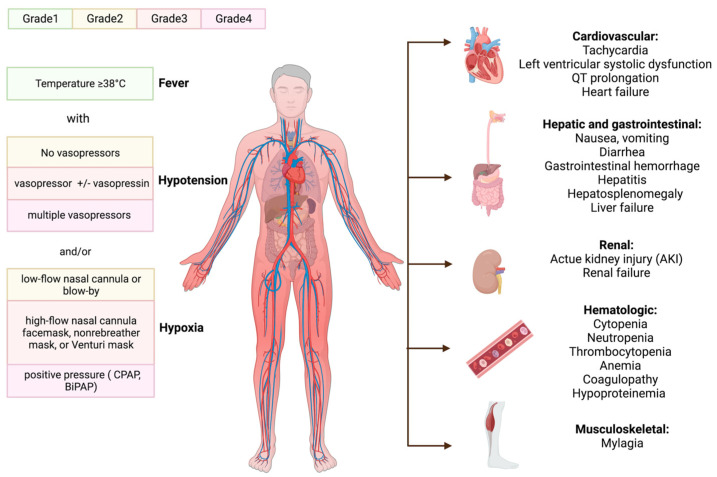
The manifestations of CRS and ASTCT CRS consensus grading. The initial fever may progress to numerous hematologic and organ toxicities before the clinical signs of cytokine release syndrome (CRS) appear. ASTCT classified it into four grades based on its chief manifestation: hypoxia, hypotension, and fever. Continuous positive pressure airway (CPAP); bilevel positive airway pressure (BiPAP).
Figure 4
Figure 4
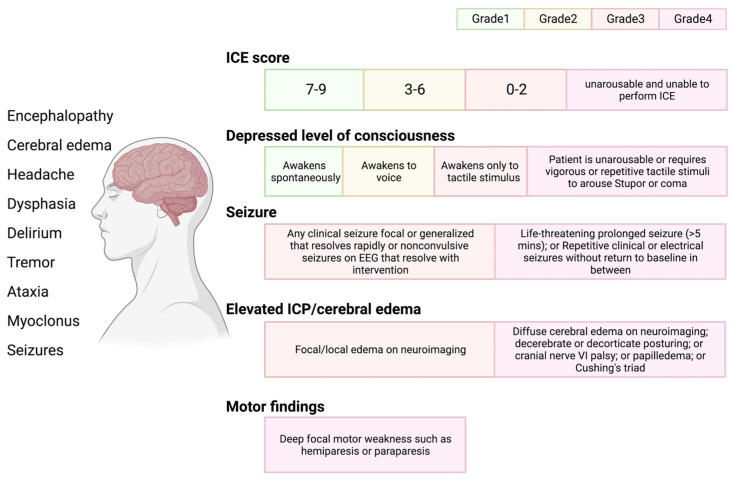
ICANS and ASTCT CRS consensus grading for adults. Immune effector cell associated neurotoxicity syndrome (ICANS) includes multiple distinct neurologic symptoms. ASTCT graded ICANS into four categories based on an immune effector cell associated encephalopathy (ICE) score: depressed level of consciousness, seizure, elevated intracranial pressure (ICP)/cerebral edema, and motor findings.

References

    1. Jayaraman J., Mellody M.P., Hou A.J., Desai R.P., Fung A.W., Pham A.H.T., Chen Y.Y., Zhao W. CAR-T Design: Elements and Their Synergistic Function. EBioMedicine. 2020;58:102931. doi: 10.1016/j.ebiom.2020.102931. - DOI - PMC - PubMed
    1. Gill S., Maus M.V., Porter D.L. Chimeric Antigen Receptor T Cell Therapy: 25years in the Making. Blood Rev. 2016;30:157–167. doi: 10.1016/j.blre.2015.10.003. - DOI - PubMed
    1. Fesnak A.D., June C.H., Levine B.L. Engineered T Cells: The Promise and Challenges of Cancer Immunotherapy. Nat. Rev. Cancer. 2016;16:566–581. doi: 10.1038/nrc.2016.97. - DOI - PMC - PubMed
    1. Raje N., Berdeja J., Lin Y., Siegel D., Jagannath S., Madduri D., Liedtke M., Rosenblatt J., Maus M.V., Turka A., et al. Anti-BCMA CAR T-Cell Therapy Bb2121 in Relapsed or Refractory Multiple Myeloma. N. Engl. J. Med. 2021;380:1726–1737. doi: 10.1056/NEJMoa1817226. - DOI - PMC - PubMed
    1. Wei J., Guo Y., Wang Y., Wu Z., Bo J., Zhang B., Zhu J., Han W. Clinical Development of CAR T Cell Therapy in China: 2020 Update. Cell Mol. Immunol. 2021;18:792–804. doi: 10.1038/s41423-020-00555-x. - DOI - PMC - PubMed

LinkOut - more resources