


Metabolic Dysfunction-Associated Steatotic Liver Disease and Metabolic Dysfunction-Associated Steatohepatitis: The Patient and Physician Perspective
- PMID: 37834859
- PMCID: PMC10573476
- DOI: 10.3390/jcm12196216
Metabolic Dysfunction-Associated Steatotic Liver Disease and Metabolic Dysfunction-Associated Steatohepatitis: The Patient and Physician Perspective
Abstract
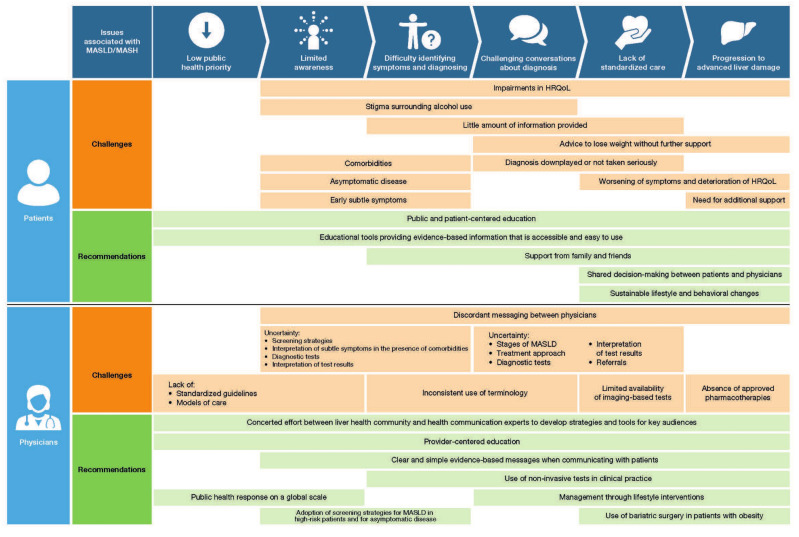
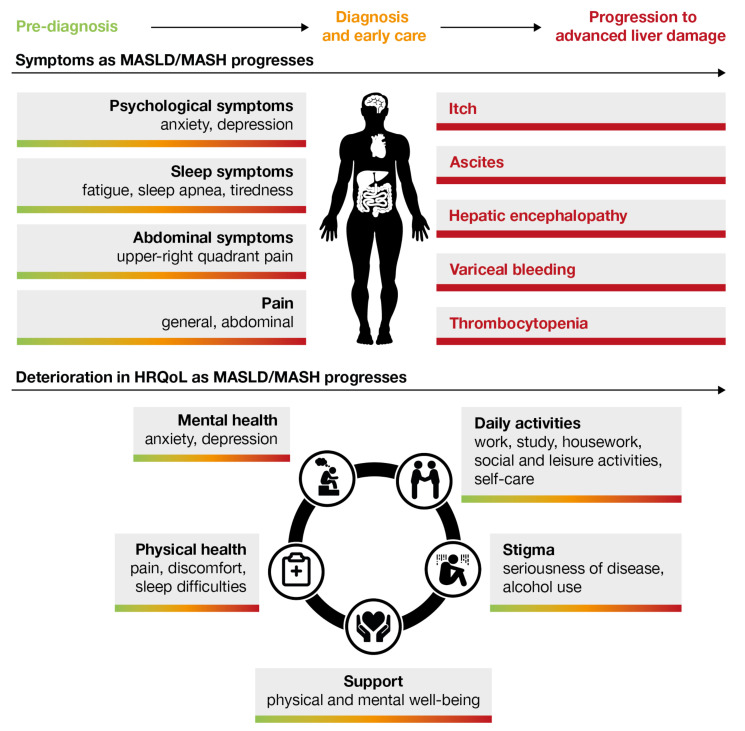
Diagnosing and managing metabolic dysfunction-associated steatotic liver disease (MASLD) remains a major challenge in primary care due to lack of agreement on diagnostic tools, difficulty in identifying symptoms and determining their cause, absence of approved pharmacological treatments, and limited awareness of the disease. However, prompt diagnosis and management are critical to preventing MASLD from progressing to more severe forms of liver disease. This highlights the need to raise awareness and improve understanding of MASLD among both patients and physicians. The patient perspective is invaluable to advancing our knowledge of this disease and how to manage it, as their perspectives have led to the growing recognition that patients experience subtle symptoms and that patient-reported outcomes should be incorporated into drug development. This review and expert opinion examine MASLD and metabolic dysfunction-associated steatohepatitis from the patient and physician perspective from pre-diagnosis to diagnosis and early care, through to progression to advanced liver damage. Specifically, the paper dives into the issues patients and physicians experience, and, in turn, what is required to improve diagnosis and management, including tips and tools to empower patients and physicians dealing with MASLD.
Keywords: advocacy; cirrhosis; fatty liver; liver disease; metabolic dysfunction-associated steatohepatitis; metabolic dysfunction-associated steatotic liver disease; outcome; primary care physicians; quality of life.
Conflict of interest statement
A.G. has no conflict of interest for this project. A.G. has participated in advisory boards for Boehringer Ingelheim and Novo Nordisk; has served as a consultant for Fractyl, Inventiva, Merck Sharp & Dohme, and Pfizer; has received unrestricted educational grants from Eli Lilly, Gilead, and Novo Nordisk and honoraria and other fees as a speaker for Eli Lilly and Novo Nordisk. A.J.S. has no conflict of interest for this project. A.J.S. has stock options in Durect, Exhalenz, Galmed, Genfit, Indalo, Inversago, and Tiziana; has served as a consultant for Alnylam, Amgen, AstraZeneca, Blade, Boehringer Ingelheim, Bristol Myers Squibb, Eli Lilly, Genentech, Gilead Sciences, Hanmi, Hemoshear, Histoindex, Intercept, Janssen, LG Chem, Lipocine, Merck, Novartis, Novo Nordisk, Path AI, Pfizer, Pharmanest, Poxel, Regeneron, Salix, Siemens, Surrozen, Takeda, Terns Pharmaceuticals, Tobira, and Valeant; his institution has received grant support from Akero, AstraZeneca, Bristol Myers Squibb, Echosense, Eli Lilly, Gilead Sciences, Hanmi, Intercept, Malinckrodt, Merck, Novartis, Novo Nordisk, and Salix; and he receives royalties from Elsevier and UptoDate. A.M.A. is a consultant for Novo Nordisk and has received research funding from Galmed, Pfizer, and Target Pharma. D.R.H.C. is an employee of the Global Liver Institute, which convenes the NASH Council, and has received grants and sponsorships from several companies in the NASH therapeutic space. H.M. has received grant support from LISCure. J.M.S. is a consultant for Albireo Pharma Inc., Apollo Endosurgery, Bayer, Boehringer Ingelheim, Bristol Myers Squibb, Echosens, Genfit, Gilead Sciences, GSK, Heel GmbH, Intercept Pharmaceuticals, Inventiva Pharma, Ipsen, Madrigal Pharmaceuticals, Merck, Nordic Bioscience, Novartis, Novo Nordisk, Pfizer, Roche, Sanofi, and Siemens Healthcare GmbH; has received research funding from Boehringer Ingelheim, Gilead Sciences, Nordic Bioscience, and Siemens Healthcare GmbH; and has received honoraria as a speaker for Boehringer Ingelheim and MedPublico GmbH. M.N. has advised for 89BIO, Abbott, Allergan, Blade, EchoSens, Fractyl, Gilead Sciences, Intercept, Novartis, Novo Nordisk, OWL, Roche Diagnostics, Siemens, and Terns; has received research support from Allergan, Bristol Myers Squibb, Conatus, Enanta, Galectin, Galmed, Genfit, Gilead Sciences, Madrigal, Novartis, Shire, Viking, and Zydus; and is a shareholder of, or has stocks in, Anaetos and Viking. W.E. is affiliated with the Fatty Liver Foundation, which has received program support and educational grants from 89Bio, Allergan, Bristol Myers Squibb, Celgene, Clinical Care Options, Continuum Clinical, Echosens, Eskridge Family Trust, Fibronostics, Gilead Sciences, Google, Health Business Solutions, Intercept Pharmaceuticals, Madrigal Pharmaceuticals, NetNoggin, Pfizer, Prosciento, Terns Pharmaceuticals, and various private and philanthropic individual donors.
Figures
References
-
- Chalasani N., Younossi Z., Lavine J.E., Charlton M., Cusi K., Rinella M., Harrison S.A., Brunt E.M., Sanyal A.J. The diagnosis and management of nonalcoholic fatty liver disease: Practice guidance from the American Association for the Study of Liver Diseases. Hepatology. 2018;67:328–357. doi: 10.1002/hep.29367. - DOI - PubMed
-
- Schattenberg J.M., Lazarus J.V., Newsome P.N., Serfaty L., Aghemo A., Augustin S., Tsochatzis E., de Ledinghen V., Bugianesi E., Romero-Gomez M., et al. Disease burden and economic impact of diagnosed non-alcoholic steatohepatitis in five European countries in 2018: A cost-of-illness analysis. Liver Int. 2021;41:1227–1242. doi: 10.1111/liv.14825. - DOI - PMC - PubMed
Publication types
LinkOut - more resources
Full Text Sources
Other Literature Sources
