. 2023 Sep 30;15(19):4229.
doi: 10.3390/nu15194229.

Ex Vivo Colonic Fermentation of NUTRIOSE® Exerts Immuno-Modulatory Properties and Strong Anti-Inflammatory Effects

Affiliations

Ex Vivo Colonic Fermentation of NUTRIOSE® Exerts Immuno-Modulatory Properties and Strong Anti-Inflammatory Effects

Caroline Perreau et al. Nutrients. .

Abstract

NUTRIOSE® (Roquette, Lestrem, France) is a resistant dextrin with well-established prebiotic effects. This study evaluated the indirect effects of pre-digested NUTRIOSE® on host immune response and gut barrier integrity. Fecal samples from eight healthy donors were inoculated in a Colon-on-a-plate® system (ProDigest, Ghent, Belgium) with or without NUTRIOSE® supplementation. Following 48 h fermentation, colonic suspensions were tested in a Caco-2/THP1-Blue™ co-culture system to determine their effects on gut barrier activity (transepithelial electrical resistance) and immune response following lipopolysaccharide stimulation. Additionally, changes in short-chain fatty acid levels (SCFA) and microbial community composition following a 48 h fermentation in the Colon-on-a-plate® system were measured. Across all donors, immune-mediated intestinal barrier damage was significantly reduced with NUTRIOSE®-supplemented colonic suspensions versus blank. Additionally, IL-6 and IL-10 levels were significantly increased, and the level of the neutrophil chemoattractant IL-8 was significantly decreased with NUTRIOSE®-supplemented colonic suspensions versus blank in the co-culture models following lipopolysaccharide stimulation. These beneficial effects of NUTRIOSE® supplementation were likely due to increased acetate and propionate levels and the enrichment of SCFA-producing bacteria. NUTRIOSE® was well fermented by the colonic bacteria of all eight donors and had protective effects on inflammation-induced disruption of the intestinal epithelial barrier and strong anti-inflammatory effects.

Keywords: Colon-on-a-plate; anti-inflammatory; immunomodulation; prebiotic; resistant dextrin; short-chain fatty acid.


Conflict of interest statement

Authors are employees of Roquette (C.P. and C.T.) or ProDigest (L.V., J.G., and M.M.) as indicated by our affiliations. This work and the article processing charge were funded by Roquette. ProDigest is a company based in Ghent, Belgium which specializes in offering pre-clinical services to food and functional food companies. The funders were involved in the design of the study, in the writing of the manuscript, and in the decision to publish the results.

Figures
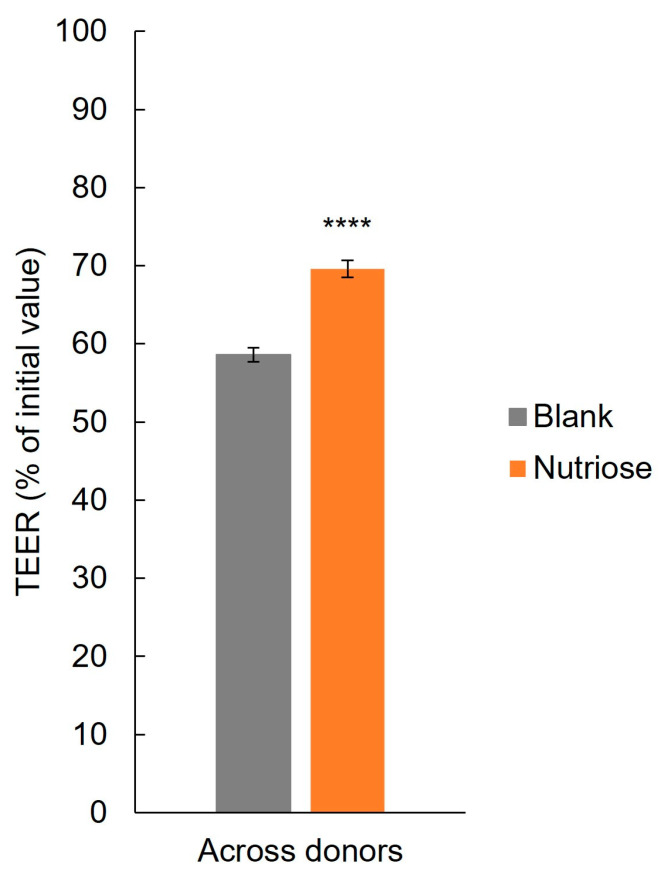
Figure 1
Figure 1
Barrier integrity of Caco-2 cells after exposure to colonic suspensions. **** p < 0.0001 for differences between the NUTRIOSE®-supplemented and blank samples. Data are plotted as mean (all 8 donors) ± standard error of the mean; TEER = transepithelial electric resistance.
Figure 2
Figure 2
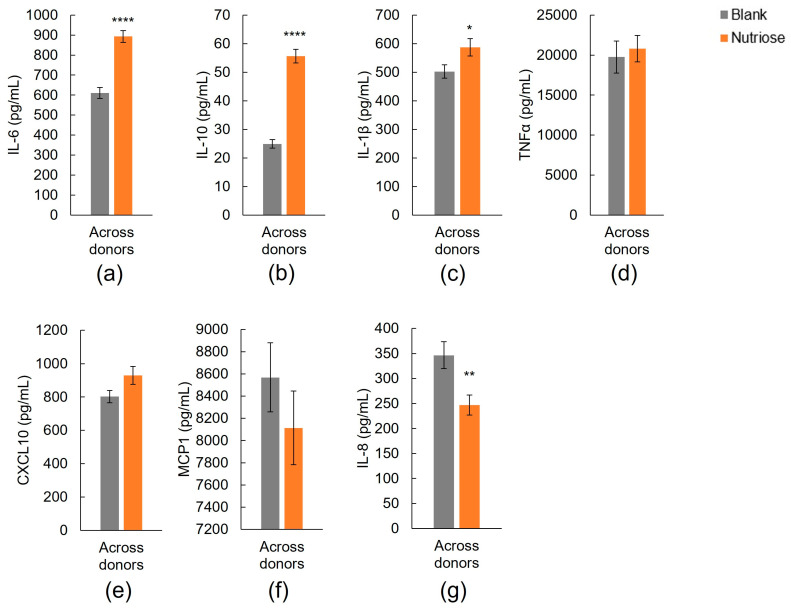
Effect of colonic suspensions on release of (a) IL-6, (b) IL-10, (c) IL-1β, (d) TNF-α, (e) CXCL10, (f) MCP1, and (g) IL-8 by PMA-treated THP1-blue™ cells after LPS stimulation in the Caco-2/THP1-blue™ co-culture model. * p < 0.05, ** p < 0.01, **** p < 0.0001 for differences between the NUTRIOSE®-supplemented and blank samples. Data are plotted as mean (all 8 donors) ± standard error of the mean. LPS = lipopolysaccharide.
Figure 3
Figure 3
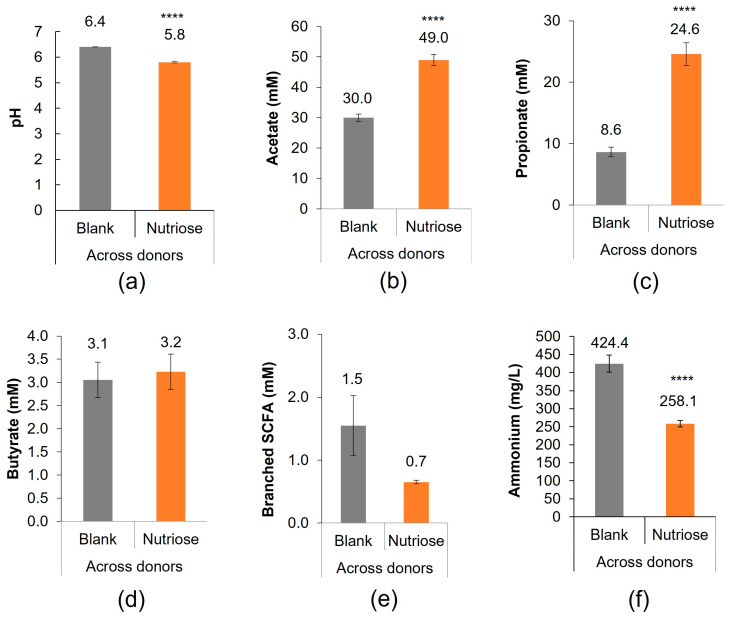
Overall microbial community activity (acidification) and microbial metabolic activity shown as (a) pH, (b) acetate, (c) propionate, (d) butyrate, (e) branched SCFA, and (f) ammonium at 48 h. Measurements were collected in triplicate. **** p < 0.0001 for differences between the NUTRIOSE®-supplemented and blank samples. Data are plotted as mean (all 8 donors) ± standard error of the mean. SCFA = short-chain fatty acid.
Figure 4
Figure 4
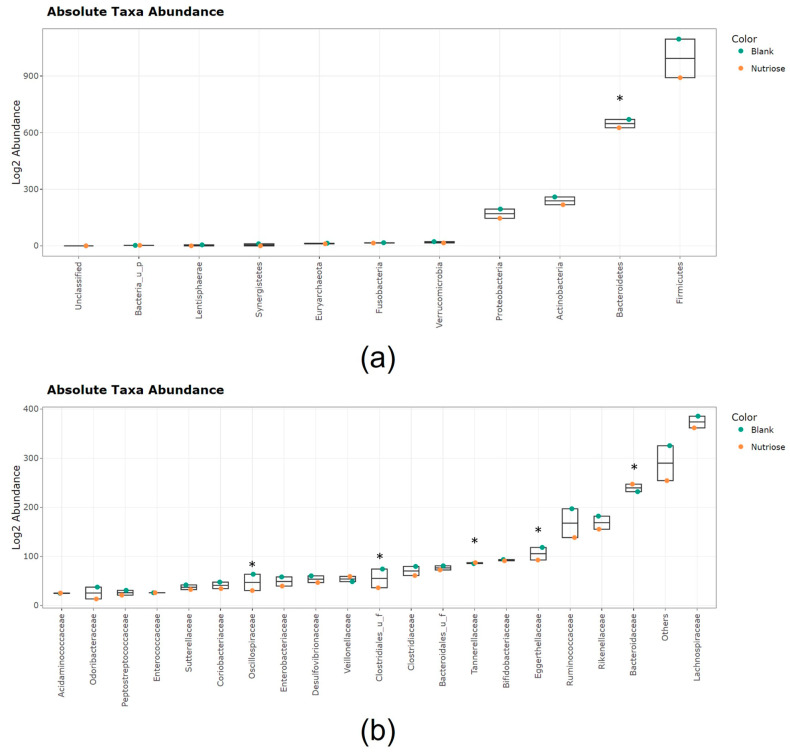
Jitter plots showing average abundances (log2 abundances) at 48 h shown as (a) phylum and (b) family (20 most abundant families; the sum of abundances of the remaining families is categorized as ‘others’). Data for average values were derived using data from all 8 donors. Orange circles represent NUTRIOSE®-supplemented colonic microbiota and the turquoise circles represent blank colonic microbiota. UF, unidentified family. Asterisks indicate phyla/families that were differentially abundant in blank and NUTRIOSE® condition, for which statistical significance was reached based on treeclimbR.
Figure 5
Figure 5
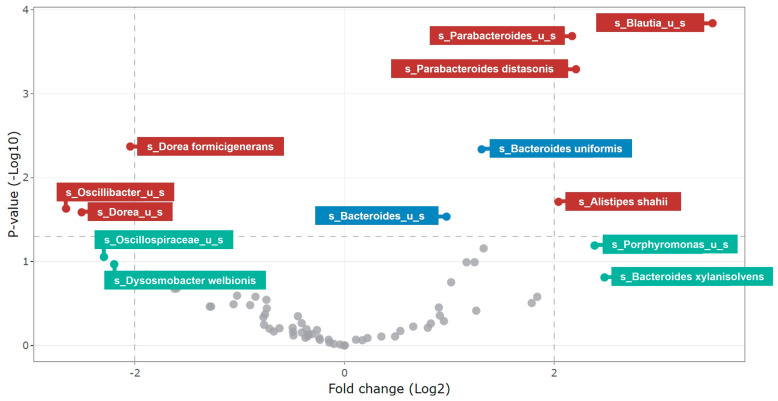
Differential abundance analysis at 48 h using treeblimbR. A p-value of < 0.05 is considered statistically significant and a >4-fold change is considered biologically significant. Maroon circles represent biologically and statistically significant changes, turquoise circles represent biologically significant but not statistically significant changes; gray circles represent non-significant changes; and blue circles represent statistically significant but not biologically significant changes. US = unidentified species.
Figure 6
Figure 6
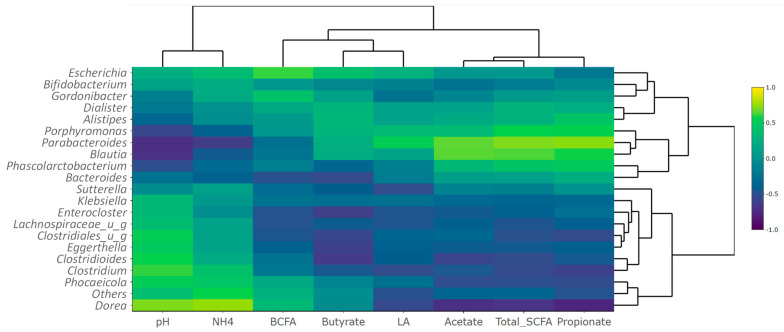
Metabolite-taxon correlation plot at the genus level (20 most abundant genera are shown). Hierarchical clustering of columns (metabolites) and rows (taxa) of the metabolite-taxon heatmaps is based on Euclidean distances (high-dimensional). The heatmaps were made into dendrograms using complete-linkage clustering. UG = unidentified genus.

References

    1. Vallianou N., Christodoulatos G.S., Karampela I., Tsilingiris D., Magkos F., Stratigou T., Kounatidis D., Dalamaga M. Understanding the role of the gut microbiome and microbial metabolites in non-alcoholic fatty liver disease: Current evidence and perspectives. Biomolecules. 2021;12:56. doi: 10.3390/biom12010056. - DOI - PMC - PubMed
    1. Frank D.N., St Amand A.L., Feldman R.A., Boedeker E.C., Harpaz N., Pace N.R. Molecular-phylogenetic characterization of microbial community imbalances in human inflammatory bowel diseases. Proc. Natl. Acad. Sci. USA. 2007;104:13780–13785. doi: 10.1073/pnas.0706625104. - DOI - PMC - PubMed
    1. Kostic A.D., Gevers D., Siljander H., Vatanen T., Hyotylainen T., Hamalainen A.M., Peet A., Tillmann V., Poho P., Mattila I., et al. The dynamics of the human infant gut microbiome in development and in progression toward type 1 diabetes. Cell Host Microbe. 2015;17:260–273. doi: 10.1016/j.chom.2015.01.001. - DOI - PMC - PubMed
    1. Clemente J.C., Manasson J., Scher J.U. The role of the gut microbiome in systemic inflammatory disease. BMJ. 2018;360:j5145. doi: 10.1136/bmj.j5145. - DOI - PMC - PubMed
    1. Hevia A., Milani C., Lopez P., Cuervo A., Arboleya S., Duranti S., Turroni F., Gonzalez S., Suarez A., Gueimonde M., et al. Intestinal dysbiosis associated with systemic lupus erythematosus. mBio. 2014;5:e01548-14. doi: 10.1128/mBio.01548-14. - DOI - PMC - PubMed

Grants and funding

LinkOut - more resources