


Non-Invasive Blood Pressure Sensing via Machine Learning
- PMID: 37837172
- PMCID: PMC10574845
- DOI: 10.3390/s23198342
Non-Invasive Blood Pressure Sensing via Machine Learning
Abstract
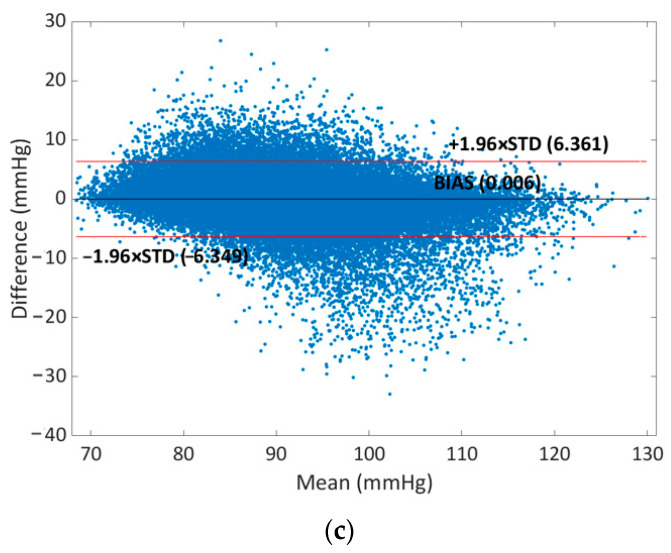
In this paper, a machine learning (ML) approach to estimate blood pressure (BP) using photoplethysmography (PPG) is presented. The final aim of this paper was to develop ML methods for estimating blood pressure (BP) in a non-invasive way that is suitable in a telemedicine health-care monitoring context. The training of regression models useful for estimating systolic blood pressure (SBP) and diastolic blood pressure (DBP) was conducted using new extracted features from PPG signals processed using the Maximal Overlap Discrete Wavelet Transform (MODWT). As a matter of fact, the interest was on the use of the most significant features obtained by the Minimum Redundancy Maximum Relevance (MRMR) selection algorithm to train eXtreme Gradient Boost (XGBoost) and Neural Network (NN) models. This aim was satisfactorily achieved by also comparing it with works in the literature; in fact, it was found that XGBoost models are more accurate than NN models in both systolic and diastolic blood pressure measurements, obtaining a Root Mean Square Error (RMSE) for SBP and DBP, respectively, of 5.67 mmHg and 3.95 mmHg. For SBP measurement, this result is an improvement compared to that reported in the literature. Furthermore, the trained XGBoost regression model fulfills the requirements of the Association for the Advancement of Medical Instrumentation (AAMI) as well as grade A of the British Hypertension Society (BHS) standard.
Keywords: blood pressure (BP); digital health; machine learning (ML); physiological monitoring.
Conflict of interest statement
The authors declare no conflict of interest.
Figures




References
-
- Fan Y., Xu P., Jin H., Ma J., Qin L. Vital Sign Measurement in Telemedicine Rehabilitation Based on Intelligent Wearable Medical Devices. IEEE Access. 2019;7:54819–54823. doi: 10.1109/ACCESS.2019.2913189. - DOI
-
- De Palma L., Attivissimo F., Di Nisio A., Lanzolla A.M.L., Ragolia M.A., Spadavecchia M. Development of a web-based system for interfacing a portable Bluetooth vital sign monitor; Proceedings of the 2022 IEEE International Symposium on Medical Measurements and Applications (MeMeA); Messina, Italy. 22–24 June 2022; pp. 1–6. - DOI
-
- Scarpetta M., Spadavecchia M., Andria G., Ragolia M.A., Giaquinto N. Simultaneous Measurement of Heartbeat Intervals and Respiratory Signal using a Smartphone; Proceedings of the 2021 IEEE International Symposium on Medical Measurements and Applications (MeMeA); Lausanne, Switzerland. 23–25 June 2021; pp. 1–5. - DOI
MeSH terms
LinkOut - more resources
Full Text Sources
Medical
Research Materials
