. 2023 Dec 1;44(17):5892-5905.
doi: 10.1002/hbm.26483. Epub 2023 Oct 14.

dcSBM: A federated constrained source-based morphometry approach for multivariate brain structure mapping

Affiliations

dcSBM: A federated constrained source-based morphometry approach for multivariate brain structure mapping

Debbrata K Saha et al. Hum Brain Mapp. .

Abstract

The examination of multivariate brain morphometry patterns has gained attention in recent years, especially for their powerful exploratory capabilities in the study of differences between patients and controls. Among the many existing methods and tools for the analysis of brain anatomy based on structural magnetic resonance imaging data, data-driven source-based morphometry (SBM) focuses on the exploratory detection of such patterns. Here, we implement a semi-blind extension of SBM, called constrained source-based morphometry (constrained SBM), which enables the extraction of maximally independent reference-alike sources using the constrained independent component analysis (ICA) approach. To do this, we combine SBM with a set of reference components covering the full brain, derived from a large independent data set (UKBiobank), to provide a fully automated SBM framework. This also allows us to implement a federated version of constrained SBM (cSBM) to allow analysis of data that is not locally accessible. In our proposed decentralized constrained source-based morphometry (dcSBM), the original data never leaves the local site. Each site operates constrained ICA on its private local data using a common distributed computation platform. Next, an aggregator/master node aggregates the results estimated from each local site and applies statistical analysis to estimate the significance of the sources. Finally, we utilize two additional multisite patient data sets to validate our model by comparing the resulting group difference estimates from both cSBM and dcSBM.

Keywords: SBM; federated learning; neuroimaging; sMRI.


Conflict of interest statement

The authors declare no conflicts of interest.

Figures

FIGURE 1
FIGURE 1
Flow diagram of decentralized constrained SBM. SBM, source‐based morphometry.
FIGURE 2
FIGURE 2
Correlation plots of loading parameters and sources. Panels (a) and (b) represent the correlation between centralized versus centralized and centralized versus decentralized loading parameters, respectively. Panels (c) and (d) represent the correlation between centralized versus centralized and centralized versus decentralized sources, respectively. Panels (a) and (c) are the expected similarity structures for the centralized loadings and sources, respectively. Panels (b) and (d) are the recovered similarity structures among the centralized and decentralized loadings and sources, respectively. The diagonal exhibits near‐1 correlations, showing that we can successfully estimate sources on data by iterating on locally run computations, allowing analysis of data that cannot be shared centrally.
FIGURE 3
FIGURE 3
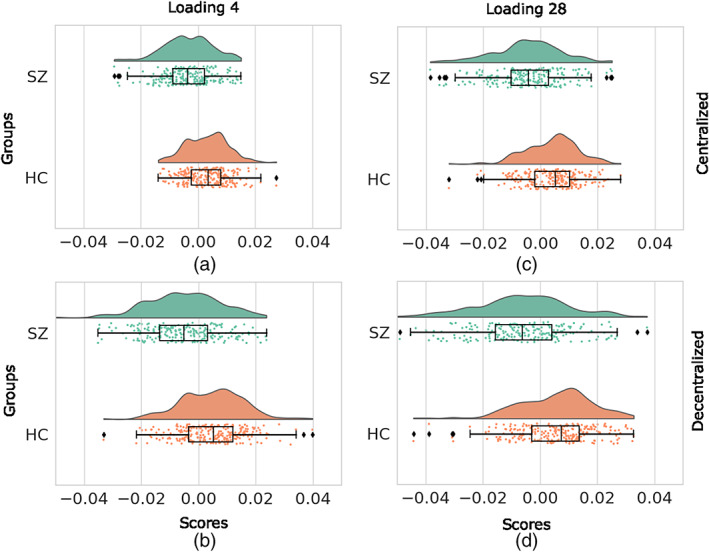
Cloud plot of adjusted loading parameters 4 and 28. Panels (a) and (b) represent the cloud plot of adjusted loading parameters 4 for the centralized and decentralized analysis, respectively. Panels (c) and (d) represent the plot of adjusted loading parameters 28 for the centralized and decentralized analysis, respectively. In each panel, upper plot (Green) and lower (Brown) plots are the clouds of loading score for the patients and healthy controls, respectively.
FIGURE 4
FIGURE 4
Scatter plot between the centralized and decentralized effect sizes. Panels (a), (b), and (c) correspond to variables age, gender, and diagnosis, respectively. Scatter plots of centralized and decentralized effect sizes exhibit high consistency.
FIGURE 5
FIGURE 5
Visual summary of sources with large effect sizes.
FIGURE 6
FIGURE 6
Scatter plot of centralized versus decentralized p values. The values are presented in log–log scale. Panels (a), (b), and (c) correspond to variables age, gender, and diagnosis, respectively. The similar p values for centralized and decentralized analysis indicate high consistency.
FIGURE 7
FIGURE 7
Similarity metrics of loading parameters and sources. Panels (a) and (b) represent the similarity metrics of loading parameters and sources, respectively. The left Y‐axis represents the correlation measure and the right Y‐axis represents mean square error, max absolute error, and median absolute error.
FIGURE 8
FIGURE 8
Similarity metrics for loading parameters and sources. Panels (a) and (b) represent the similarity metrics of loading parameters and sources, respectively, for increasing number of sites. The left Y‐axis and right Y‐axis are utilized for correlation and mean square error (MSE), respectively.
FIGURE 9
FIGURE 9
Similarity metrics for loading parameters. Panels (a) and (b) represent the similarity metrics of loading parameters in centralized and decentralized setups. The left Y‐axis and right Y‐axis are utilized for correlation and mean square error (MSE), respectively.
FIGURE 10
FIGURE 10
Visual summary of components in eight different brain regions: five components in visual (VS), nine in cerebellum (CB), three in frontal (FN), two in default‐mode (DMN), two in subcortical (SC), two in sensorimotor (SM), two in insula (IS), and one in hippocampus (HIP) domain.

References

    1. Abrol, A. , Fu, Z. , Du, Y. , & Calhoun, V. D. (2019). Multimodal data fusion of deep learning and dynamic functional connectivity features to predict Alzheimer's disease progression. In 2019 41st annual international conference of the IEEE engineering in medicine and biology society (EMBC) (pp. 4409–4413). IEEE. - PubMed
    1. Abrol, A. , Fu, Z. , Salman, M. , Silva, R. , Du, Y. , Plis, S. , & Calhoun, V. (2021). Deep learning encodes robust discriminative neuroimaging representations to outperform standard machine learning. Nature Communications, 12(1), 1–17. - PMC - PubMed
    1. Aine, C. , Bockholt, H. J. , Bustillo, J. R. , Cañive, J. M. , Caprihan, A. , Gasparovic, C. , Hanlon, F. M. , Houck, J. M. , Jung, R. E. , Lauriello, J. , Liu, J. , Mayer, A. R. , Perrone‐Bizzozero, N. I. , Posse, S. , Stephen, J. M. , Turner, J. A. , Clark, V. P. , & Calhoun, V. D. (2017). Multimodal neuroimaging in schizophrenia: Description and dissemination. Neuroinformatics, 15(4), 343–364. - PMC - PubMed
    1. Arbabshirani, M. R. , Kiehl, K. A. , Pearlson, G. D. , & Calhoun, V. D. (2013). Classification of schizophrenia patients based on resting‐state functional network connectivity. Frontiers in Neuroscience, 7, 133. - PMC - PubMed
    1. Bostami, B. , Calhoun, V. D. , Van Der Horn, H. J. , & Vergara, V. (2021). Harmonization of multi‐site dynamic functional connectivity network data. In 2021 IEEE 21st international conference on bioinformatics and bioengineering (BIBE) (pp. 1–4). IEEE.

Publication types