


Management of Glucose-Lowering Therapy in Older Adults with Type 2 Diabetes: Challenges and Opportunities
- PMID: 37841649
- PMCID: PMC10573466
- DOI: 10.2147/CIA.S423122
Management of Glucose-Lowering Therapy in Older Adults with Type 2 Diabetes: Challenges and Opportunities
Abstract
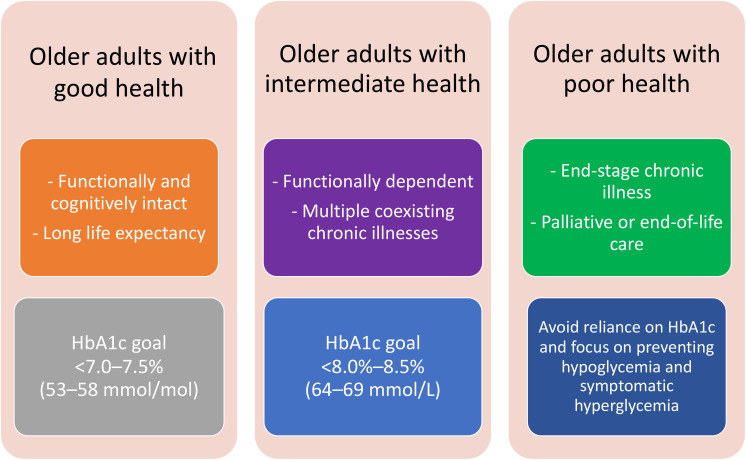
The population of older adults (≥65 years) with type 2 diabetes mellitus (T2DM) is diverse, encompassing individuals with varying functional capabilities, living arrangements, concomitant medical conditions, and life expectancies. Hence, their categorization into different patient profiles (ie, good health, intermediate health, poor health) may aid in clinical decision-making when establishing glycemic goals and pharmacological treatment strategies. Further granularity in assessing each patient profile through interdisciplinary collaboration may also add precision to therapeutic and monitoring decisions. In this review, we discuss with a multidisciplinary approach how to deliver the best benefit from advanced diabetes therapies and technologies to older adults with T2DM according to each patient profile. There remain however several areas that deserve further research in older adults with T2DM, including the efficacy and safety of continuous glucose monitoring and automated insulin delivery systems, the switch to once-weekly insulin, the effectiveness of multidisciplinary care models, and the use of supported telemedicine and remote blood glucose monitoring in the oldest-old (≥85 years) who particularly require the assistance of others.
Keywords: management; older adults; patient profiles; type 2 diabetes.
© 2023 Doucet et al.
Conflict of interest statement
Jean Doucet has received occasional fees, either personally or institutionally, for the activities of speaking or scientific advising from Novo Nordisk, Eli Lilly, and Boehringer Ingelheim. Pierre Gourdy has received occasional fees, either personally or institutionally, for the activities of speaking, scientific advising, or clinical research from Abbott, Amarin, Amgen, AstraZeneca, Bayer, Boehringer Ingelheim, Eli Lilly, Gilead, GlaxoSmithKline, Merck Sharp & Dohme, Novo Nordisk, Organon, Pfizer, and Sanofi. Laurent Meyer has received occasional fees, either personally or institutionally, for the activities of speaking, scientific advising, or clinical research from Abbott, AstraZeneca, Boehringer Ingelheim, Dexcom, Eli Lilly, Novo Nordisk, Merck Sharp & Dohme, Pfizer, Servier, Medtronic, and Isis Diabète. Nabil Benabdelmoumene has received occasional fees, either personally or institutionally, from AstraZeneca, Novo Nordisk, Boehringer Ingelheim, and Eli Lilly. Isabelle Bourdel-Marchasson has received occasional fees from Novo-Nordisk for activities of speaking or scientific advising. The authors report no other conflicts of interest in this work.
Figures
References
-
- Orimo H, Ito H, Suzuki T, Araki A, Hosoi T, Sawabe M. Reviewing the definition of “elderly”. Geriatr Gerontol Int. 2006;6(3):149–158. doi:10.1111/j.1447-0594.2006.00341.x - DOI
Publication types
MeSH terms
Substances
LinkOut - more resources
Full Text Sources
Medical
