


Cardiac thrombus dissolution in acute ischemic stroke: A substudy of Mind the Heart
- PMID: 37842570
- PMCID: PMC10570568
- DOI: 10.1016/j.heliyon.2023.e20627
Cardiac thrombus dissolution in acute ischemic stroke: A substudy of Mind the Heart
Abstract
Background: Cardiac thrombi are an important cause of ischemic stroke but are infrequently detected on cardiac imaging. We hypothesized that this might be explained by early dissolution of these cardiac thrombi after stroke occurrence.
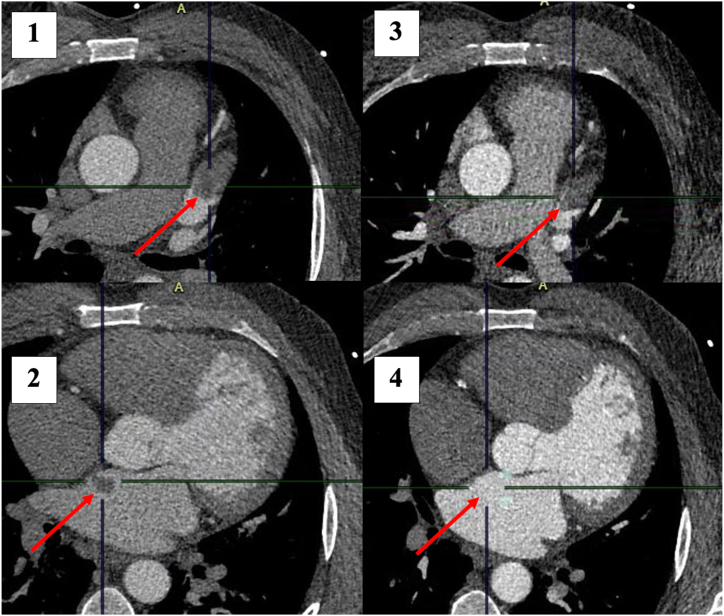
Methods: We performed a single-center observational pilot study between November 2019 and November 2020, embedded in the larger "Mind-the-Heart" study. We included patients with AIS and a cardiac thrombus in the left atrium or ventricle (filling defect <100 Hounsfield Units) diagnosed on cardiac CT that was acquired during the initial stroke imaging protocol. We repeated cardiac CT within one week to determine if the thrombus had dissolved.
Results: Five patients (four men, median age 52 years, three with atrial fibrillation and one with anticoagulation therapy at baseline) were included. Median time from symptom onset to first cardiac CT was 383 (range 42-852) minutes and median time from first to second cardiac CT was three days (range 1-7). Two patients received intravenous thrombolysis (IVT). In total, six thrombi were seen on initial CT imaging (one in the left ventricle, four in the left atrial appendage, one in the left atrium). The left atrium thrombus and one left atrial appendage thrombus had dissolved on follow-up cardiac CT, one of which was in a patient with IVT treatment.
Conclusion: This pilot study illustrates that cardiac thrombi can dissolve within days of stroke occurrence both with and without IVT treatment.
© 2023 The Authors. Published by Elsevier Ltd.
Conflict of interest statement
The authors declare the following financial interests/personal relationships which may be considered as potential competing interests: CBLMM has received research grants from CVON/Dutch Heart Foundation, European Commission, TWIN Foundation, Healthcare Evaluation Netherlands and Stryker (paid to institution). CBLMM, HAM and YBWEMR are shareholders of Nicolab, a company that focuses on the use of artificial intelligence for medical image analysis. JMC reports grants from Medtronic, Boehringer Ingelheim, and Bayer outside the submitted work (paid to institution). JMC and HAM are shareholder of TrianecT. The other authors have no financial conflicts of interest.
Figures
References
-
- Kleindorfer D.O., Towfighi A., Chaturvedi S., Cockroft K.M., Gutierrez J., Lombardi-Hill D., Kamel H., Kernan W.N., Kittner S.J., Leira E.C., et al. 2021 Guideline for the prevention of stroke in patients with stroke and transient ischemic attack: a guideline from the American heart association/American stroke association. Stroke. 2021;52:e364–e467. doi: 10.1161/STR.0000000000000375. - DOI - PubMed
-
- Thomalla G., Upneja M., Camen S., Jensen M., Schröder J., Barow E., Boskamp S., Ostermeier B., Kissling S., Leinisch E., et al. Treatment-relevant findings in transesophageal echocardiography after stroke: a prospective multicenter cohort study. Stroke. 2021 doi: 10.1161/strokeaha.121.034868. - DOI - PubMed
-
- Saric M., Armour A.C., Arnaout M.S., Chaudhry F.A., Grimm R.A., Kronzon I., Landeck B.F., Maganti K., Michelena H.I., Tolstrup K. Guidelines for the use of echocardiography in the evaluation of a cardiac source of embolism. J. Am. Soc. Echocardiogr. 2016;29:1–42. doi: 10.1016/j.echo.2015.09.011. - DOI - PubMed
LinkOut - more resources
Full Text Sources
