


Regenerative medicine strategies for chronic complete spinal cord injury
- PMID: 37843217
- PMCID: PMC10664101
- DOI: 10.4103/1673-5374.382230
Regenerative medicine strategies for chronic complete spinal cord injury
Abstract
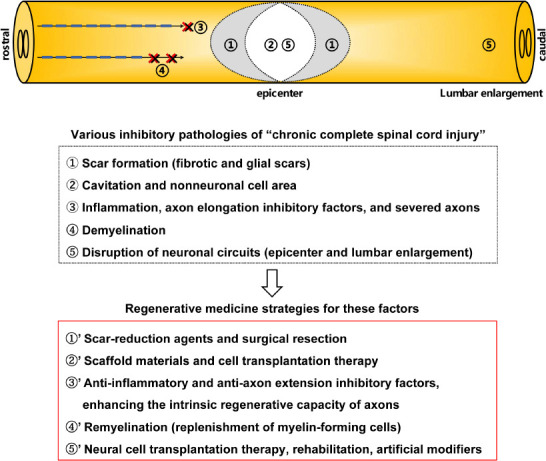
Spinal cord injury is a condition in which the parenchyma of the spinal cord is damaged by trauma or various diseases. While rapid progress has been made in regenerative medicine for spinal cord injury that was previously untreatable, most research in this field has focused on the early phase of incomplete injury. However, the majority of patients have chronic severe injuries; therefore, treatments for these situations are of fundamental importance. The reason why the treatment of complete spinal cord injury has not been studied is that, unlike in the early stage of incomplete spinal cord injury, there are various inhibitors of neural regeneration. Thus, we assumed that it is difficult to address all conditions with a single treatment in chronic complete spinal cord injury and that a combination of several treatments is essential to target severe pathologies. First, we established a combination therapy of cell transplantation and drug-releasing scaffolds, which contributes to functional recovery after chronic complete transection spinal cord injury, but we found that functional recovery was limited and still needs further investigation. Here, for the further development of the treatment of chronic complete spinal cord injury, we review the necessary approaches to the different pathologies based on our findings and the many studies that have been accumulated to date and discuss, with reference to the literature, which combination of treatments is most effective in achieving functional recovery.
Keywords: cell transplantation; chronic phase; complete transection; regenerative medicine; spinal cord injury.
Conflict of interest statement
None
Figures
References
-
- Ago K, Nagoshi N, Imaizumi K, Kitagawa T, Kawai M, Kajikawa K, Shibata R, Kamata Y, Kojima K, Shinozaki M, Kondo T, Iwano S, Miyawaki A, Ohtsuka M, Bito H, Kobayashi K, Shibata S, Shindo T, Kohyama J, Matsumoto M, Nakamura M, Okano H. A non-invasive system to monitor in vivo neural graft activity after spinal cordinjury. Commun Biol. 2022;5:803. - PMC - PubMed
-
- Alstermark B, Ogawa J, Isa T. Lack of monosynaptic corticomotoneuronal EPSPs in rats: disynaptic EPSPs mediated via reticulospinal neurons and polysynaptic EPSPs via segmental interneurons. J Neurophysiol. 1999;6:3580–3585. - PubMed
-
- Alstermark B, Isa T, Ohki Y, Saito Y. disynaptic pyramidal excitation in forelimb motoneurons mediated via C3-C4 Propriospinal Neurons in the Macaca fuscata. J Neurophysiol. 2004;6:3580–3585. - PubMed
-
- Anderson MA, O'Shea TM, Burda JE, Ao Y, Barlatey SL, Bernstein AM, Kim JH, James ND, Rogers A, Kato B, Wollenberg AL, Kawaguchi R, Coppola G, Wang C, Deming TJ, He Z, Courtine G, Sofroniew MV. Required growth facilitators propel axon regeneration across complete spinal cord injury. Nature. 2018;561:396–400. - PMC - PubMed
Publication types
LinkOut - more resources
Full Text Sources
