


Protein-modified nanomaterials: emerging trends in skin wound healing
- PMID: 37843732
- PMCID: PMC10579214
- DOI: 10.1186/s11671-023-03903-8
Protein-modified nanomaterials: emerging trends in skin wound healing
Abstract
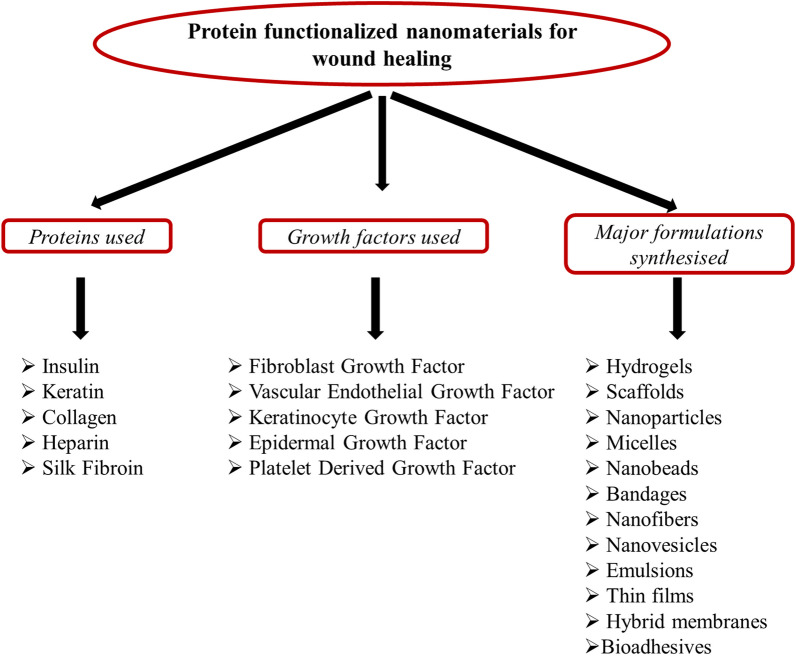
Prolonged inflammation can impede wound healing, which is regulated by several proteins and cytokines, including IL-4, IL-10, IL-13, and TGF-β. Concentration-dependent effects of these molecules at the target site have been investigated by researchers to develop them as wound-healing agents by regulating signaling strength. Nanotechnology has provided a promising approach to achieve tissue-targeted delivery and increased effective concentration by developing protein-functionalized nanoparticles with growth factors (EGF, IGF, FGF, PDGF, TGF-β, TNF-α, and VEGF), antidiabetic wound-healing agents (insulin), and extracellular proteins (keratin, heparin, and silk fibroin). These molecules play critical roles in promoting cell proliferation, migration, ECM production, angiogenesis, and inflammation regulation. Therefore, protein-functionalized nanoparticles have emerged as a potential strategy for improving wound healing in delayed or impaired healing cases. This review summarizes the preparation and applications of these nanoparticles for normal or diabetic wound healing and highlights their potential to enhance wound healing.
Keywords: Antidiabetic agents; Growth factors; Nanoformulations; Proteins; Wound healing.
© 2023. Springer Science+Business Media, LLC, part of Springer Nature.
Conflict of interest statement
The authors declare no competing interests.
Figures

References
-
- Wang Z, Wang Z, Lu WW, et al. Novel biomaterial strategies for controlled growth factor delivery for biomedical applications. NPG Asia Mater. 2017;9(10):e435–e435. doi: 10.1038/am.2017.171. - DOI
-
- Oliveira SF, Bisker G, Bakh NA, et al. Protein functionalized carbon nanomaterials for biomedical applications. Carbon N Y. 2015;95:767–779. doi: 10.1016/J.CARBON.2015.08.076. - DOI
-
- Wang F, Tan WB, Zhang Y, et al. Luminescent nanomaterials for biological labelling. Nanotechnology. 2006 doi: 10.1088/0957-4484/17/1/R01. - DOI
Publication types
Grants and funding
LinkOut - more resources
Full Text Sources