. 2023 Oct 16;14(1):6525.
doi: 10.1038/s41467-023-42075-y.

Soluble organic matter Molecular atlas of Ryugu reveals cold hydrothermalism on C-type asteroid parent body

Collaborators, Affiliations

Soluble organic matter Molecular atlas of Ryugu reveals cold hydrothermalism on C-type asteroid parent body

Philippe Schmitt-Kopplin et al. Nat Commun. .

Abstract

The sample from the near-Earth carbonaceous asteroid (162173) Ryugu is analyzed in the context of carbonaceous meteorites soluble organic matter. The analysis of soluble molecules of samples collected by the Hayabusa2 spacecraft shines light on an extremely high molecular diversity on the C-type asteroid. Sequential solvent extracts of increasing polarity of Ryugu samples are analyzed using mass spectrometry with complementary ionization methods and structural information confirmed by nuclear magnetic resonance spectroscopy. Here we show a continuum in the molecular size and polarity, and no organomagnesium molecules are detected, reflecting a low temperature and water-rich environment on the parent body approving earlier mineralogical and chemical data. High abundance of sulfidic and nitrogen rich compounds as well as high abundance of ammonium ions confirm the water processing. Polycyclic aromatic hydrocarbons are also detected in a structural continuum of carbon saturations and oxidations, implying multiple origins of the observed organic complexity, thus involving generic processes such as earlier carbonization and serpentinization with successive low temperature aqueous alteration.


Conflict of interest statement

The authors declare no competing interests.

Figures
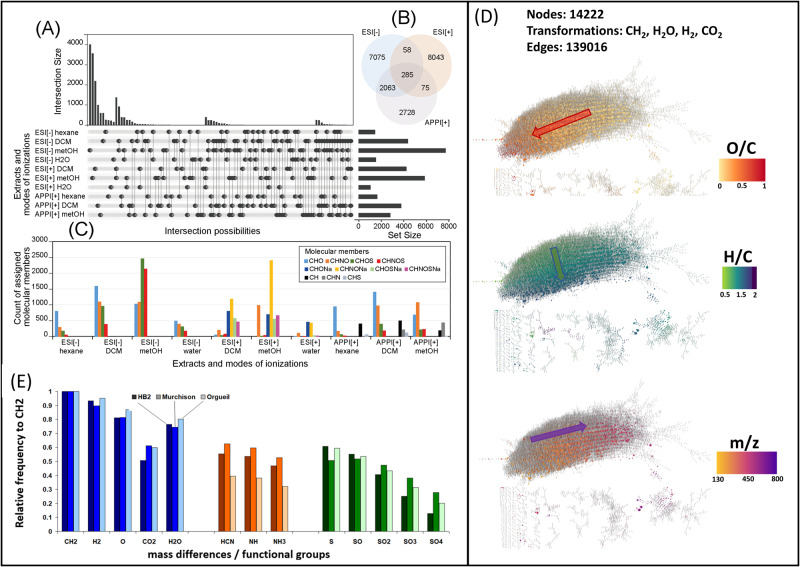
Fig. 1
Fig. 1. Molecular atlas of the Ryugu soluble organic matter.
A counting of the number of elementary composition retrieved from exact mass analysis in ESI(-), ESI(+) and APPI(+) ionization modes of the sequential extractions in hexane, dichloromethane, methanol and water. B Venn-diagram of the ionization mode signatures, C abundances of the various chemical families in the various extracts and ionization modes, involving, CH, CHO, CHN, CHS, CHOS, CHNO, CHNOS, CHONa, CHNONa, CHOSNa and CHNOSNa. D Network representation of the methanol extract using the most frequent mass transitions and showing the strong structural connectivity and the regular gradients in O/C, H/C and m/z. E frequency histogram of the exact mass differences (i.e., CH2, H2, O, CO2, H2O, HCN, NH, NH3, SO, S, SO2, SO3, and SO4).
Fig. 2
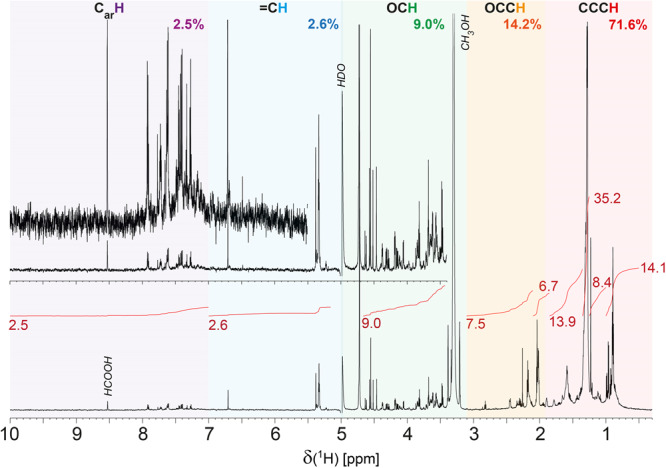
Fig. 2. Nuclear magnetic resonance spectroscopy of A0106.
1H NMR spectrum (800 MHz, CD3OD) of mHDOM extract 4A0106, with 1H NMR section integrals of main substructures (cf. Table S3). Apart from certain sharp NMR resonances which possibly denote individual aliphatic CHO molecules, mHDOM comprised relevant background of broad bulk 1H NMR resonances that represent a huge diversity of aliphatic branched alkyl and remotely oxygenated aliphatic groups (δH ~ 0.6-2.7 ppm) and aliphatic OCH molecules (δH ~ 3.2-4.2 ppm); the overall curvature suggests higher relative abundance of aliphatic alcohols and ethers (δH < 3.8 ppm) in comparison with e.g. aliphatic esters (δH > 3.8 ppm). Ammonium (14NH4+) showed a distinct 1:1:1 triplet at δH ~ 4.5 ppm with 1JNH = 42.7 Hz (1.2% of 1H NMR integral; Fig. S8a–c).
Fig. 3
Fig. 3. FT-ICR-MS data evaluation of sample A0106 compared to carbonaceous meteorites.
Comparison of the mass edited H/C ratios and van Krevelen diagrams of sample A0106 with Murchison CM2 and Orgueil CI. The bubble size is proportional to the intensity in the original ESI(-)-FTICR-MS mass spectra and the color codes correspond to defined chemical classes of CHO(blue), CHNO(orange), CHOS(green) and CHONS(red). Histograms on the right are the abundance profiles of the heteroatoms as well as the oxygenation profiles of the CHO, CHNO and CHOS chemical families.
Fig. 4
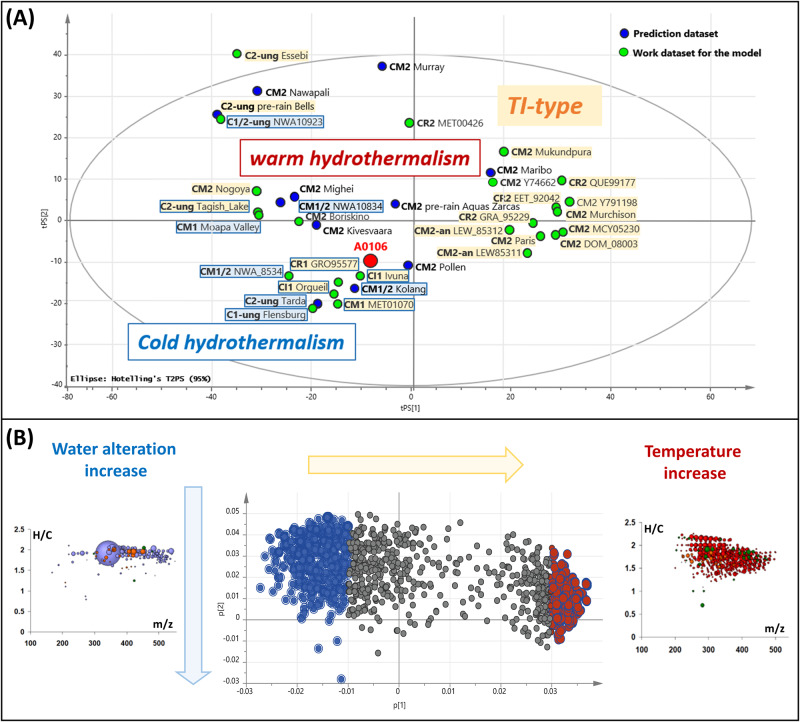
Fig. 4. Hydrothermal prediction of sample A0106 based on meteoritic soluble organic matter data.
A Principal component analysis (PCA) and model positioning the sample A0106 within 36 carbonaceous chondrites of TI-type (we defined the TI-type in Quirico et al. as a combination of XRD/mineral observation and Raman/IR data). All TI meteorites experiences aqueous alteration at temperatures <300 °C. In green the work dataset of the samples taken for the model and in blue the simulated positions form predicted dataset. B The loading plot represents the m/z values that differentiates an increase in water alteration (left) and temperature (right) represented in mass edited H/C ratios, accordingly; the bubble size is proportional to the intensity in the original ESI(-)-FTICR-MS mass spectra and the color codes correspond to defined chemical classes of CHO(blue), CHNO(orange), CHOS(green) and CHONS(red).

References

    1. Ph. Schmitt-Kopplin Z, et al. High molecular diversity of extraterrestrial organic matter in Murchison meteorite revealed 40 years after its fall. Proc. Natl Acad. Sci. USA. 2010;107:2763–2768. doi: 10.1073/pnas.0912157107. - DOI - PMC - PubMed
    1. Ruf A, et al. Previously unknown class of metalorganic compounds revealed in meteorites. Proc. Natl Acad. Sci. USA. 2017;114:2819–2824. doi: 10.1073/pnas.1616019114. - DOI - PMC - PubMed
    1. Matzka, M. et al. Thermal history of asteroid parent bodies is reflected in their metalorganic chemistry. Astrophys. J. Lett. 915, L7 (2021).
    1. Yokoyama, T. et al. Samples returned from the asteroid Ryugu are similar to Ivuna-type carbonaceous meteorites. Science379, eabn7850 (2023). - PubMed
    1. Naraoka H, et al. Organic compounds from Ryugu – prebiotic molecules in a C-type asteroid. Science. 2023;379:eabn9033. doi: 10.1126/science.abn9033. - DOI - PubMed