


Navigating and diagnosing cognitive frailty in research and clinical domains
- PMID: 37845509
- PMCID: PMC10936574
- DOI: 10.1038/s43587-023-00504-z
Navigating and diagnosing cognitive frailty in research and clinical domains
Abstract
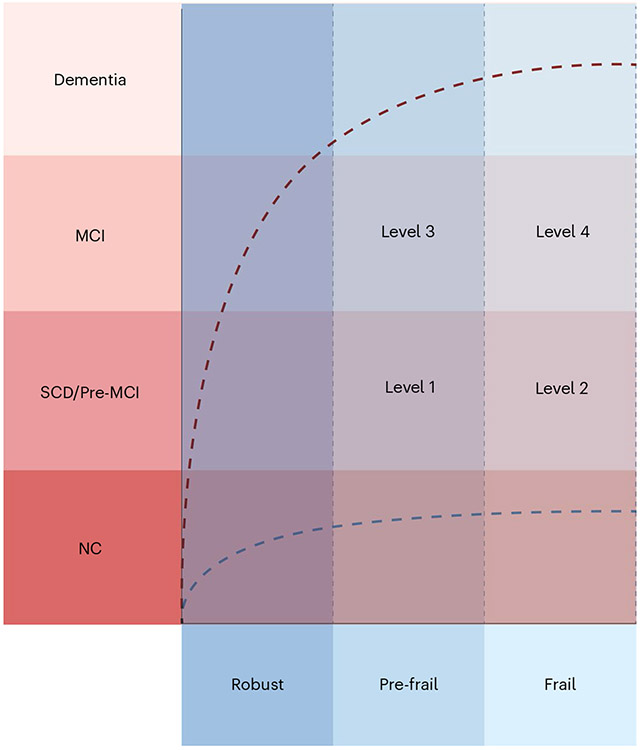
While physical frailty has been recognized as a clinical entity for some time, the concept of cognitive frailty (CF) is now gaining increasing attention in the geriatrics research community. CF refers to the co-occurrence of physical frailty and cognitive impairment in older adults, which has been suggested as a potential precursor to both dementia and adverse physical outcomes. However, this condition represents a challenge for researchers and clinicians, as there remains a lack of consensus regarding the definition and diagnostic criteria for CF, which has limited its utility. Here, using insights from both the physical frailty literature and cognitive science research, we describe emerging research on CF. We highlight areas of agreement as well as areas of confusion and remaining knowledge gaps, and provide our perspective on fine-tuning the current construct, aiming to stimulate further discussion in this developing field.
© 2023. Springer Nature America, Inc.
Figures


References
-
- Godin J, Armstrong JJ, Rockwood K & Andrew MK Dynamics of frailty and cognition after age 50: why it matters that cognitive decline is mostly seen in old age. J. Alzheimers Dis 58, 231–242 (2017). - PubMed
-
- Avila-Funes JA et al. Cognitive impairment improves the predictive validity of the phenotype of frailty for adverse health outcomes: the three-city study. J. Am. Geriatr. Soc 57, 453–461 (2009). - PubMed
-
- Robertson DA, Savva GM & Kenny RA Frailty and cognitive impairment—a review of the evidence and causal mechanisms. Ageing Res. Rev 12, 840–851 (2013). - PubMed
Publication types
MeSH terms
Grants and funding
LinkOut - more resources
Full Text Sources
Medical
