


Longitudinal trend of urolithiasis incidence rates among world countries during past decades
- PMID: 37845667
- PMCID: PMC10577967
- DOI: 10.1186/s12894-023-01336-0
Longitudinal trend of urolithiasis incidence rates among world countries during past decades
Abstract
Introduction: This study explores the trend of urolithiasis in various countries and categorizes the countries in terms of how their urolithiasis incidence rate has changed over time.
Methods: The incidence rate of urolithiasis in 204 countries from 1990 to 2019, extracted from the Global Burden of Disease study, has been analyzed.
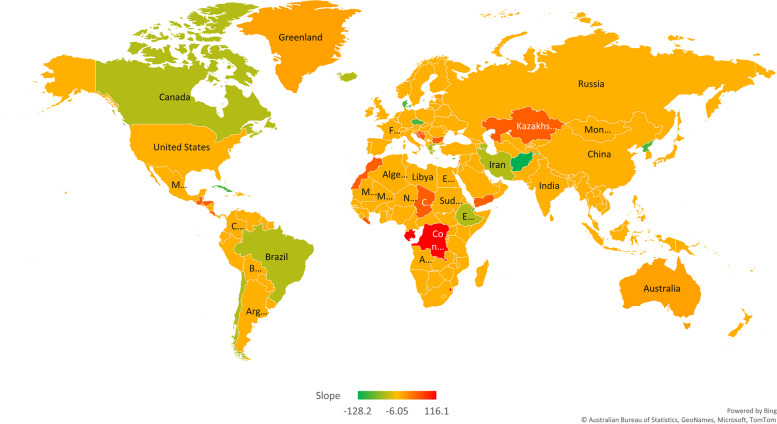
Results: According to the results, all regions had experienced an increasing trend in urolithiasis rate, except for Eastern Europe, Central Europe, and Southeast Asia regions (decreasing rates of -71.4, -56.2, and -9.2 per 100000, respectively). Moreover, the Caribbean region had the highest increasing trend of urolithiasis rates, and Central Asia was in the next rank (increasing rate of 48.3 and 34.3 per 100,000, respectively, p-value < .05). Also, African regions revealed significant increasing trends over time (p-value < 0.05). The outstanding findings in cluster analysis showed that Afghanistan, Andorra, and Comoros had the most decreasing trend in urolithiasis rates over time (decreasing rate of -128.2 per 100000, p-value < .001). Cuba, Cyprus, Czechia, the Democratic People's Republic of Korea, Denmark, and Djibouti were in the next rank in terms of decreasing rate (decreasing rate of -92.3 per 100000, p-value < .001). In addition, urolithiasis rates in Congo, Eswatini, Gabon, and Grenada have the most increasing trend (increasing rate of 116.1 per 100000, p-value < .001).
Conclusion: The trend of urolithiasis rates was significantly increased in most countries, and Congo, Eswatini, Gabon, and Grenada had the highest trend among others. Also, Afghanistan, Andorra, and Comoros revealed the most decreasing rates, and the trend has dropped remarkably in several other countries.
Keywords: GBD study; Growth mixture model; Longitudinal analysis; Urolithiasis.
© 2023. BioMed Central Ltd., part of Springer Nature.
Conflict of interest statement
The authors declare no competing interests.
Figures

References
-
- Alatab S, Pourmand G, El Howairis MEF, Buchholz N, Najafi I, Pourmand MR, et al. National profiles of urinary calculi (a comparison between developing and developed worlds) 2016. - PubMed
MeSH terms
LinkOut - more resources
Full Text Sources
Miscellaneous
