


SGLT2 inhibitors and diabetic retinopathy progression
- PMID: 37847267
- PMCID: PMC11196159
- DOI: 10.1007/s00417-023-06273-0
SGLT2 inhibitors and diabetic retinopathy progression
Abstract
Purpose: To evaluate whether sodium-glucose co-transporter 2 (SGLT2) inhibitors affect progression of non-proliferative diabetic retinopathy (NPDR) compared to standard of care.
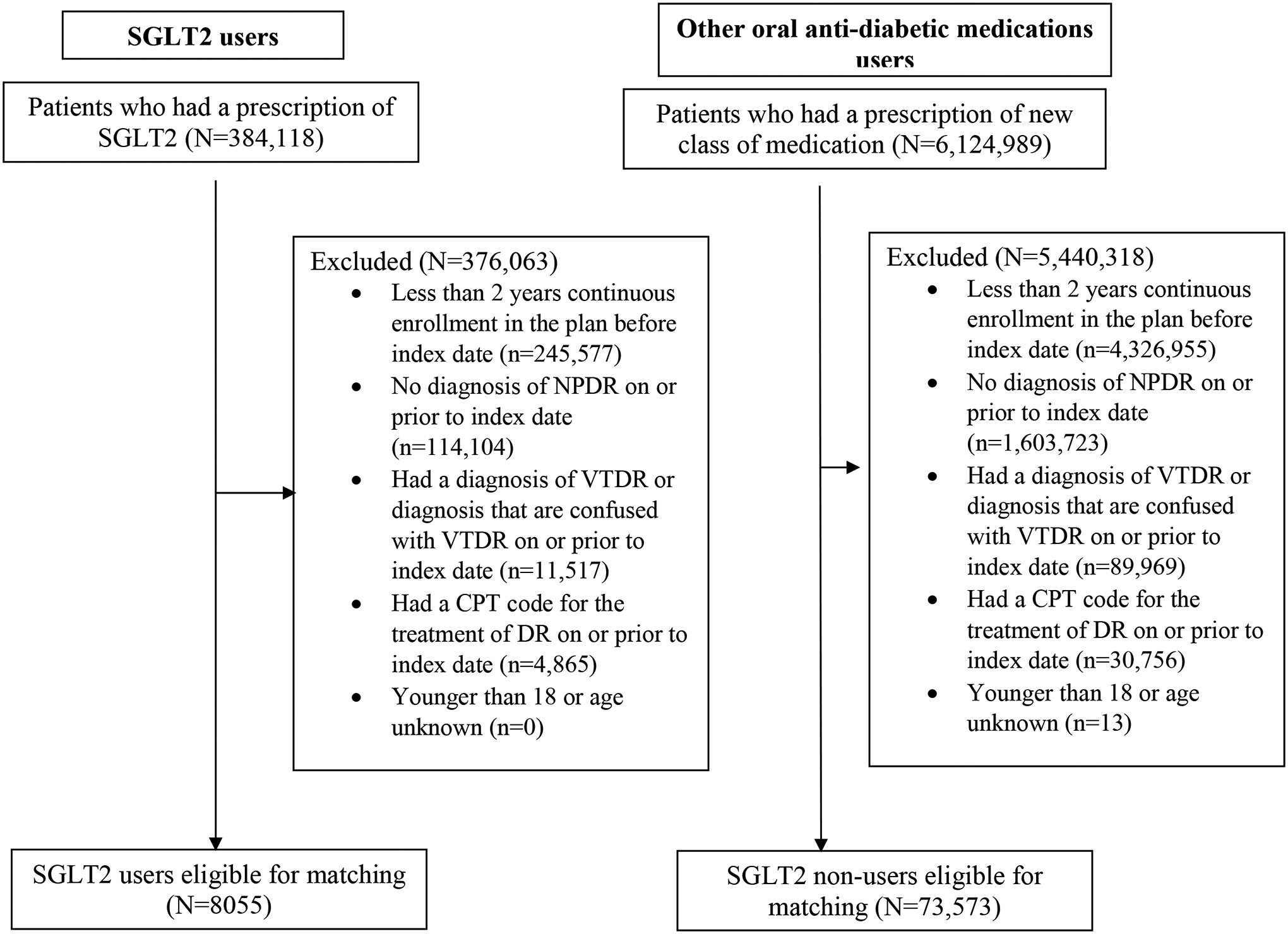
Methods: A retrospective cohort study compared subjects enrolled in a commercial and Medicare Advantage medical claims database who filled a prescription for a SGLT2 inhibitor between 2013 and 2020 to unexposed controls, matched up to a 1:3 ratio. Patients were excluded if they were enrolled for less than 2 years in the plan, had no prior ophthalmologic exam, had no diagnosis of NPDR, had a diagnosis of diabetic macular edema (DME) or proliferative diabetic retinopathy (PDR), had received treatment for vision-threatening diabetic retinopathy (VTDR), or were younger than 18 years. To balance covariates of interest between the cohorts, an inverse probability treatment weighting (IPTW) propensity score for SGLT2 inhibitor exposure was used. Multivariate Cox proportional hazard regression modeling was employed to assess the hazard ratio (HR) for VTDR, PDR, or DME relative to SGLT2 exposure.
Results: A total of 6065 patients who initiated an SGLT2 inhibitor were matched to 12,890 controls. There were 734 (12%), 657 (10.8%), and 72 (1.18%) cases of VTDR, DME, and PDR, respectively, in the SGLT2 inhibitor cohort. Conversely, there were 1479 (11.4%), 1331 (10.3%), and 128 (0.99%) cases of VTDR, DME, and PDR, respectively, among controls. After IPTW, Cox regression analysis showed no difference in hazard for VTDR, PDR, or DME in the SGLT2 inhibitor-exposed cohort relative to the unexposed group [HR = 1.04, 95% CI 0.94 to 1.15 for VTDR; HR = 1.03, 95% CI 0.93 to 1.14 for DME; HR = 1.22, 95% CI 0.89 to 1.67 for PDR].
Conclusion: Exposure to SGLT2 inhibitor therapy was not associated with progression of NPDR compared to patients receiving other diabetic therapies.
Keywords: Diabetic macular edema; Diabetic retinopathy; Proliferative diabetic retinopathy; Sodium-glucose co-transporter 2 (SGLT2) inhibitors; Vision-threatening diabetic retinopathy.
© 2023. The Author(s), under exclusive licence to Springer-Verlag GmbH Germany, part of Springer Nature.
Conflict of interest statement
Potential conflicts of interest:
Brian VanderBeek previously consulted for EyePoint Pharmaceuticals. Charles Miller is an employee of Regeneron Pharmaceuticals. No other financial relationships or potential conflicts exist for any author.
Figures
References
-
- Diabetes Control and Complications Trial Research Group, Nathan DM, Genuth S, Lachin J, et al. (1993). The effect of intensive treatment of diabetes on the development and progression of long-term complications in insulin-dependent diabetes mellitus. N Engl J Med. 329(14):977–86. doi: 10.1056/NEJM199309303291401. - DOI - PubMed
-
- UK Prospective Diabetes Study (UKPDS) Group. (1998) Intensive blood-glucose control with sulphonylureas or insulin compared with conventional treatment and risk of complications in patients with type 2 diabetes (UKPDS 33). Lancet. 352(9131):837–53. Erratum in: Lancet 1999 Aug 14;354(9178):602. - PubMed
MeSH terms
Substances
Grants and funding
LinkOut - more resources
Full Text Sources
Medical
