. 2023 Oct 17;14(1):6549.
doi: 10.1038/s41467-023-42289-0.

Visible-to-mid-IR tunable frequency comb in nanophotonics

Affiliations

Visible-to-mid-IR tunable frequency comb in nanophotonics

Arkadev Roy et al. Nat Commun. .

Abstract

Optical frequency comb is an enabling technology for a multitude of applications from metrology to ranging and communications. The tremendous progress in sources of optical frequency combs has mostly been centered around the near-infrared spectral region, while many applications demand sources in the visible and mid-infrared, which have so far been challenging to achieve, especially in nanophotonics. Here, we report widely tunable frequency comb generation using optical parametric oscillators in lithium niobate nanophotonics. We demonstrate sub-picosecond frequency combs tunable beyond an octave extending from 1.5 up to 3.3 μm with femtojoule-level thresholds on a single chip. We utilize the up-conversion of the infrared combs to generate visible frequency combs reaching 620 nm on the same chip. The ultra-broadband tunability and visible-to-mid-infrared spectral coverage of our source highlight a practical and universal path for the realization of efficient frequency comb sources in nanophotonics, overcoming their spectral sparsity.


Conflict of interest statement

L.L., R.M.B., and A.M. are inventors on granted U.S. patent 11,226,538 covering thin-film optical parametric oscillators. L.L., A.M., A.R., R.S., and R.G. are inventors on a U.S. provisional patent application filed by the California Institute of Technology (application number 63/466,188) on 12 May 2023. L.L., A.M., and R.G. are inventors on a U.S. provisional patent application filed by the California Institute of Technology (application number 63/434,015) on 20 December 2022. L.L. and A.M. are involved in developing photonic integrated nonlinear circuits at PINC Technologies Inc. L.L. and A.M. have an equity interest in PINC Technologies Inc. The other authors declare that they have no competing interests.

Figures

Fig. 1
Fig. 1. Ultra-widely tunable frequency combs from nanophotonic parametric oscillators.
a Schematic of a doubly resonant optical parametric oscillator fabricated on an X-cut thin-film lithium niobate consisting of a periodically poled region for efficient parametric nonlinear interaction. The waveguides (dimensions: width of 2.5 μm, etch depth of 250 nm) support guided-modes in the mid-infrared corresponding to the idler wave. b Quasi-phase matched parametric gain tuning from visible-to-mid-IR. Phase-matching curves leading to tunable mid-infrared idler emission enabled by optical parametric oscillator devices with slightly different poling periods (Λ) integrated on the same chip. The same chip is capable of producing tunable visible frequency combs thanks to the sum-frequency generation (SFG) process between the pump with the signal and idler waves. Other accompanying up-conversion processes include the second-harmonic (SH) of the signal and the idler. The phase-matching curves for the up-conversion processes are plotted (dotted lines) according to the energy conservation relations and do not strictly satisfy quasi-phase-matching. Some second-harmonic phase-matching curves have been omitted for better clarity. c The emission from the chip overlaps with strong molecular absorption lines in the mid-infrared, covering a spectral window important for molecular spectroscopy. The spectral coverage in the visible includes atomic transition wavelengths corresponding to commonly used trapped ions/ neutral atoms/color centers.
Fig. 2
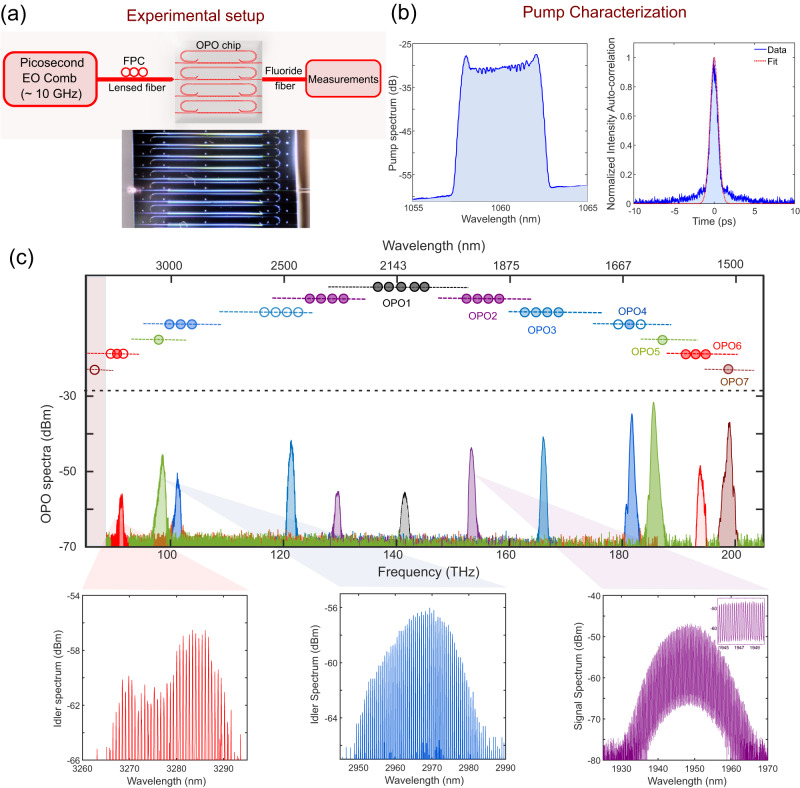
Fig. 2. Near-IR to mid-IR frequency combs from nanophotonic OPOs on a single chip.
a Schematic of the experimental setup used to pump and measure the synchronously pumped optical parametric oscillator chip. The image of the OPO chip is shown alongside, b Experimental measurements of the spectral and temporal characteristics (intensity auto-correlation trace) of the electro-optic pulsed pump showing a pulse-width of ~1 ps, c Broadband infrared spectral coverage of the OPO chip showing the signal and the idler spectrum as its operation is tuned from degeneracy to far non-degeneracy. Separate colors represent outputs from different OPO devices on the same chip with distinct poling periods. Zoomed-in versions display the underlying comb line structure of the power spectrum envelope of the signal and idler combs. The top panel represents the fine-tuning range of the corresponding OPO spectrum obtained by pump wavelength tuning. The dashed line indicates the tuning range for each OPO (assuming 30 nm of pump tuning). Filled dots represent measured data, while empty dots indicate inferred spectrum from its signal/idler counterpart. (Detailed spectrum for the tuning results are presented in Fig. 3c and Supplementary Section 14).
Fig. 3
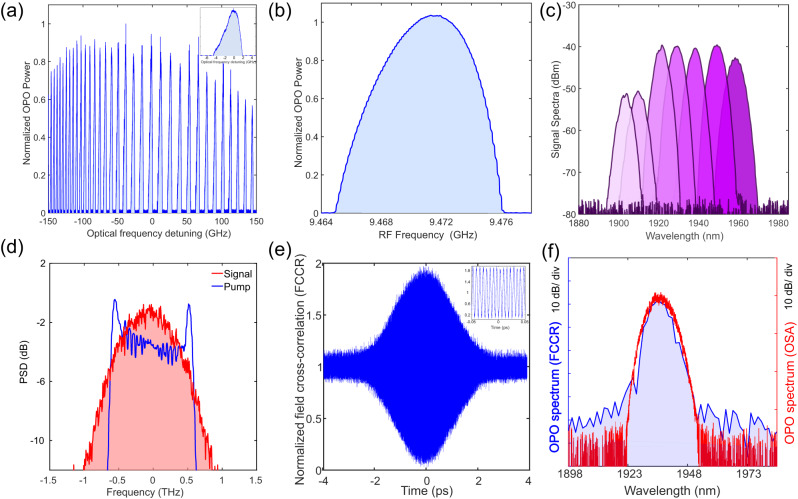
Fig. 3. Characteristics of the frequency comb generated from the synchronously pumped on-chip OPOs.
a Resonance peak structure obtained by sweeping the pump central wavelength which is typical of doubly resonant OPO operation. A zoomed-in view of a single peak is shown in the inset, b Range of the existence of the synchronously pumped OPO for a fixed pump power as the pump repetition rate is varied, c An example of fine-tuning of a single OPO output by tuning the pump central wavelength (please see Supplementary Section 14 for more experimental results), d Spectral broadening of the OPO operating at degeneracy corresponding to a sub-picosecond transform-limited duration of ~400 fs. The spectrum for both the pump and the signal are normalized for the aid of visualization of the spectral broadening, e Verification of the coherence of the OPO output as evident from the existence of interference fringes (see inset) in the electric-field cross-correlation trace, f The close agreement between the spectra obtained from an optical spectrum analyzer measurement and that obtained by Fourier transforming the field cross-correlation corroborates the coherence of the OPO output.
Fig. 4
Fig. 4. Visible frequency comb generation from the integrated optical parametric oscillator chip.
a The complete emission spectrum of an OPO (Spectra obtained from different optical spectrum analyzers/ spectrometers are stitched together). Apart from the emission of the signal and the idler waves, the OPO also produces output in the visible spectra owing to the auxiliary nonlinear processes, namely the second-harmonic generation (SHG) and the sum-frequency generation (SFG). Schematic representations of the different nonlinear processes are shown. The processes marked by solid black arrows are initiated first, followed by the ones marked in gray. b Optical microscope image capturing the visible light emission from various regions of the periodically poled section of the OPO device, c Tunable visible frequency comb generation from the integrated OPO chip, where different colors indicate spectra obtained from OPOs with distinct poling periods.

References

    1. Diddams SA, Vahala K, Udem T. Optical frequency combs: coherently uniting the electromagnetic spectrum. Science. 2020;369:eaay3676. doi: 10.1126/science.aay3676. - DOI - PubMed
    1. Kippenberg TJ, Gaeta AL, Lipson M, Gorodetsky ML. Dissipative Kerr solitons in optical microresonators. Science. 2018;361:eaan8083. doi: 10.1126/science.aan8083. - DOI - PubMed
    1. Coddington I, Newbury N, Swann W. Dual-comb spectroscopy. Optica. 2016;3:414–426. doi: 10.1364/OPTICA.3.000414. - DOI - PMC - PubMed
    1. Marin-Palomo P, et al. Microresonator-based solitons for massively parallel coherent optical communications. Nature. 2017;546:274–279. doi: 10.1038/nature22387. - DOI - PubMed
    1. Xu X, et al. 11 tops photonic convolutional accelerator for optical neural networks. Nature. 2021;589:44–51. doi: 10.1038/s41586-020-03063-0. - DOI - PubMed