


Electrocardiographic abnormalities in patients with cardiomyopathies
- PMID: 37848591
- PMCID: PMC10904564
- DOI: 10.1007/s10741-023-10358-7
Electrocardiographic abnormalities in patients with cardiomyopathies
Abstract
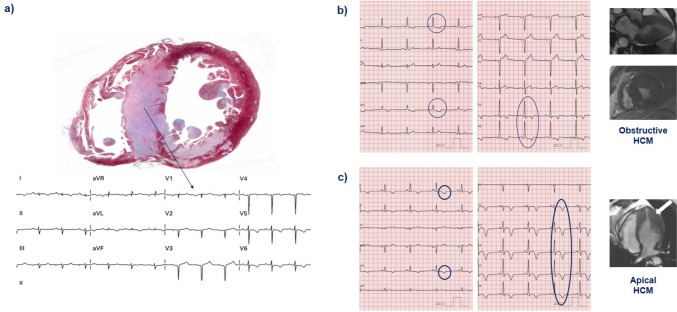
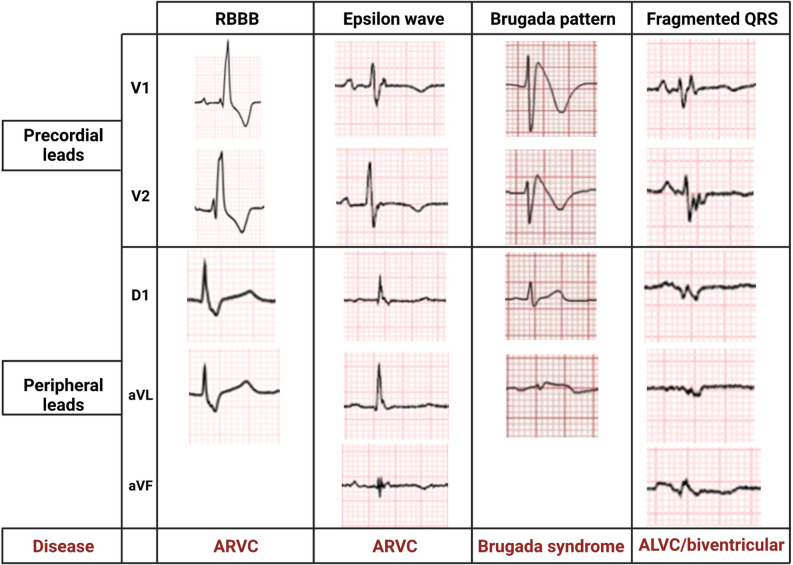
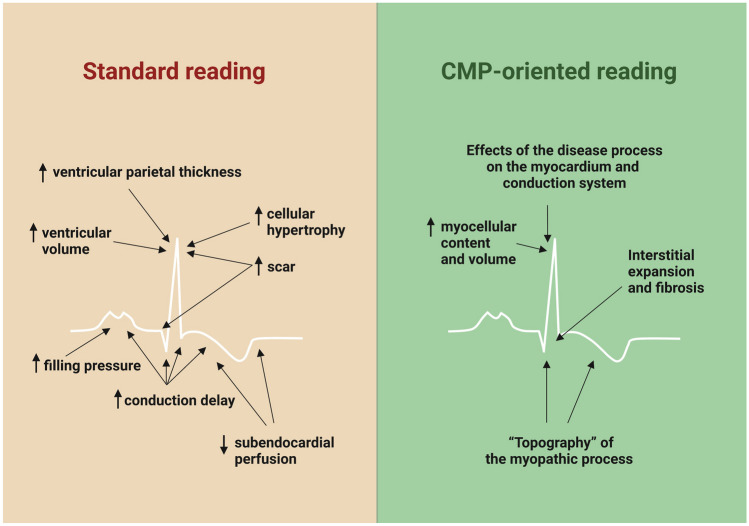
Abnormalities in impulse generation and transmission are among the first signs of cardiac remodeling in cardiomyopathies. Accordingly, 12-lead electrocardiogram (ECG) of patients with cardiomyopathies may show multiple abnormalities. Some findings are suggestive of specific disorders, such as the discrepancy between QRS voltages and left ventricular (LV) mass for cardiac amyloidosis or the inverted T waves in the right precordial leads for arrhythmogenic cardiomyopathy. Other findings are less sensitive and/or specific, but may orient toward a specific diagnosis in a patient with a specific phenotype, such as an increased LV wall thickness or a dilated LV. A "cardiomyopathy-oriented" mindset to ECG reading is important to detect the possible signs of an underlying cardiomyopathy and to interpret correctly the meaning of these alterations, which differs in patients with cardiomyopathies or other conditions.
Keywords: Amyloidosis; Cardiomyopathy; ECG; Electrocardiogram; Hypertrophic cardiomyopathy.
© 2023. The Author(s).
Conflict of interest statement
The authors declare no competing interests.
Figures
References
-
- Arbelo E, Protonotarios A, Gimeno JR, Arbustini E, Barriales-Villa R, Basso C, Bezzina CR, Biagini E, Blom NA, de Boer RA, De Winter T, Elliott PM, Flather M, Garcia-Pavia P, Haugaa KH, Ingles J, Jurcut RO, Klaassen S, Limongelli G, Loeys B, Mogensen J, Olivotto I, Pantazis A, Sharma S, Van Tintelen JP, Ware JS, Kaski JP; ESC Scientific Document Group (2023) ESC Guidelines for the management of cardiomyopathies. Eur Heart J 44(37):3503−3626. 10.1093/eurheartj/ehad194. PMID: 37622657
-
- Mahfouz Badran H, Soltan G, Eltahan E, Yacoub MH, Faheem N (2021) Relation of atrial electromechanical delay to P-wave dispersion on surface ECG using vector velocity imaging in patients with hypertrophic cardiomyopathy. Ann Noninvasive Electrocardiol 26(1):e12801. 10.1111/anec.12801. Epub 2020 Sep 24. PMID: 32969115; PMCID: PMC7816806 - PMC - PubMed
-
- Rapezzi C, Merlini G, Quarta CC, Riva L, Longhi S, Leone O, Salvi F, Ciliberti P, Pastorelli F, Biagini E, Coccolo F, Cooke RM, Bacchi-Reggiani L, Sangiorgi D, Ferlini A, Cavo M, Zamagni E, Fonte ML, Palladini G, Salinaro F, Musca F, Obici L, Branzi A, Perlini S. Systemic cardiac amyloidoses: disease profiles and clinical courses of the 3 main types. Circulation. 2009;120:1203–1212. doi: 10.1161/CIRCULATIONAHA.108.843334. - DOI - PubMed
Publication types
MeSH terms
LinkOut - more resources
Full Text Sources
Medical
