


Body mass index, neck circumference, and hypertension: a prospective cohort study
- PMID: 37849941
- PMCID: PMC10578437
- DOI: 10.3389/fcvm.2023.1269328
Body mass index, neck circumference, and hypertension: a prospective cohort study
Abstract
Objective: This study aimed to investigate the association between BMI combined with neck circumference and the risk of hypertension.
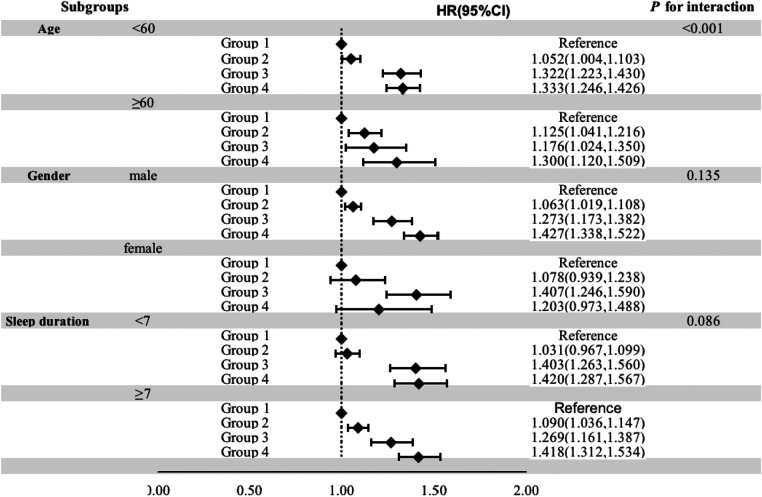
Methods: We selected participants from the Kailuan study in 2014 who were normotensive as our research subjects. We compared the risk of hypertension among individuals in group 1 (non-obese with low neck circumference), group 2 (non-obese with high neck circumference), group 3 (obese with low neck circumference), and group 4 (obese with high neck circumference).
Results: After a median observation period of 3.86 years, hypertension occurred in 13,383 participants. Subjects in Group 2, 3, and 4 had significantly higher risks of hypertension compared to Group 1, with hazard ratios (HRs) of 1.066 (95% CI: 1.025, 1.110), 1.322 (95% CI: 1.235, 1.415), and 1.422 (95% CI: 1.337, 1.512), respectively. Additionally, adding BMI to a conventional model had a greater incremental effect on predicting hypertension compared to adding neck circumference alone. However, considering both BMI and neck circumference together further improved the prediction of hypertension.
Conclusion: Individuals with both high BMI and high neck circumference face a higher risk of hypertension. Moreover, BMI is a superior predictor of hypertension risk compared to neck circumference, but using both of these measures can further enhance the accuracy of hypertension risk prediction.
Keywords: BMI; hypertension; kailuan; neck circumference; prospective cohort study.
© 2023 Ren, Zhang, Li, Ren, Huang, Yang, Wu and Li.
Conflict of interest statement
The authors declare that the research was conducted in the absence of any commercial or financial relationships that could be construed as a potential conflict of interest. The reviewer HZ declared a shared parent affiliation with the author(s) TR, KZ, STR, YH, NY, YL to the handling editor at the time of review.
Figures


References
-
- Zhou B, Carrillo-Larco RM, Danaei G, Riley LM, Paciorek CJ, Stevens GA, et al. Worldwide trends in hypertension prevalence and progress in treatment and control from 1990 to 2019: a pooled analysis of 1201 population-representative studies with 104 million participants. Lancet. (2021) 398(10304):957–80. 10.1016/S0140-6736(21)01330-1 - DOI - PMC - PubMed
-
- Tao S, Wu X, Duan X, Fang W, Hao J, Fan D, et al. Hypertension prevalence and status of awareness, treatment and control in China. Chin Med J. (1995) 108(7):483–9. - PubMed
LinkOut - more resources
Full Text Sources
