Review
. 2023 Aug 4;8(10):1924-1940.
doi: 10.1016/j.ekir.2023.07.017. eCollection 2023 Oct.

Cardiovascular Manifestations and Management in ADPKD

Affiliations
Review

Cardiovascular Manifestations and Management in ADPKD

Priyanka S Sagar et al. Kidney Int Rep. .

Abstract

Cardiovascular disease (CVD) is the major cause of mortality in autosomal dominant polycystic kidney disease (ADPKD) and contributes to significant burden of disease. The manifestations are varied, including left ventricular hypertrophy (LVH), intracranial aneurysms (ICAs), valvular heart disease, and cardiomyopathies; however, the most common presentation and a major modifiable risk factor is hypertension. The aim of this review is to detail the complex pathogenesis of hypertension and other extrarenal cardiac and vascular conditions in ADPKD drawing on preclinical, clinical, and epidemiological evidence. The main drivers of disease are the renin-angiotensin-aldosterone system (RAAS) and polycystin-related endothelial cell dysfunction, with the sympathetic nervous system (SNS), nitric oxide (NO), endothelin-1 (ET-1), and asymmetric dimethylarginine (ADMA) likely playing key roles in different disease stages. The reported rates of some manifestations, such as LVH, have decreased likely due to the use of antihypertensive therapies; and others, such as ischemic cardiomyopathy, have been reported with increased prevalence likely due to longer survival and higher rates of chronic disease. ADPKD-specific screening and management guidelines exist for hypertension, LVH, and ICAs; and these are described in this review.

Keywords: autosomal dominant polycystic kidney disease; cardiovascular disease; endothelial dysfunction; hypertension; intracranial aneurysms; valvular heart disease.


Figures

Figure 1
Figure 1
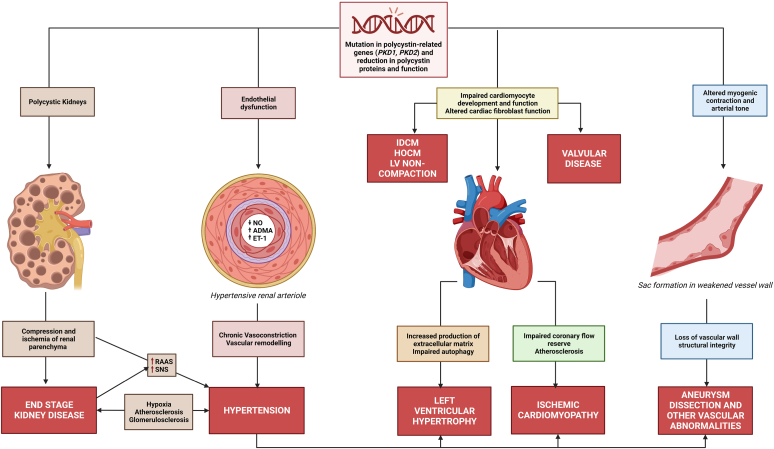
Pathogenesis of cardiovascular disease in ADPKD. Inherited abnormalities and reduction of functional polycystin-1 and polycystin-2 proteins impact multiple organ systems. Kidney cyst growth activates the RAAS and SNS, driving hypertension and other cardiovascular abnormalities. Endothelial dysfunction and chronic vasoconstriction lead to hypertension and vascular abnormalities, including arterial stiffness, thickening of vessel walls and atherosclerosis. These vascular changes also contribute to other arterial abnormalities such as intracranial aneurysms, dissections, and coronary artery disease. Hypertension is also a key risk factor for development of LVH and together contribute to the risk of coronary ischemia, likely predisposing patients to ischemic cardiomyopathy. Hypertensive arterial injury and development of cardiomyopathy leads to impaired end organ perfusion and atheroma development, which in turn, leads to renal injury with glomerulosclerosis and further RAAS activation in a pathogenic cycle. ADMA, asymmetric dimethylarginine; ADPKD, autosomal dominant polycystic kidney disease; ET-1, endothelin-1; HOCM, hypertrophic obstructive cardiomyopathy; IDCM, idiopathic dilated cardiomyopathy; LVH, left ventricular hypertrophy; NO, nitric oxide; RAAS, renin-angiotensin-aldosterone system; SNS, sympathetic nervous system.

References

    1. Chebib F.T., Torres V.E. Autosomal dominant polycystic kidney disease: core curriculum 2016. Am J Kidney Dis. 2016;67:792–810. doi: 10.1053/j.ajkd.2015.07.037. - DOI - PMC - PubMed
    1. Harris P.C., Torres V.E. Polycystic kidney disease, autosomal dominant. https://www.ncbi.nlm.nih.gov/books/NBK1246/
    1. Lemoine H., Raud L., Foulquier F., et al. Monoallelic pathogenic ALG5 variants cause atypical polycystic kidney disease and interstitial fibrosis. Am J Hum Genet. 2022;109:1484–1499. doi: 10.1016/j.ajhg.2022.06.013. - DOI - PMC - PubMed
    1. Ong A.C., Harris P.C. A polycystin-centric view of cyst formation and disease: the polycystins revisited. Kidney Int. 2015;88:699–710. doi: 10.1038/ki.2015.207. - DOI - PMC - PubMed
    1. Gallagher A.R., Germino G.G., Somlo S. Molecular advances in autosomal dominant polycystic kidney disease. Adv Chronic Kidney Dis. 2010;17:118–130. doi: 10.1053/j.ackd.2010.01.002. - DOI - PMC - PubMed

LinkOut - more resources