. 2023 Oct 12:15:823-838.
doi: 10.2147/NSS.S420650. eCollection 2023.

Sleep Architecture and Sleep EEG Alterations are Associated with Impaired Cognition Under Sleep Restriction

Affiliations

Sleep Architecture and Sleep EEG Alterations are Associated with Impaired Cognition Under Sleep Restriction

Tianxin Mao et al. Nat Sci Sleep. .

Abstract

Purpose: Many studies have investigated the cognitive, emotional, and other impairments caused by sleep restriction. However, few studies have explored the relationship between cognitive performance and changes in sleep structure and electroencephalography (EEG) during sleep. The present study aimed to examine whether changes in sleep structure and EEG can account for cognitive impairment caused by sleep restriction.

Patients and methods: Sixteen young adults spent five consecutive nights (adaptation 9h, baseline 8h, 1st restriction 6h, 2nd restriction 6h, and recovery 10h) in a sleep laboratory, with polysomnography recordings taken during sleep. Throughout waking periods in each condition, participants completed the psychomotor vigilance test (PVT), which measures vigilant attention, and the Go/No-Go task, which measures inhibition control.

Results: The results showed that sleep restriction significantly decreased the proportion of N1 and N2 sleep, increased the proportion of N3 sleep, and reduced the time spent awake after sleep onset (WASO) and sleep onset latency. Poorer performance on the PVT and Go/No Go task was associated with longer WASO, a larger proportion of N3 sleep, and a smaller proportion of N2 sleep. Additionally, the power spectral density of delta waves significantly increased after sleep restriction, and this increase predicted a decrease in vigilance and inhibition control the next day.

Conclusion: These findings suggest that sleep architecture and EEG signatures may partially explain cognitive impairment caused by sleep restriction.

Keywords: inhibition control; sleep EEG; sleep architecture; sleep restriction; vigilance.


Conflict of interest statement

The authors report no conflicts of interest in this work.

Figures
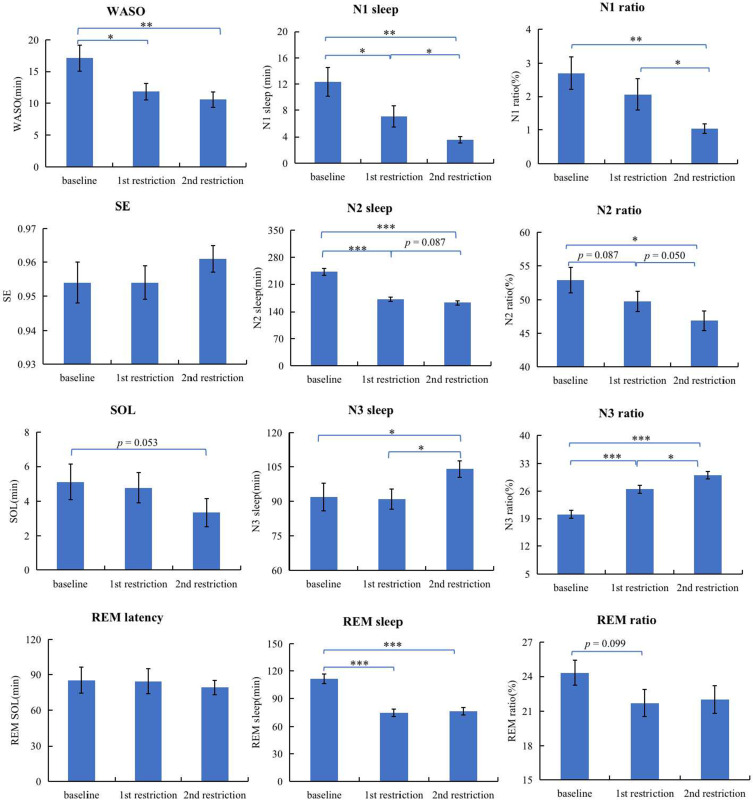
Figure 1
Figure 1
Differences of sleep architecture among baseline and SR nights.
Figure 2
Figure 2
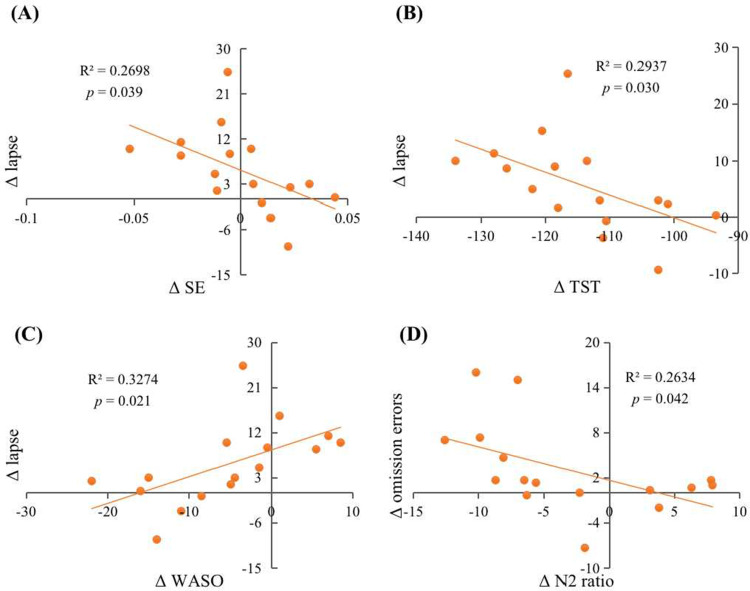
Scatter plots of the relationship between changes in sleep architecture during 1st SR nights and changes in cognition after 1st SR night. The relationship between (A) Δ SE and Δ lapse; (B) Δ TST and Δ lapse; (C) Δ WASO and Δ lapse; (D) Δ N2 ratio and Δ omission errors.
Figure 3
Figure 3
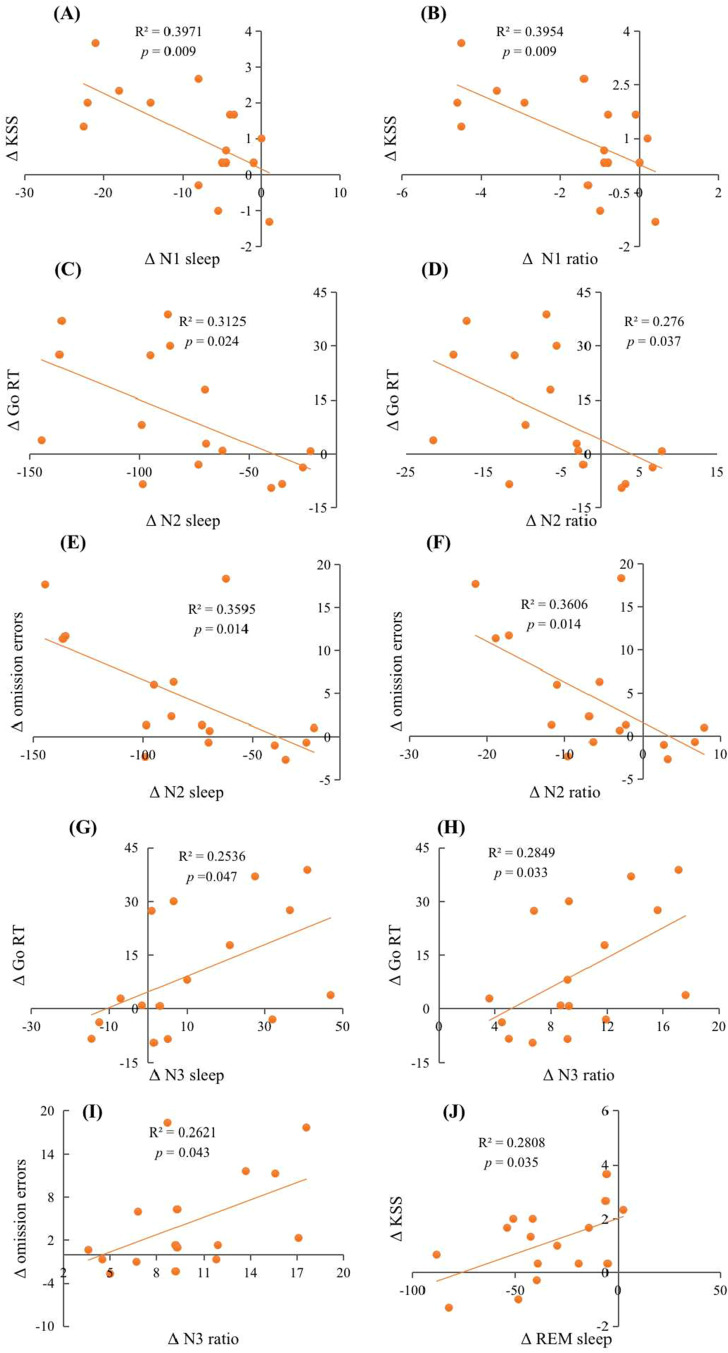
Scatter plots of the relationship between changes in sleep architecture during 2nd SR nights and changes in cognition after 2nd SR nights. The relationship between (A) Δ N1 sleep and Δ KSS; (B) Δ N1 sleep and Δ KSS; (C) Δ N2 sleep and Δ Go RT; (D) Δ N2 ratio and Δ Go RT; (E) Δ N2 sleep and Δ omission errors; (F) Δ N2 ratio and Δ omission errors; (G) Δ N3 sleep and Δ Go RT; (H) Δ N3 ratio and Δ Go RT; (I) Δ N3 ratio and Δ omission errors; (J) Δ REM sleep and Δ KSS.
Figure 4
Figure 4
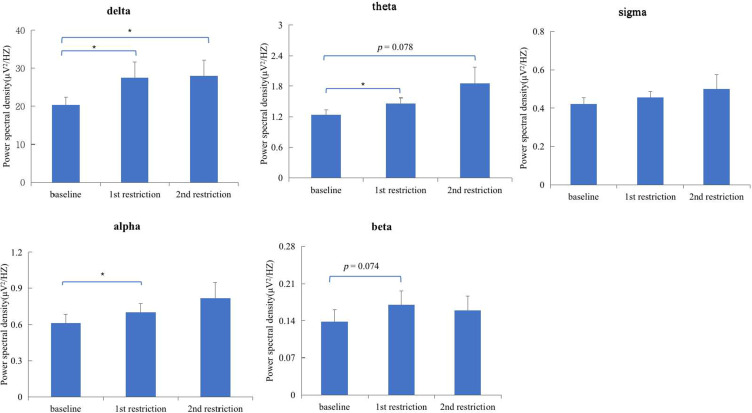
Differences of sleep EEG power density among baseline and SR nights.
Figure 5
Figure 5
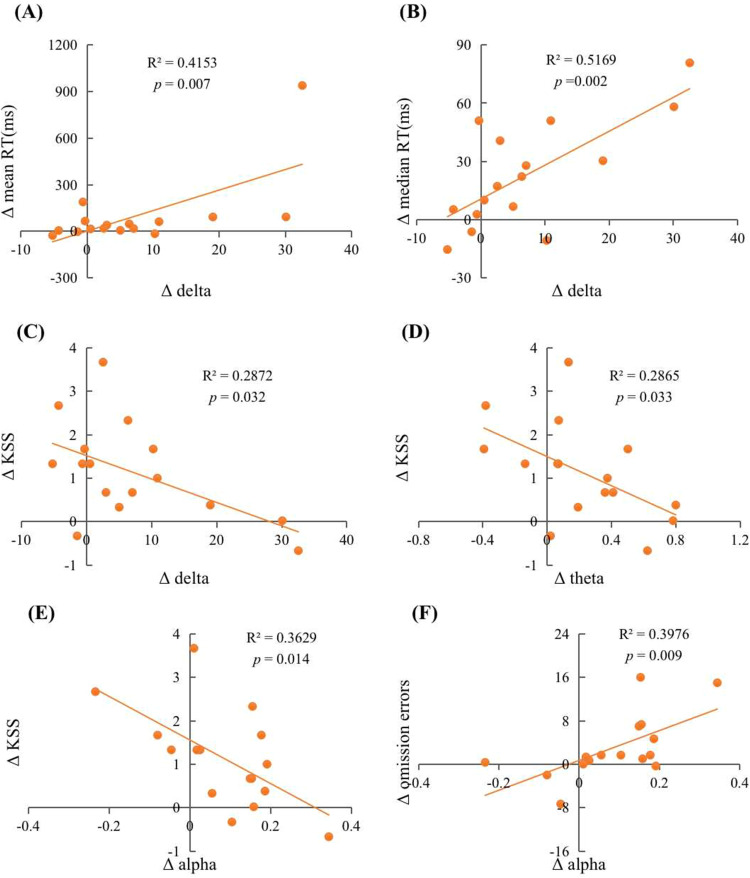
Scatter plots of the relationship between changes in sleep EEG power density during 1st SR night and changes in cognition after 1st SR night. The relationship between (A) Δ delta and Δ mean RT; (B) Δ delta and Δ median RT; (C) Δ delta and Δ KSS; (D) Δ theta and Δ KSS; (E) Δ alpha and Δ KSS; (F) Δ alpha and Δ omission errors.
Figure 6
Figure 6
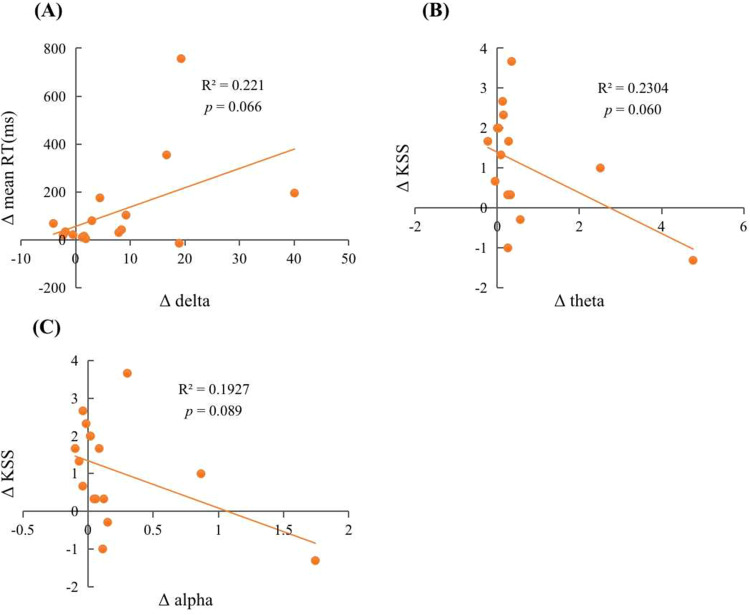
Scatter plots of the relationship between changes in sleep EEG power density during 2nd SR nights and changes in cognition after 2nd SR nights. The relationship between (A) Δ delta and Δ mean RT; (B) Δ theta and Δ KSS; (C) Δ alpha and Δ KSS.

References

    1. Chua EC, Fang E, Gooley JJ, Lee P-L. Effects of total sleep deprivation on divided attention performance. PLoS One. 2017;12(11):e0187098. doi:10.1371/journal.pone.0187098 - DOI - PMC - PubMed
    1. Van Peer JM, Gladwin TE, Nieuwenhuys A. Effects of threat and sleep deprivation on action tendencies and response inhibition. Emotion. 2019;19(8):1425–1436. doi:10.1037/emo0000533 - DOI - PubMed
    1. Anderson C, Platten CR. Sleep deprivation lowers inhibition and enhances impulsivity to negative stimuli. Behav Brain Res. 2011;217(2):463–466. doi:10.1016/j.bbr.2010.09.020 - DOI - PubMed
    1. Carskadon MA, Harvey K, Dement WC. Acute restriction of nocturnal sleep in children. Percept Mot Skills. 1981;53(1):103–112. doi:10.2466/pms.1981.53.1.103 - DOI
    1. Brunner DP, Dijk DJ, Tobler I, Borbely AA. Effect of partial sleep deprivation on sleep stages and EEG power spectra: evidence for non-rem and REM sleep homeostasis. Electroencephalogr Clin Neurophysiol. 1990;75(6):492–499. doi:10.1016/0013-4694(90)90136-8 - DOI - PubMed