. 2023 Oct 18;13(1):17739.
doi: 10.1038/s41598-023-44389-9.

Real-world treatment patterns of rheumatoid arthritis in Brazil: analysis of DATASUS national administrative claims data for pharmacoepidemiology studies (2010-2020)

Affiliations

Real-world treatment patterns of rheumatoid arthritis in Brazil: analysis of DATASUS national administrative claims data for pharmacoepidemiology studies (2010-2020)

Marina G Birck et al. Sci Rep. .

Abstract

Our study assessed DATASUS as a potential source for pharmacoepidemiologic studies in rheumatoid arthritis (RA) in the Brazilian population focusing on treatment patterns and determinants of initiating or switching to a novel therapy. This was a descriptive database study of RA patients with at least one claim of RA and ≥ 2 claims of disease-modifying anti-rheumatic drug (DMARD); conventional synthetic (cs), biologic (b) or targeted synthetic (ts) DMARD with more than 6 months of follow-up from 01-Jan-2010 to 31-Dec-2020. Analyses were stratified for SUS-exclusive and SUS+ private user cohorts. We identified 250,251 patients with RA in DATASUS: mean age of 58.4 years, majority female (83%) and white (58%). 62% were SUS-exclusive and 38% SUS+ private. Most common bDMARDs were adalimumab and etanercept. Age (adjusted odds ratio 1.78 [50+]; 95% CI 1.57-2.01), SUS exclusive status (0.53; 0.47-0.59), distance to clinic [160+ km] (0.57; 0.45-0.72), and pre-index csDMARD claims (1.23; 1.08-1.41) were independent predictors of initiating a novel oral tsDMARD. Switching from bDMARD to tsDMARD, associations were similar, except for the direction of associations for SUS exclusive status (adjusted hazard ratio 1.10; 1.03-1.18), distance to clinic (1.18; 1.03-1.35), and number of previous bDMARD (0.15; 0.14-0.16). DATASUS is a source suitable for treatment-related analyses in RA reflecting the public health system in Brazil.


Conflict of interest statement

Competing interests are financial in nature and associated with employment. MGB was an employee of IQVIA (Brazil) at the time of study conduct, and currently has no conflict of interest to declare. RF is an employee of IQVIA. WSK, MC, and AL are employees and stockholders with AbbVie Inc. GSJ was an employee of IQVIA (Brazil) at the time of study conduct, and is currently an employee and stockholder with Pfizer (Brazil). Otherwise, authors do not have further non-financial competing interests to declare.

Figures
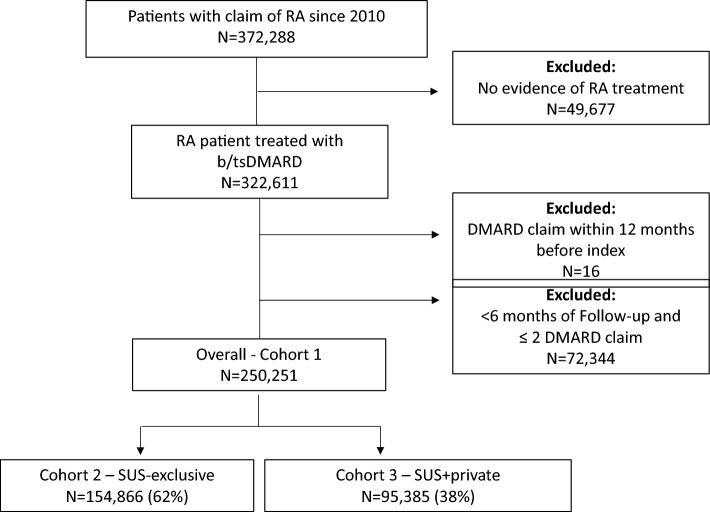
Figure 1
Figure 1
Study population of b/tsDMARD-treated rheumatoid arthritis patients in DATASUS with cohorts defined by their dependency on Brazil´s public health system (Sistema Único de Saúde), either exclusively (SUS_exclusive) or in combination with private insurance coverage (SUS+ private) (STROBE diagram). RA rheumatoid arthritis, DMARD disease modifying antirheumatic drug, N total number of patients, SUS Sistema Único de Saúde, SUS-exclusive comprehensive public health system for the entire population, SUS+ private refers to individuals on SUS only for prescription drug coverage.
Figure 2
Figure 2
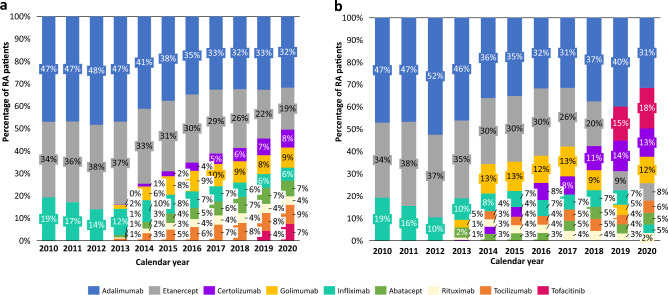
Prevalent users (a) and new users (b) of b/tsDMARD treatment among patients with rheumatoid arthritis in DATASUS per year. Prevalent users: patients with RA currently receiving b/tsDMARD treatment, percentage shown by b/tsDMARD type by year. New users: patients with RA initiating a new b/tsDMARD treatment (i.e., their first prescription). b/tsDMARD biologic/targeted synthetic DMARD. tsDMARD limited to tofacitinib at time of analysis.
Figure 3
Figure 3
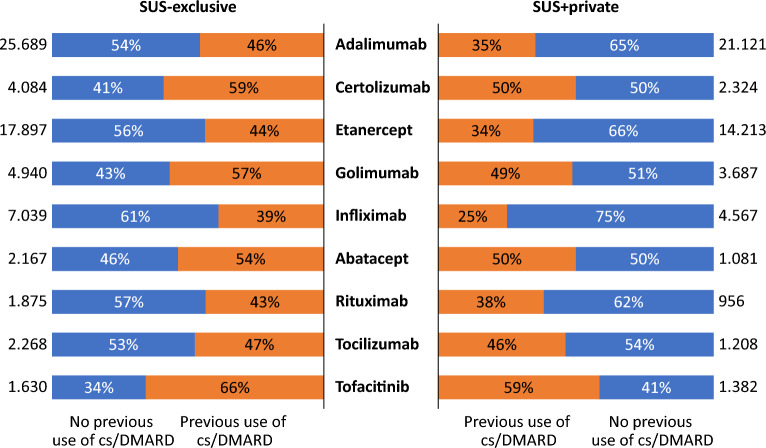
Previous use of csDMARD before initiating b/tsDMARD, stratified by SUS coverage dependency (exclusive or with private insurance) among patients with rheumatoid arthritis in DATASUS. b/tsDMARD biologics target synthetic disease modifying antirheumatic drug. tsDMARD limited to tofacitinib at time of analysis. SUS-exclusive, dependent on SUS for all healthcare resources; SUS+ private, individuals dependent on SUS only for prescription drug coverage. csDMARD conventional synthetic disease modifying antirheumatic.
Figure 4
Figure 4
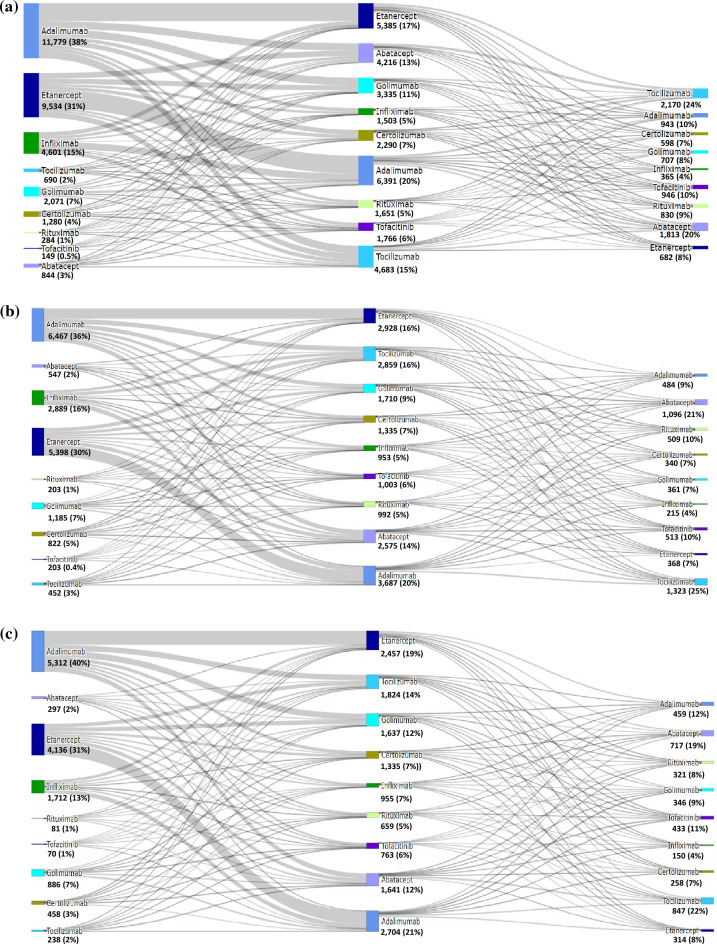
(a) Sankey diagram depicting treatment sequencing among patients with rheumatoid arthritis initiating a b/tsDMARD who transition to a second-line, and/or third-line treatment (N = 31,232). b/tsDMARD biologic target synthetic disease modifying antirheumatic drug; tsDMARD limited to tofacitiniv at time of analysis; Sankey diagram limited to b/tsDMARDs. csDMARDs, conventional disease modifying antirheumatics, not shown and may be combination with b/tsDMARDs). (b) Sankey diagram of patients with rheumatoid arthritics initiating a b/tsDMARD who transition to a second-line, or third-line treatment (SUS-exclusive cohort) in DATASUS (N = 18,042). b/tsDMARD biologic target synthetic disease modifying antirheumatic. tsDMARD limited to tofacitinib at time of analysis;Sankey limited to b/tsDMARDs (csDMARD, conventional disease modifying antirheumatics, not shown and may be combination with b/tsDMARDs); SUS-exclusive are individuals, dependent on SUS for all healthcare resources. (c) Sankey diagram of patients with rheumatoid arthritis initiating a b/tsDMARD who transition to a second-line and/or third-line treatment (SUS+ private insurance cohort)in DATASUS (N = 13,190). b/tsDMARD biologic target synthetic disease modifying antirheumatic. tsDMARD limited to tofacitinib at time of analysis. Sankey limited to b/tsDMARDs (csDMARDs, conventional disease modifying antirheumatics, not shown and may be combination with b/tsDMARDs). SUS+ private insurance are individuals dependent on SUS only for prescription drug coverage.
Figure 5
Figure 5
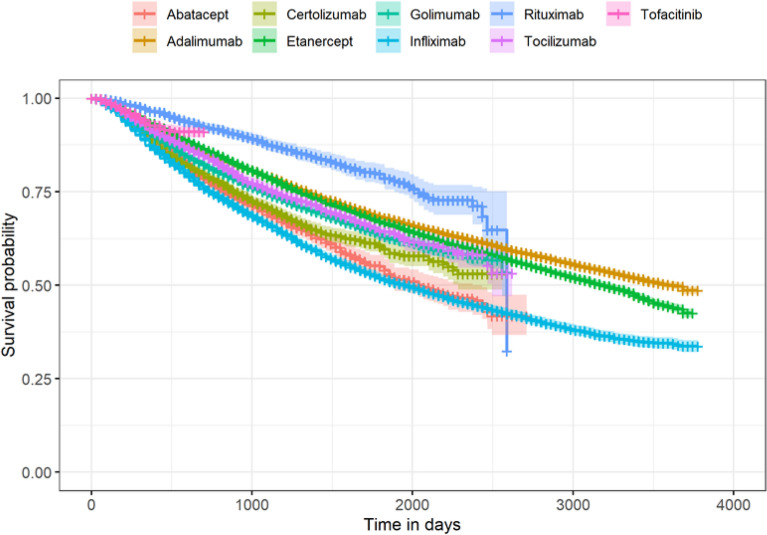
Kaplan Meier plot depicting timing of switch from first-line (LOT1) to second-line treatment (LOT2) among rheumatoid arthritis patients receiving b/tsDMARD therapies in DATASUS (2010–2020). b/tsDMARD biologic target synthetic disease modifying antirheumatic; tsDMARD limited to tofacitinib at the time of analysis.

References

    1. Corrigan-Curay J, Sacks L, Woodcock J. Real-world evidence and real-world data for evaluating drug safety and effectiveness. JAMA. 2018;32:867–868. doi: 10.1001/jama.2018.10136. - DOI - PubMed
    1. Katkade VB, Sanders KN, Zou KH. Real world data: An opportunity to supplement existing evidence for the use of long-established medicines in health care decision making. J. Multidiscip. Healthc. 2018;11:295–304. doi: 10.2147/JMDH.S160029. - DOI - PMC - PubMed
    1. U.S. Food and Drug. Real-World Evidence. https://www.fda.gov/science-research/science-and-research-special-topics... (2023).
    1. Leal LF, et al. Data sources for drug utilization research in Brazil—DUR-BRA Study. Front. Pharmacol. 2022;12:789872. doi: 10.3389/fphar.2021.789872. - DOI - PMC - PubMed
    1. Ogale S, Hitraya E, Henk HJ. Patterns of biologic agent utilization among patients with rheumatoid arthritis: A retrospective cohort study. BMC Musculoskelet. Disord. 2011;12:204. doi: 10.1186/1471-2474-12-204. - DOI - PMC - PubMed

Publication types