The Cross-sectional and Longitudinal Association Between Thyroid Function and Depression: A Population-Based Study
- PMID: 37855318
- PMCID: PMC11031221
- DOI: 10.1210/clinem/dgad620
The Cross-sectional and Longitudinal Association Between Thyroid Function and Depression: A Population-Based Study
Erratum in
-
Correction to: "The Cross-sectional and Longitudinal Association Between Thyroid Function and Depression: A Population-Based Study".J Clin Endocrinol Metab. 2024 Apr 19;109(5):e1418. doi: 10.1210/clinem/dgae148. J Clin Endocrinol Metab. 2024. PMID: 38484136 Free PMC article. No abstract available.
Abstract
Context: An association of thyroid function with mood disorders has been widely suggested, but very few studies have examined this association longitudinally.
Objective: We assessed the cross-sectional and longitudinal association between thyroid function and depression in a population-based cohort.
Methods: A total of 9471 individuals were included in cross-sectional analyses, of whom 8366 had longitudinal data. At baseline, we assessed thyroid function using serum samples (thyrotropin [TSH], free thyroxine (FT4), and thyroid peroxidase antibodies) and depressive symptoms using the Centre for Epidemiologic Studies Depression (CES-D) scale. Incident depressive events (n = 1366) were continuously followed up with the CES-D and clinical interviews. We analyzed the cross-sectional association of thyroid function and thyroid disease with depressive symptoms using linear and logistic regression, and the longitudinal association with Cox proportional hazard models for depressive events.
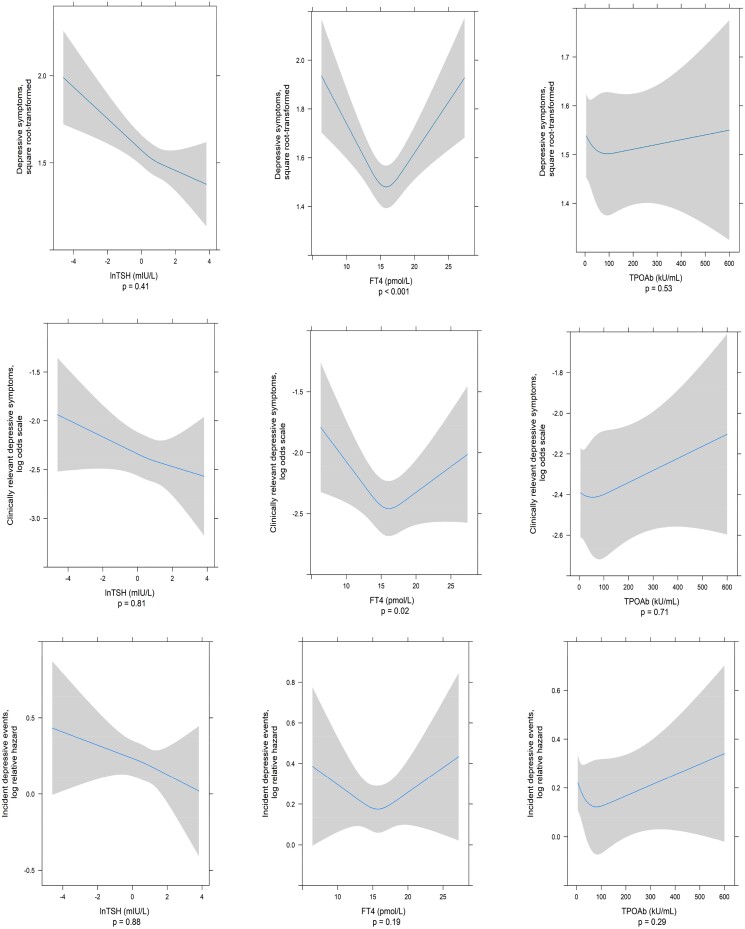
Results: Lower TSH levels and lower and higher FT4 levels were cross-sectionally associated with more depressive symptoms with a B value of -0.07 per 1 unit increase of natural log-transformed TSH (95% CI -0.11; -0.04). Furthermore, hypothyroidism was cross-sectionally associated with less depressive symptoms and hyperthyroidism with more depressive symptoms. Longitudinally, there was a U-shaped association between FT4 and incident depressive events but only in euthyroid participants.
Conclusion: We show a cross-sectional association between thyroid (dys)function with depressive symptoms, and a U-shaped association between FT4 and incident depressive events in euthyroid individuals. Our findings suggest an association of thyroid function with the risk of developing depression, albeit small. Reverse causation and additional underlying factors may also contribute to the association.
Keywords: FT4; TSH; cross-sectional; depression; prospective; thyroid disease.
© The Author(s) 2023. Published by Oxford University Press on behalf of the Endocrine Society.
Figures
References
-
- Bernal J. Thyroid hormone receptors in brain development and function. Nat Clin Pract Endocrinol Metabol. 2007;3(3):249‐259. - PubMed
-
- Montero-Pedrazuela A, Venero C, Lavado-Autric R, et al. Modulation of adult hippocampal neurogenesis by thyroid hormones: implications in depressive-like behavior. Mol Psychiatry. 2006;11(4):361‐371. - PubMed
-
- Shoib S, Ahmad J, Wani MA, et al. Depression and anxiety among hyperthyroid female patients and impact of treatment. Middle East Curr Psychiatry. 2021;28(1):26.
-
- Chaker L, Razvi S, Bensenor IM, Azizi F, Pearce EN, Peeters RP. Hypothyroidism. Nat Rev Dis Primers. 2022;8(1):30. - PubMed
MeSH terms
Substances
Grants and funding
LinkOut - more resources
Full Text Sources
Medical