


Pulsed field ablation versus thermal energy ablation for atrial fibrillation: a systematic review and meta-analysis of procedural efficiency, safety, and efficacy
- PMID: 37855992
- PMCID: PMC11016003
- DOI: 10.1007/s10840-023-01660-3
Pulsed field ablation versus thermal energy ablation for atrial fibrillation: a systematic review and meta-analysis of procedural efficiency, safety, and efficacy
Abstract
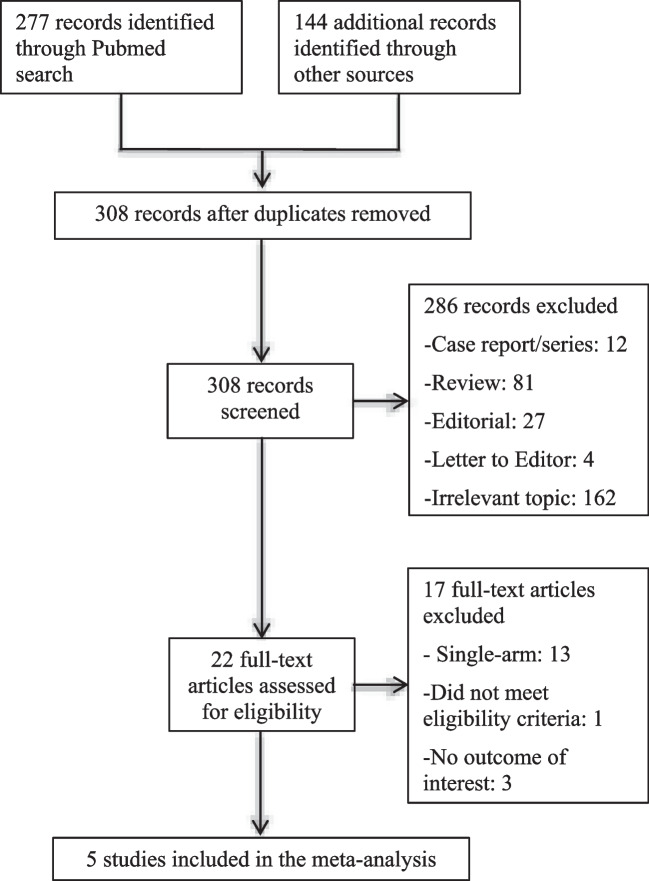
Background: Pulsed field ablation (PFA) induces cell death through electroporation using ultrarapid electrical pulses. We sought to compare the procedural efficiency characteristics, safety, and efficacy of ablation of atrial fibrillation (AF) using PFA compared with thermal energy ablation.
Methods: We performed an extensive literature search and systematic review of studies that compared ablation of AF with PFA versus thermal energy sources. Risk ratio (RR) 95% confidence intervals (CI) were measured for dichotomous variables and mean difference (MD) 95% CI were measured for continuous variables, where RR < 1 and MD < 0 favor the PFA group.
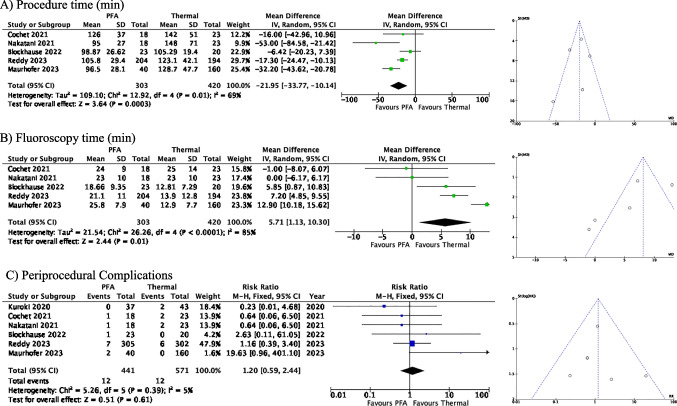
Results: We included 6 comparative studies for a total of 1012 patients who underwent ablation of AF: 43.6% with PFA (n = 441) and 56.4% (n = 571) with thermal energy sources. There were significantly shorter procedures times with PFA despite a protocolized 20-min dwell time (MD - 21.95, 95% CI - 33.77, - 10.14, p = 0.0003), but with significantly longer fluroscopy time (MD 5.71, 95% CI 1.13, 10.30, p = 0.01). There were no statistically significant differences in periprocedural complications (RR 1.20, 95% CI 0.59-2.44) or recurrence of atrial tachyarrhythmias (RR 0.64, 95% CI 0.31, 1.34) between the PFA and thermal ablation cohorts.
Conclusions: Based on the results of this meta-analysis, PFA was associated with shorter procedural times and longer fluoroscopy times, but no difference in periprocedural complications or rates of recurrent AF when compared to ablation with thermal energy sources. However, larger randomized control trials are needed.
Keywords: Atrial fibrillation; Catheter ablation; Pulsed field ablation; Thermal ablation.
© 2023. The Author(s).
Conflict of interest statement
Dr. Hsu reports receiving honoraria from Medtronic, Abbott, Boston Scientific, Biotronik, Janssen Pharmaceuticals, Bristol-Myers Squibb, Pfizer, Sanofi, Zoll Medical, Hillrom, iRhythm, Acutus Medical, and Biosense-Webster; equity interest in Vektor Medical; and research grants from Biotronik and Biosense-Webster. Dr. Ho reports receiving a research grant from Abbott, equity in Vektor Medical, and fellowship support from Medtronic, Abbott, Boston Scientific, and Biotronik. Dr. Feld reports receiving fellowship training program stipends (as CCEP fellowship training program director) from Medtronic, Biotronik, Biosense Webster, and Abbott Medical; has equity interest in Vektor Medical; is co-founder and co-owner of Perminova; and is a consultant to Acutus Medical. Dr Han receives research support from Abbott and honoraria from Abbott.
Figures

References
-
- January CT, Wann LS, Calkins H, Chen LY, Cigarroa JE, Cleveland JC, Jr., Ellinor PT, Ezekowitz MD, Field ME, Furie KL, Heidenreich PA, Murray KT, Shea JB, Tracy CM and Yancy CW. 2019 AHA/ACC/HRS focused update of the 2014 AHA/ACC/HRS guideline for the management of patients with atrial fibrillation. Circulation. 2019:CIR0000000000000665.
-
- Calkins H, Hindricks G, Cappato R, Kim YH, Saad EB, Aguinaga L, Akar JG, Badhwar V, Brugada J, Camm J, Chen PS, Chen SA, Chung MK, Nielsen JC, Curtis AB, Wyn Davies D, Day JD, d’Avila A, de Groot N, Di Biase L, Duytschaever M, Edgerton JR, Ellenbogen KA, Ellinor PT, Ernst S, Fenelon G, Gerstenfeld EP, Haines DE, Haissaguerre M, Helm RH, Hylek E, Jackman WM, Jalife J, Kalman JM, Kautzner J, Kottkamp H, Kuck KH, Kumagai K, Lee R, Lewalter T, Lindsay BD, Macle L, Mansour M, Marchlinski FE, Michaud GF, Nakagawa H, Natale A, Nattel S, Okumura K, Packer D, Pokushalov E, Reynolds MR, Sanders P, Scanavacca M, Schilling R, Tondo C, Tsao HM, Verma A, Wilber DJ, Yamane T. 2017 HRS/EHRA/ECAS/APHRS/SOLAECE expert consensus statement on catheter and surgical ablation of atrial fibrillation: executive summary. J Interv Card Electrophysiol. 2017;50:1–55. doi: 10.1007/s10840-017-0277-z. - DOI - PMC - PubMed
