


Evidence-Based Care of Older Adults With Metastatic Colorectal Cancer: Insights From Landmark Clinical Trials
- PMID: 37856768
- PMCID: PMC10691792
- DOI: 10.1200/JCO.23.01337
Evidence-Based Care of Older Adults With Metastatic Colorectal Cancer: Insights From Landmark Clinical Trials
Abstract
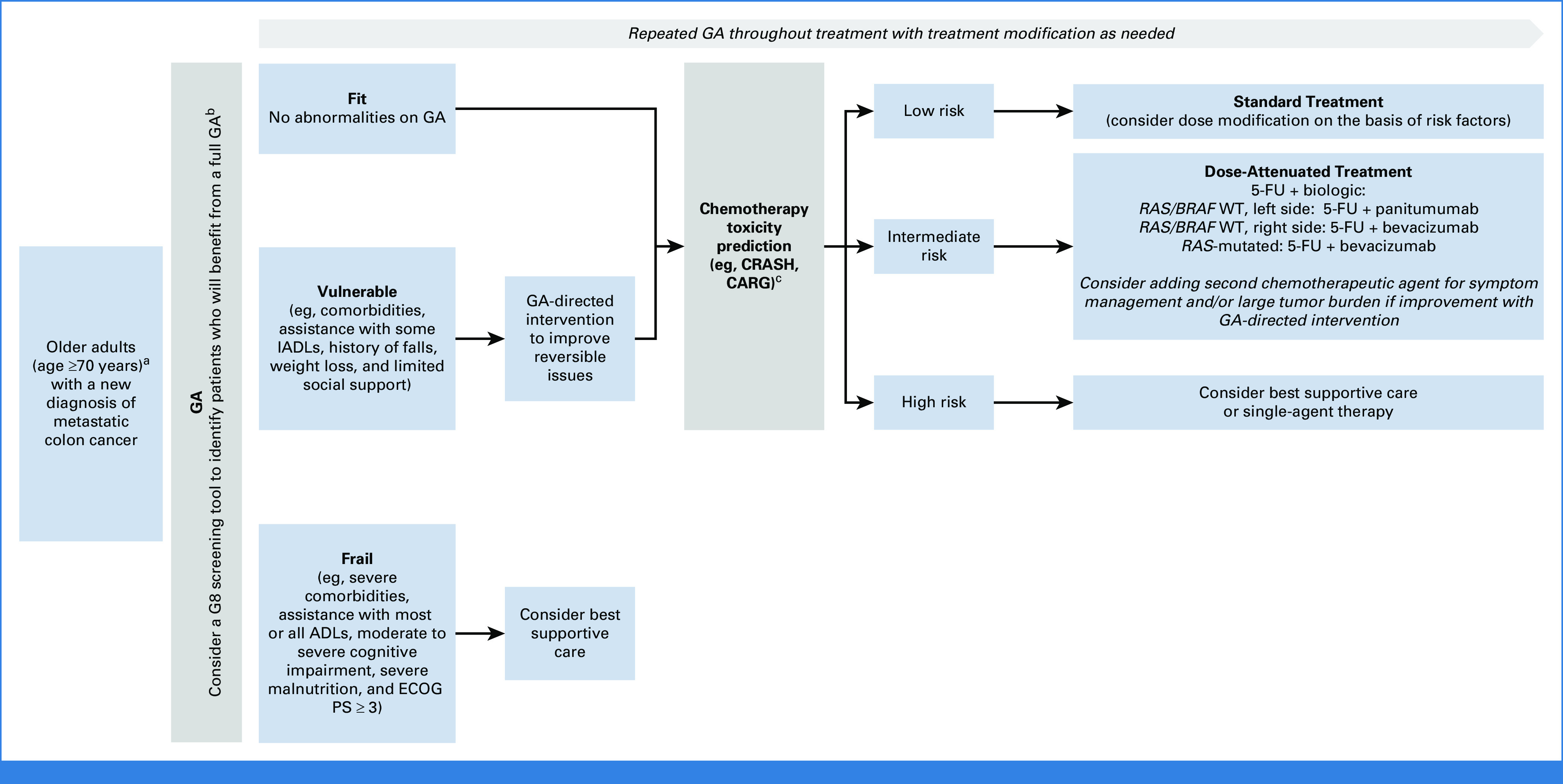
The Oncology Grand Rounds series is designed to place original reports published in the Journal into clinical context. A case presentation is followed by a description of diagnostic and management challenges, a review of the relevant literature, and a summary of the authors' suggested management approaches. The goal of this series is to help readers better understand how to apply the results of key studies, including those published in Journal of Clinical Oncology, to patients seen in their own clinical practice.Colorectal cancer (CRC) is the second leading cause of cancer-related death in the United States with more than half of the patients diagnosed being older than 65 years, and an expected further increase in older adults (OA) diagnosed with this cancer in the coming years as the population ages. Prospective data guiding the management of older patients with metastatic CRC (mCRC) have been limited and treatment decisions for these patients are often guided by chronologic age, crude evaluation of performance status, and extrapolation from trials conducted in younger individuals. Recent evidence from randomized clinical trials specifically designed for OA supports treatment deintensification and dose modification to increase tolerability without compromising efficacy in older, frailer patients with mCRC. Additional studies support the incorporation of geriatric assessment (GA)-driven care to further improve the outcomes of OA with mCRC. Although the use of GA has not been validated in guiding specific treatment selection or modification for OA with mCRC, it provides a comprehensive and objective evaluation of a patient's functional status, comorbidities, risk of potential toxicities, effect on the quality of life, goals of care, and assists with personalizing therapy. With the increase in the number of OA we care for in our practices, it is time to stop extrapolating and define an evidence-based approach for this population that is based on data from prospective elderly specific clinical trials.
Conflict of interest statement
The following represents disclosure information provided by authors of this manuscript. All relationships are considered compensated unless otherwise noted. Relationships are self-held unless noted. I = Immediate Family Member, Inst = My Institution. Relationships may not relate to the subject matter of this manuscript. For more information about ASCO's conflict of interest policy, please refer to
Open Payments is a public database containing information reported by companies about payments made to US-licensed physicians (
No other potential conflicts of interest were reported.
Figures
References
-
- Siegel RL, Miller KD, Fuchs HE, et al. : Cancer statistics, 2022. CA Cancer J Clin 72:7-33, 2022 - PubMed
-
- Siegel RL, Miller KD, Goding Sauer A, et al. : Colorectal cancer statistics, 2020. CA Cancer J Clin 70:145-164, 2020 - PubMed
-
- Fried TR, Bradley EH, Towle VR, et al. : Understanding the treatment preferences of seriously ill patients. N Engl J Med 346:1061-1066, 2002 - PubMed
Publication types
MeSH terms
Grants and funding
LinkOut - more resources
Full Text Sources
