Comparison of survival outcomes between robotic and laparoscopic radical hysterectomies for early-stage cervical cancer: a systemic review and meta-analysis
- PMID: 37857564
- PMCID: PMC10792214
- DOI: 10.3802/jgo.2024.35.e9
Comparison of survival outcomes between robotic and laparoscopic radical hysterectomies for early-stage cervical cancer: a systemic review and meta-analysis
Abstract
Objective: Survival outcomes of robotic radical hysterectomy (RRH) remain controversial. Therefore, we performed a meta-analysis to evaluate survival outcomes between RRH) and laparoscopic radical hysterectomy (LRH) in patients with early-stage cervical cancer.
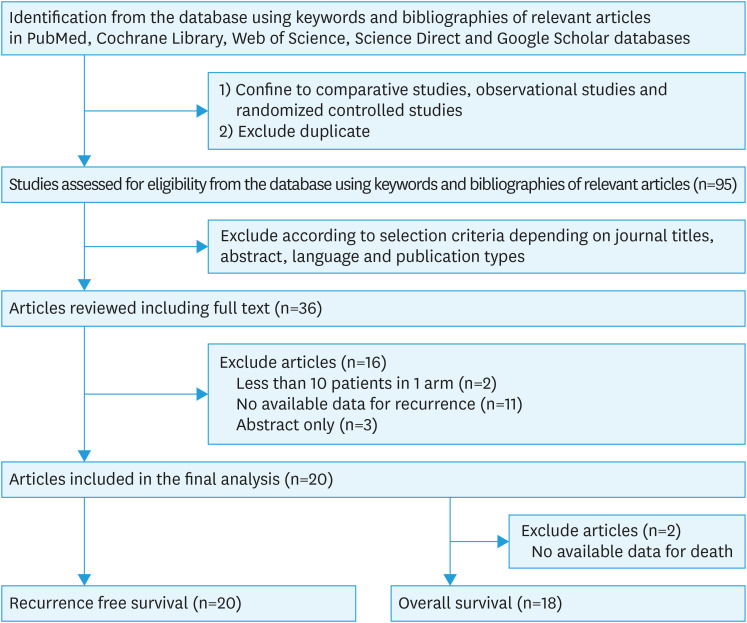
Methods: Studies comparing between RRH and LRH published up to November 2022 were systemically searched in the PubMed, Cochrane Library, Web of Science, ScienceDirect, and Google Scholar databases. Manual searches of related articles and relevant bibliographies of the published studies were also performed. Two researchers independently extracted data. Studies with information on recurrence and death after minimally invasive radical hysterectomy were also included. The extracted data were analyzed using the Stata MP software package version 17.0.
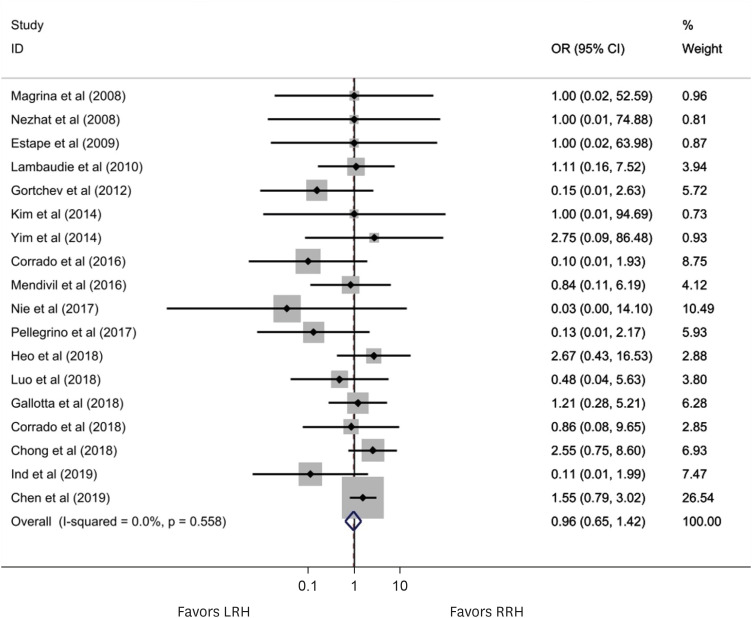
Results: Twenty eligible clinical trials were included in the meta-analysis. When all studies were pooled, the odds ratios of RRH for recurrence and death were 1.19 (95% confidence interval [CI]=0.91-1.55; p=0.613; I²=0.0%) and 0.96 (95% CI=0.65-1.42; p=0.558; I²=0.0%), respectively. In a subgroup analysis, the quality of study methodology, study size, country where the study was conducted, and publication year were not associated with survival outcomes between RRH and LRH.
Conclusion: This meta-analysis demonstrates that the survival outcomes are comparable between RRH and LRH.
Trial registration: International Prospective Register of Systematic Reviews Identifier: CRD42023387916.
Keywords: Hysterectomy; Laparoscopy; Robotic Surgical Procedures; Survival Analysis; Uterine Cervical Neoplasm.
© 2024. Asian Society of Gynecologic Oncology, Korean Society of Gynecologic Oncology, and Japan Society of Gynecologic Oncology.
Conflict of interest statement
No potential conflict of interest relevant to this article was reported.
Figures

References
-
- Ramirez PT, Frumovitz M, Pareja R, Lopez A, Vieira M, Ribeiro R, et al. Minimally invasive versus abdominal radical hysterectomy for cervical cancer. N Engl J Med. 2018;379:1895–1904. - PubMed
-
- Chiva L, Zanagnolo V, Querleu D, Martin-Calvo N, Arévalo-Serrano J, Căpîlna ME, et al. SUCCOR study: an international European cohort observational study comparing minimally invasive surgery versus open abdominal radical hysterectomy in patients with stage IB1 cervical cancer. Int J Gynecol Cancer. 2020;30:1269–1277. - PubMed
-
- Summitt RL, Jr, Stovall TG, Steege JF, Lipscomb GH. A multicenter randomized comparison of laparoscopically assisted vaginal hysterectomy and abdominal hysterectomy in abdominal hysterectomy candidates. Obstet Gynecol. 1998;92:321–326. - PubMed
-
- Herron DM, Marohn M SAGES-MIRA Robotic Surgery Consensus Group. A consensus document on robotic surgery. Surg Endosc. 2008;22:313–325. - PubMed