Review
. 2023 Oct 19;9(1):23.
doi: 10.1038/s41514-023-00120-6.

Assessing cognitive decline in the aging brain: lessons from rodent and human studies

Collaborators, Affiliations
Review

Assessing cognitive decline in the aging brain: lessons from rodent and human studies

D V C Brito et al. NPJ Aging. .

Abstract

As life expectancy continues to increase worldwide, age-related dysfunction will largely impact our societies in the future. Aging is well established to promote the deterioration of cognitive function and is the primary risk factor for the development of prevalent neurological disorders. Even in the absence of dementia, age-related cognitive decline impacts specific types of memories and brain structures in humans and animal models. Despite this, preclinical and clinical studies that investigate age-related changes in brain physiology often use largely different methods, which hinders the translational potential of findings. This review seeks to integrate what is known about age-related changes in the brain with analogue cognitive tests used in humans and rodent studies, ranging from "pen and paper" tests to virtual-reality-based paradigms. Finally, we draw parallels between the behavior paradigms used in research compared to the enrollment into clinical trials that aim to study age-related cognitive decline.


Conflict of interest statement

The authors declare that they have no known competing financial interests or personal relationships that could have appeared to influence the work reported in this paper.

Figures
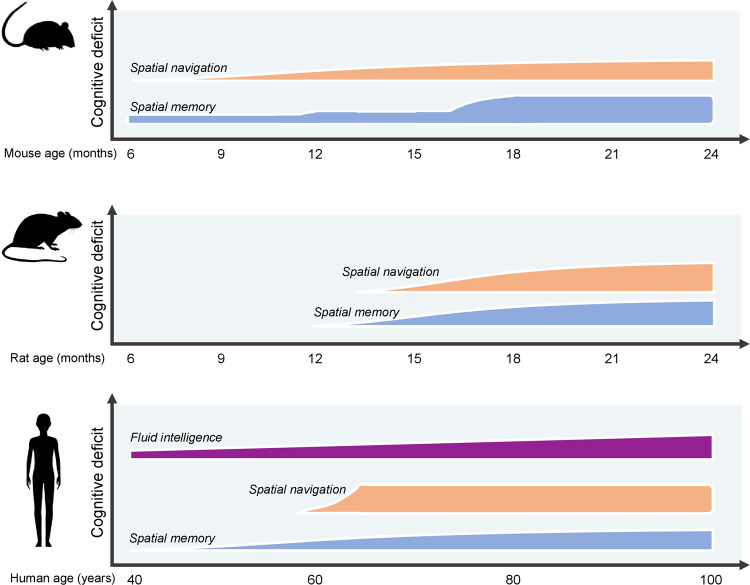
Fig. 1
Fig. 1. Illustration on the onset and progression of cognitive deficits in humans and rodent animal models.
Ages depicted are based on the progression of age-related cognitive decline in mouse,,–, rats,,, and human,,, studies.
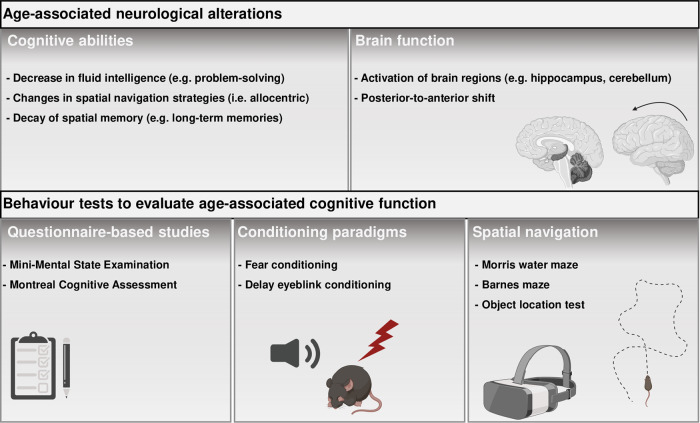
Fig. 2
Fig. 2. Overview of main neurological alterations during aging and available tests.
Major age-associated modifications in cognitive abilities and brain functioning are depicted in the top part of the table. Bottom part highlights “pen and paper” questionaries, routinely performed in the clinic, associative learning and spatial navigation-based tests that can be used to access age-related cognitive decline.
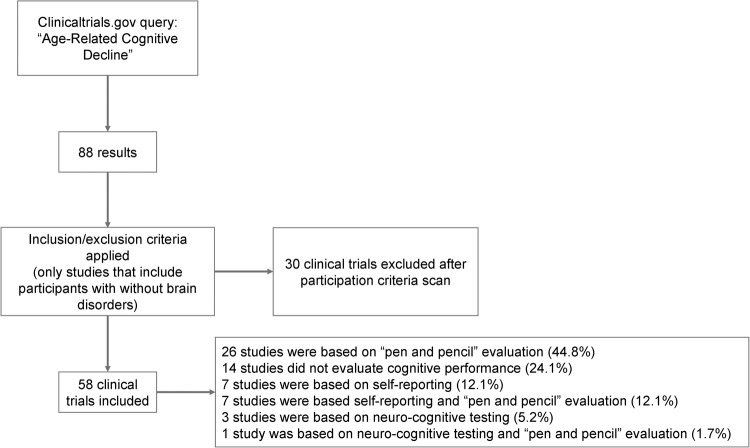
Fig. 3
Fig. 3. Flow chart of the systematic approach.
The diagram depicts the flow of information through the different phases of screening.

References

    1. Crimmins EM. Lifespan and healthspan: past, present, and promise. Gerontologist. 2015;55:901–911. doi: 10.1093/geront/gnv130. - DOI - PMC - PubMed
    1. Vollset SE, et al. Fertility, mortality, migration, and population scenarios for 195 countries and territories from 2017 to 2100: a forecasting analysis for the Global Burden of Disease Study. Lancet. 2020;396:1285–1306. doi: 10.1016/S0140-6736(20)30677-2. - DOI - PMC - PubMed
    1. Finch CE. Evolution in health and medicine Sackler colloquium: evolution of the human lifespan and diseases of aging: roles of infection, inflammation, and nutrition. Proc. Natl Acad. Sci. USA. 2010;107:1718–1724. doi: 10.1073/pnas.0909606106. - DOI - PMC - PubMed
    1. Brayne C, Gill C, Paykel ES, Huppert F, O’Connor DW. Cognitive decline in an elderly population—a two wave study of change. Psychol. Med. 1995;25:673–683. doi: 10.1017/S0033291700034930. - DOI - PubMed
    1. Aigbogun MS, Stellhorn R, Krasa H, Kostic D. Severity of memory impairment in the elderly: Association with health care resource use and functional limitations in the United States. Alzheimer’s Dementia (Amsterdam, Netherlands) 2017;8:51–59. - PMC - PubMed