


A real-world clinical validation for AI-based MRI monitoring in multiple sclerosis
- PMID: 37857813
- PMCID: PMC10587188
- DOI: 10.1038/s41746-023-00940-6
A real-world clinical validation for AI-based MRI monitoring in multiple sclerosis
Abstract
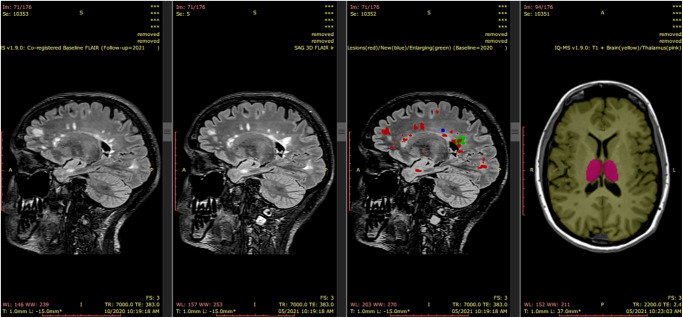
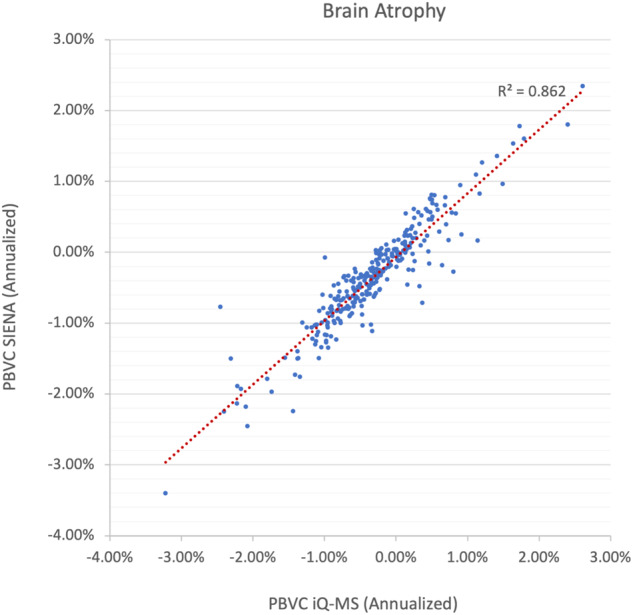
Modern management of MS targets No Evidence of Disease Activity (NEDA): no clinical relapses, no magnetic resonance imaging (MRI) disease activity and no disability worsening. While MRI is the principal tool available to neurologists for monitoring clinically silent MS disease activity and, where appropriate, escalating treatment, standard radiology reports are qualitative and may be insensitive to the development of new or enlarging lesions. Existing quantitative neuroimaging tools lack adequate clinical validation. In 397 multi-center MRI scan pairs acquired in routine practice, we demonstrate superior case-level sensitivity of a clinically integrated AI-based tool over standard radiology reports (93.3% vs 58.3%), relative to a consensus ground truth, with minimal loss of specificity. We also demonstrate equivalence of the AI-tool with a core clinical trial imaging lab for lesion activity and quantitative brain volumetric measures, including percentage brain volume loss (PBVC), an accepted biomarker of neurodegeneration in MS (mean PBVC -0.32% vs -0.36%, respectively), whereas even severe atrophy (>0.8% loss) was not appreciated in radiology reports. Finally, the AI-tool additionally embeds a clinically meaningful, experiential comparator that returns a relevant MS patient centile for lesion burden, revealing, in our cohort, inconsistencies in qualitative descriptors used in radiology reports. AI-based image quantitation enhances the accuracy of, and value-adds to, qualitative radiology reporting. Scaled deployment of these tools will open a path to precision management for patients with MS.
© 2023. Springer Nature Limited.
Conflict of interest statement
The authors declare the following financial/non-financial competing interests: D.W., K.K., L.L., A.S., Z.T., G.Z. and C.W. are employees of Sydney Neuroimaging Analysis Centre (SNAC); M.B. is a consulting neurologist and director for research at SNAC; T.D. and Y.B. are consulting radiologists at SNAC. C.W. and Y.B. personally hold equity ownership in SNAC, the entity that manufactures iQ-SolutionsTM
Figures
References
-
- Kappos L, et al. Contribution of relapse-independent progression vs relapse-associated worsening to overall confirmed disability accumulation in typical relapsing multiple sclerosis in a pooled analysis of 2 randomized clinical trials. JAMA Neurol. 2020;77:1132–1140. doi: 10.1001/jamaneurol.2020.1568. - DOI - PMC - PubMed
Grants and funding
LinkOut - more resources
Full Text Sources
Miscellaneous
