


Expression and splicing mediate distinct biological signals
- PMID: 37858135
- PMCID: PMC10588054
- DOI: 10.1186/s12915-023-01724-w
Expression and splicing mediate distinct biological signals
Abstract
Background: Through alternative splicing, most human genes produce multiple isoforms in a cell-, tissue-, and disease-specific manner. Numerous studies show that alternative splicing is essential for development, diseases, and their treatments. Despite these important examples, the extent and biological relevance of splicing are currently unknown.
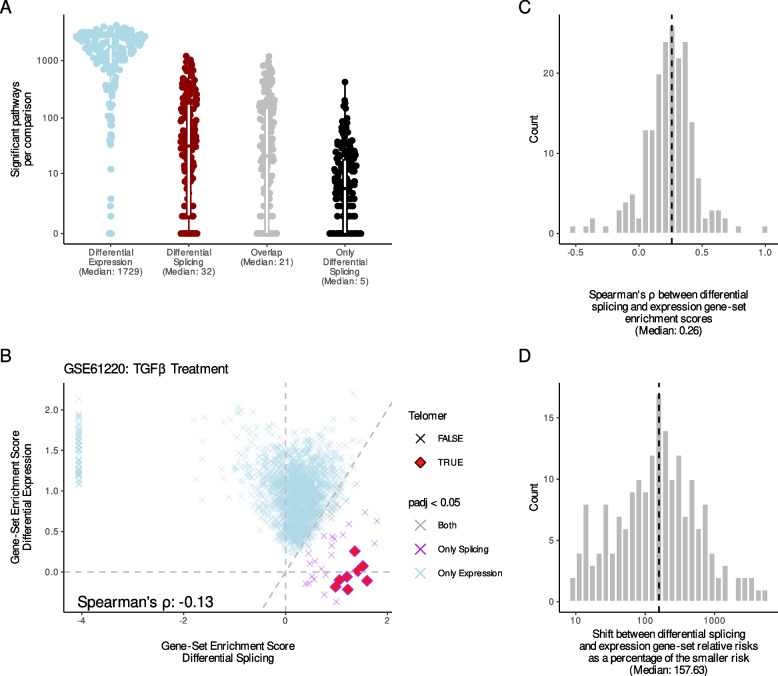
Results: To solve this problem, we developed pairedGSEA and used it to profile transcriptional changes in 100 representative RNA-seq datasets. Our systematic analysis demonstrates that changes in splicing, on average, contribute to 48.1% of the biological signal in expression analyses. Gene-set enrichment analysis furthermore indicates that expression and splicing both convey shared and distinct biological signals.
Conclusions: These findings establish alternative splicing as a major regulator of the human condition and suggest that most contemporary RNA-seq studies likely miss out on critical biological insights. We anticipate our results will contribute to the transition from a gene-centric to an isoform-centric research paradigm.
Keywords: Alternative splicing; Bioinformatics; Gene expression; Gene regulation; Isoform; Isoform expression; RNA-seq; RNA-sequencing; Systems biology.
© 2023. BioMed Central Ltd., part of Springer Nature.
Conflict of interest statement
The authors declare no competing interests.
Figures


References
-
- Pan Q, Shai O, Lee LJ, Frey BJ, Blencowe BJ. Deep surveying of alternative splicing complexity in the human transcriptome by high-throughput sequencing. Nat Genet. 2008;40:1413–1415. - PubMed
Publication types
MeSH terms
Substances
LinkOut - more resources
Full Text Sources
