


The association between reallocations of time and health using compositional data analysis: a systematic scoping review with an interactive data exploration interface
- PMID: 37858243
- PMCID: PMC10588100
- DOI: 10.1186/s12966-023-01526-x
The association between reallocations of time and health using compositional data analysis: a systematic scoping review with an interactive data exploration interface
Abstract
Background: How time is allocated influences health. However, any increase in time allocated to one behaviour must be offset by a decrease in others. Recently, studies have used compositional data analysis (CoDA) to estimate the associations with health when reallocating time between different behaviours. The aim of this scoping review was to provide an overview of studies that have used CoDA to model how reallocating time between different time-use components is associated with health.
Methods: A systematic search of four electronic databases (MEDLINE, Embase, Scopus, SPORTDiscus) was conducted in October 2022. Studies were eligible if they used CoDA to examine the associations of time reallocations and health. Reallocations were considered between movement behaviours (sedentary behaviour (SB), light physical activity (LPA), moderate-to-vigorous physical activity (MVPA)) or various activities of daily living (screen time, work, household chores etc.). The review considered all populations, including clinical populations, as well as all health-related outcomes.
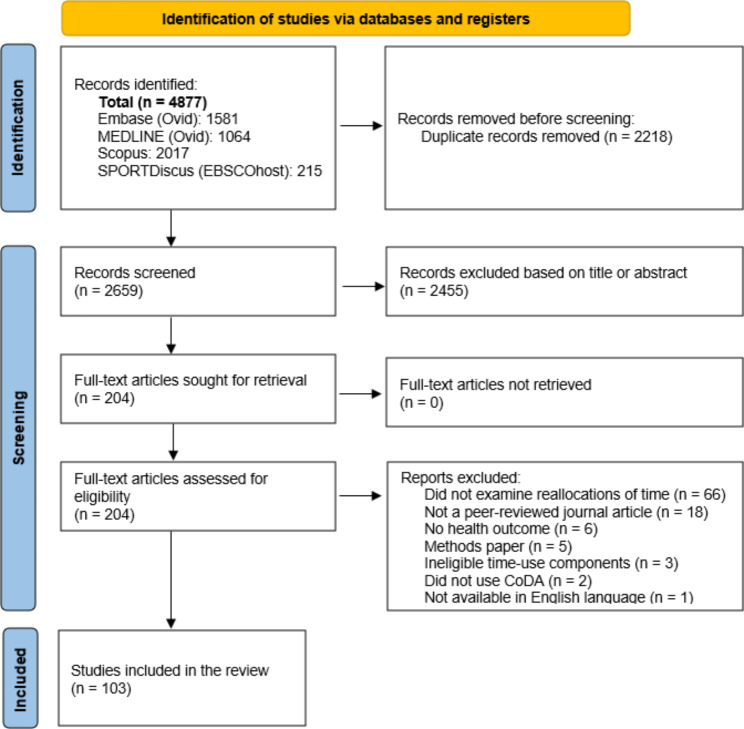
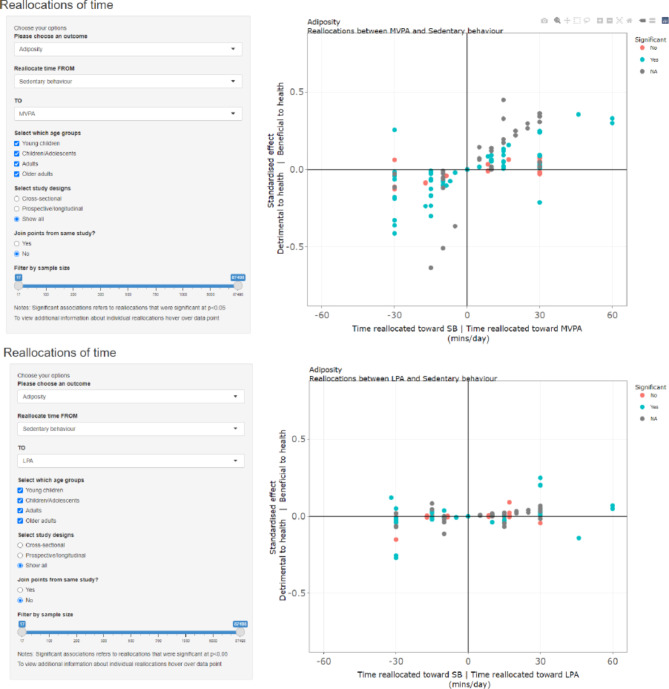
Results: One hundred and three studies were included. Adiposity was the most commonly studied health outcome (n = 41). Most studies (n = 75) reported reallocations amongst daily sleep, SB, LPA and MVPA. While other studies reported reallocations amongst sub-compositions of these (work MVPA vs. leisure MVPA), activity types determined by recall (screen time, household chores, passive transport etc.) or bouted behaviours (short vs. long bouts of SB). In general, when considering cross-sectional results, reallocating time to MVPA from any behaviour(s) was favourably associated with health and reallocating time away from MVPA to any behaviour(s) was unfavourably associated with health. Some beneficial associations were seen when reallocating time from SB to both LPA and sleep; however, the strength of the association was much lower than for any reallocations involving MVPA. However, there were many null findings. Notably, most of the longitudinal studies found no associations between reallocations of time and health. Some evidence also suggested the context of behaviours was important, with reallocations of leisure time toward MVPA having a stronger favourable association for health than reallocating work time towards MVPA.
Conclusions: Evidence suggests that reallocating time towards MVPA from any behaviour(s) has the strongest favourable association with health, and reallocating time away from MVPA toward any behaviour(s) has the strongest unfavourable association with health. Future studies should use longitudinal and experimental study designs, and for a wider range of outcomes.
Keywords: Compositional data analysis; Moderate-to-vigorous physical activity; Physical activity; Sedentary behaviour; Sleep.
© 2023. BioMed Central Ltd., part of Springer Nature.
Conflict of interest statement
The authors declare they have no competing interests.
Figures
References
-
- Warburton DE, Bredin SS. Health benefits of physical activity: a systematic review of current systematic reviews. Curr Opin Cardiol. 2017;32(5):541–56. - PubMed
-
- Chaput J-P, Dutil C, Featherstone R, Ross R, Giangregorio L, Saunders TJ, et al. Sleep duration and health in adults: an overview of systematic reviews. Appl Physiol Nutr Metab. 2020;45(10):218–S31. - PubMed
-
- Saunders TJ, McIsaac T, Douillette K, Gaulton N, Hunter S, Rhodes RE, et al. Sedentary behaviour and health in adults: an overview of systematic reviews. Appl Physiol Nutr Metab. 2020;45(10):197–S217. - PubMed
-
- Fang K, Mu M, Liu K, He Y. Screen time and childhood overweight/obesity: a systematic review and meta-analysis. Child Care Health Dev. 2019;45(5):744–53. - PubMed
-
- Dumuid D, Pedišić Ž, Stanford TE, Martín-Fernández J-A, Hron K, Maher CA, et al. The compositional isotemporal substitution model: a method for estimating changes in a health outcome for reallocation of time between sleep, physical activity and sedentary behaviour. Stat Methods Med Res. 2019;28(3):846–57. - PubMed
Publication types
MeSH terms
LinkOut - more resources
Full Text Sources
Medical
Miscellaneous
