


Facilitators and Barriers in the Implementation of a Digital Surveillance and Outbreak Response System in Ghana Before and During the COVID-19 Pandemic: Qualitative Analysis of Stakeholder Interviews
- PMID: 37862105
- PMCID: PMC10625076
- DOI: 10.2196/45715
Facilitators and Barriers in the Implementation of a Digital Surveillance and Outbreak Response System in Ghana Before and During the COVID-19 Pandemic: Qualitative Analysis of Stakeholder Interviews
Abstract
Background: In the past 2 decades, many countries have recognized the use of electronic systems for disease surveillance and outbreak response as an important strategy for disease control and prevention. In low- and middle-income countries, the adoption of these electronic systems remains a priority and has attracted the support of global health players. However, the successful implementation and institutionalization of electronic systems in low- and middle-income countries have been challenged by the local capacity to absorb technologies, decisiveness and strength of leadership, implementation costs, workforce attitudes toward innovation, and organizational factors. In November 2019, Ghana piloted the Surveillance Outbreak Response Management and Analysis System (SORMAS) for routine surveillance and subsequently used it for the national COVID-19 response.
Objective: This study aims to identify the facilitators of and barriers to the sustainable implementation and operation of SORMAS in Ghana.
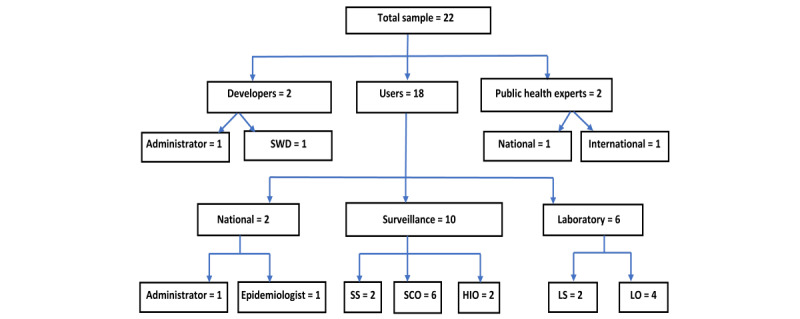
Methods: Between November 2021 and March 2022, we conducted a qualitative study among 22 resource persons representing different stakeholders involved in the implementation of SORMAS in Ghana. We interviewed study participants via telephone using in-depth interview guides developed consistent with the model of diffusion of innovations in health service organizations. We transcribed the interviews verbatim and performed independent validation of transcripts and pseudonymization. We performed deductive coding using 7 a priori categories: innovation, adopting health system, adoption and assimilation, diffusion and dissemination, outer context, institutionalization, and linkages among the aspects of implementation. We used MAXQDA Analytics Pro for transcription, coding, and analysis.
Results: The facilitators of SORMAS implementation included its coherent design consistent with the Integrated Disease Surveillance and Response system, adaptability to evolving local needs, relative advantages for task performance (eg, real-time reporting, generation of case-base data, improved data quality, mobile offline capability, and integration of laboratory procedures), intrinsic motivation of users, and a smartphone-savvy workforce. Other facilitators were its alignment with health system goals, dedicated national leadership, political endorsement, availability of in-country IT capacities, and financial and technical support from inventors and international development partners. The main barriers were unstable technical interoperability between SORMAS and existing health information systems, reliance on a private IT company for data hosting, unreliable internet connectivity, unstable national power supply, inadequate numbers and poor quality of data collection devices, and substantial dependence on external funding.
Conclusions: The facilitators of and barriers to SORMAS implementation are multiple and interdependent. Important success conditions for implementation include enhanced scope and efficiency of task performance, strong technical and political stewardship, and a self-motivated workforce. Inadequate funding, limited IT infrastructure, and lack of software development expertise are mutually reinforcing barriers to implementation and progress to country ownership. Some barriers are external, relate to the overall national infrastructural development, and are not amenable even to unlimited project funding.
Keywords: COVID-19; Ghana; SORMAS; Surveillance Outbreak Response Management and Analysis System; barriers; digital disease surveillance; facilitators; implementation; mobile phone; outbreak response; pandemic.
©Basil Benduri Kaburi, Kaspar Wyss, Ernest Kenu, Franklin Asiedu-Bekoe, Anja M Hauri, Dennis Odai Laryea, Carolina J Klett-Tammen, Frédéric Leone, Christin Walter, Gérard Krause. Originally published in JMIR Formative Research (https://formative.jmir.org), 20.10.2023.
Conflict of interest statement
Conflicts of Interest: GK conceptualized SORMAS. FA-B, DOL, and EK are involved in the implementation of SORMAS in Ghana. AMH, CW, and BBK are involved in the epidemiological specifications and overall development of SORMAS.
Figures
References
-
- Lombardo JS, Ross DL. Disease surveillance: a public health priority. In: Lombardo JS, Ross DL, editors. Disease Surveillance: A Public Health Informatics Approach. Hoboken, NJ: John Wiley & Sons; 2007.
-
- Vasudevan L, Ghoshal S, Labrique A. mHealth and its role in disease surveillance. In: Blazes DL, Lewis SH, editors. Disease Surveillance: Technological Contributions to Global Health Securit. Boca Raton, FL: CRC Press; 2016. pp. 131–8.
-
- Blazes DL, Lewis SH. Disease Surveillance: Technological Contributions to Global Health Security. Boca Raton, FL: CRC Press; 2016.
-
- Measuring digital development: facts and figures. International Communication Union. 2021. [2022-11-22]. https://www.itu.int/en /ITU-D/Statistics/Pages/facts/default.aspx .
LinkOut - more resources
Full Text Sources
Miscellaneous
