


Machine learning-based prediction models for home discharge in patients with COVID-19: Development and evaluation using electronic health records
- PMID: 37862334
- PMCID: PMC10588875
- DOI: 10.1371/journal.pone.0292888
Machine learning-based prediction models for home discharge in patients with COVID-19: Development and evaluation using electronic health records
Abstract
Objective: This study aimed to develop and validate predictive models using electronic health records (EHR) data to determine whether hospitalized COVID-19-positive patients would be admitted to alternative medical care or discharged home.
Methods: We conducted a retrospective cohort study using deidentified data from the University of Florida Health Integrated Data Repository. The study included 1,578 adult patients (≥18 years) who tested positive for COVID-19 while hospitalized, comprising 960 (60.8%) female patients with a mean (SD) age of 51.86 (18.49) years and 618 (39.2%) male patients with a mean (SD) age of 54.35 (18.48) years. Machine learning (ML) model training involved cross-validation to assess their performance in predicting patient disposition.
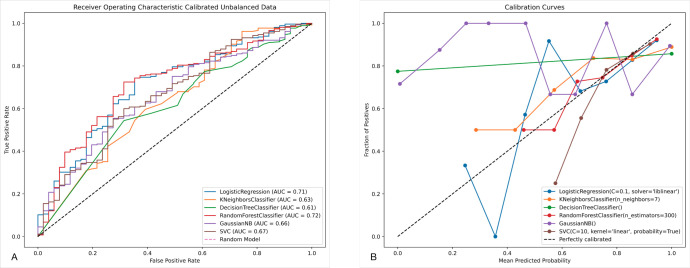
Results: We developed and validated six supervised ML-based prediction models (logistic regression, Gaussian Naïve Bayes, k-nearest neighbors, decision trees, random forest, and support vector machine classifier) to predict patient discharge status. The models were evaluated based on the area under the receiver operating characteristic curve (ROC-AUC), precision, accuracy, F1 score, and Brier score. The random forest classifier exhibited the highest performance, achieving an accuracy of 0.84 and an AUC of 0.72. Logistic regression (accuracy: 0.85, AUC: 0.71), k-nearest neighbor (accuracy: 0.84, AUC: 0.63), decision tree (accuracy: 0.84, AUC: 0.61), Gaussian Naïve Bayes (accuracy: 0.84, AUC: 0.66), and support vector machine classifier (accuracy: 0.84, AUC: 0.67) also demonstrated valuable predictive capabilities.
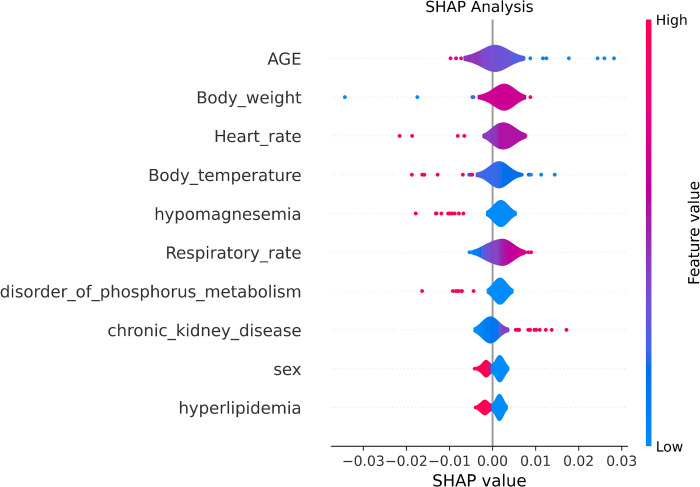
Significance: This study's findings are crucial for efficiently allocating healthcare resources during pandemics like COVID-19. By harnessing ML techniques and EHR data, we can create predictive tools to identify patients at greater risk of severe symptoms based on their medical histories. The models developed here serve as a foundation for expanding the toolkit available to healthcare professionals and organizations. Additionally, explainable ML methods, such as Shapley Additive Explanations, aid in uncovering underlying data features that inform healthcare decision-making processes.
Copyright: © 2023 Zapata et al. This is an open access article distributed under the terms of the Creative Commons Attribution License, which permits unrestricted use, distribution, and reproduction in any medium, provided the original author and source are credited.
Conflict of interest statement
The authors have declared that no competing interests exist
Figures
References
-
- Asri H, Mousannif H, Al Moatassime H, Noel T. Big data in healthcare: challenges and opportunities. 2015. [cited 2022 July 18]. In: 2015 International Conference on Cloud Technologies and Applications (CloudTech) [Internet]. Marrakech, Morocco: IEEE; [about 19 screens]. Available from: http://ieeexplore.ieee.org/document/7337020/.
MeSH terms
LinkOut - more resources
Full Text Sources
Medical
